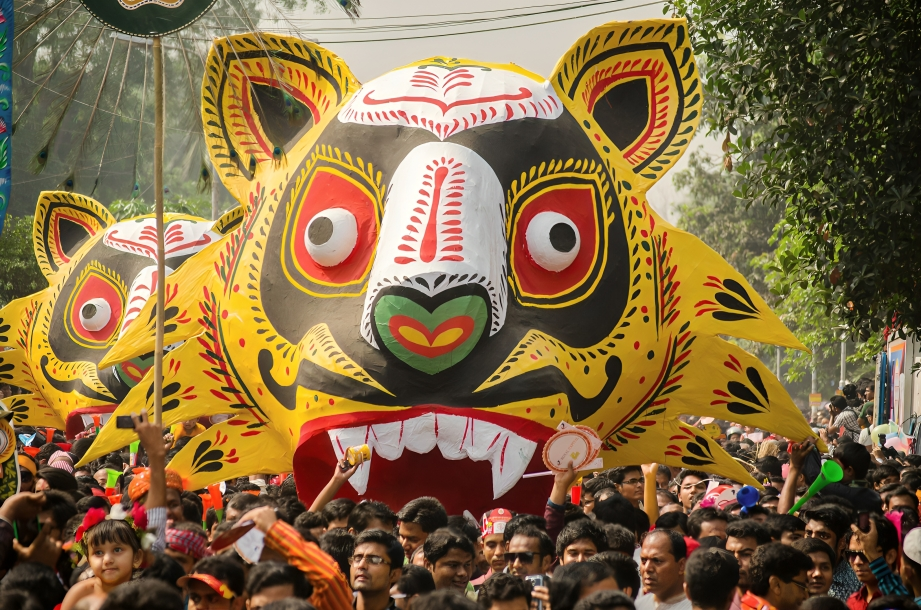
Pohela Boishakh, or the New Year festival, belongs fundamentally and predominantly to the Bengali people. The essence of this festival is inextricably intertwined with the deep roots of a millennial Bengali agrarian civilisation, its geography, and its heritage. Consequently, the right to observe Boishakh belongs exclusively to each and every Bengali. The manner in which one chooses to celebrate, the extent of one’s participation, or indeed whether one chooses to participate at all, is entirely a matter of personal autonomy. No one is required to stand guard with a self-appointed yardstick of religious or moral rectitude to judge the validity of another’s celebration.
If you consider yourself a Bengali, then this festival is yours. The nature of your participation will simply be a reflection of your own tastes and beliefs. The crowning glory of Bengal’s pluralistic culture lies precisely in its diversity. There is absolutely no need to fret over how your fellow Bengali observes Boishakh. On the contrary, allowing them to mark the day in their own fashion is the hallmark of genuine cultural courtesy.
We must all bear in mind that festivals, including Pohela Boishakh, have never been celebrated in an identical manner by all strata of society throughout history. The nature of celebration depends heavily upon time, place, financial means, education, taste, and available resources. Whatever your financial capacity, your circle of friends, and your organizational means allow—and whatever you deem to be a fitting celebration—is precisely what constitutes a true Pohela Boishakh for you. As your personal circumstances evolve, your mode of celebration may change accordingly. There is no need to compare your festivities with mine. It is quite sufficient if a few core melodies resonate within every gathering: namely, the notes of joy, camaraderie, secularism, and empathy.
Where some find harmony amidst diversity, others exploit the slightest divergence to sow the seeds of hostility. It is entirely up to you to decide whether you wish to seek the path of friendship or that of enmity.
If anyone’s religion, madhhab (school of jurisprudence), or sect dictates moral principles that bar them from celebrating this festival, then this festival is simply not for them. They may view it as ‘munkar’ (reprehensible), disavow it, and keep their distance. There is absolutely no need for you to discuss or criticise this festival; indeed, you possess no such right. I am well aware that the ‘sectarian crowd’ will still feel an itch to speak out; to them, I would suggest either taking an antihistamine or applying a soothing ointment.
Furthermore, if there are any ethnic minorities or individuals from other cultural spheres residing in Bangladesh who do not care for it, they too should keep away. If, by nationality or sentiment, you consider yourself Pakistani or pro-Pakistani, then this Boishakh celebration is certainly not your affair. You may practice your own rituals in isolation, much like the other sectarian groups.

However, if you are of Bihari descent, you have an alternative festival in the form of ‘Jur Sital’, or the Maithili New Year. You are entirely at liberty to observe that. Likewise, if you are Punjabi, you have ‘Vaisakhi’ or ‘Baisakhi’. You naturally reserve every right to celebrate it. You shall observe your festivals in accordance with your own culture. We Bengalis shall not dictate how you ought to celebrate. By the exact same token, we do not expect anyone else to attempt to dictate how we should celebrate ours.

For those who possess no specific ethnic or geographical national identity, or who take no pride in their own heritage, this Boishakhi festival serves no purpose whatsoever. For anyone whose roots are not anchored in the soil of this Bengal, Boishakh is merely another ordinary day. Therefore, those whose identities share no historical or emotional lineage with Boishakh need not display unnecessary agitation or offer any opinions on the matter. Even your praise is uncalled for.

Let those who are ‘sectarian’, traders of faith, or ostentatiously pious—those who seek religion in every conceivable thing—rest assured that this is by no means a religious event. It holds no connection to religion whatsoever. To seek a religious link here is entirely futile. It is a social and cultural custom of the Bengalis—much like ‘Sham El-Nessim’ in Egypt, ‘Akitu’ in Iraq and Syria, ‘Yalda Night’ in Iran, Afghanistan, and Tajikistan, ‘Hıdırellez’ in Turkey, ‘Galungan’ in Malaysia and Indonesia, ‘Nowruz’ or the Jalali New Year in Kazakhstan, Uzbekistan, and Kyrgyzstan, or ‘Hunu Pohela’ in the Maldives.
No one expects your opinion on these events. On the days of such festivities, it would be far better for you to occupy yourselves with other matters. Why meddle unnecessarily in what does not belong to you and cause disruptions?
Pohela Boishakh is our living heritage as Bengalis. We shall celebrate it precisely as we please, according to our individual means and surrounding circumstances. No non-Bengali has any reason to be perturbed by this.
Those who, weighed down by these thoughts, cannot bring themselves to embrace this festival as their own, should simply enjoy the public holiday. Do as you please within the comfort of your own homes.
See also: