
Whenever I listen to “Tumko Dekha To Yeh Khayal Aaya”, specifically the transition from the note Madhyam to Dhaivat during the phrase “Zindagi Dhoop”, it feels as though a searing, intensely scorched afternoon is conjured deep within the soul. Then, during “Tum Ghana Saya”, he returns to Madhyam, touches Dhaivat again, and glides into Pancham, as if spreading a comforting, dense canopy of shade. He left behind countless such moments of pure sorcery throughout his music.
Begum Akhtar’s ghazals are divine; they are beyond comparison. From what I have gathered, before the era of Mehdi Hassan, the general style of ghazal singing was not particularly modern, well-structured, or disciplined. There was very little research or refinement. Ustad Mehdi Hassan chiselled and modernised the ghazal, taking it to the absolute zenith of that era. After him, merely maintaining that benchmark was a monumental challenge—who could even think of further innovation? Establishing a distinct, individual signature in ghazals after Mehdi Hassan was no easy feat.

Table of Contents
My Jagjit Singh
When speaking of male singers who carved out a unique identity in the ghazal genre after Mehdi Hassan, only two names truly stand out: Ghulam Ali and Jagjit Singh. Ghulam Ali Saheb chose the traditional, silsiladar (structured lineage) path, which was equally matchless. Jagjit, however, forged an entirely new, contemporary path for himself—akin to the modern song genre. Through this, he introduced a vast new audience to ghazals (people who had never listened to the genre before). In fact, among everyone working with ghazals at the time, Jagjit’s endeavour can be considered the most successful in terms of both popularity and artistic quality.
When one reflects on Jagjit’s music, it becomes evident that he researched extensively to craft his ultimate signature form. He possessed rigorous training in classical music. The fact that he could compose and sing across three octaves is brilliantly showcased in the song “Sunte Hain Ki Mil Jaati Hai Har Chiz Dua Se”. Yet, he deliberately chose not to flaunt this regularly. Instead, he identified his finest, most resonant range within nearly a single octave. Most of his legendary compositions are set right there. While many artists resorted to heavy gamaks, long taans, zamzamas, or intricate sargams to display their virtuosity, Jagjit completely avoided that path. The application of meend, gitkari, khatka, murki, and pukar in his ghazals was incredibly subtle. Barring live concerts, he was rarely heard performing complex sargams in studio recordings. Listening to him gave the impression that he composed as a creator, listened back repeatedly as an audience member, stripped away all unnecessary ornamentation, and refined it to perfection. This is precisely why my reverence for him grew so deeply.

His voice was a magnificent baritone, and comparing the movement of his singing to the gentle bends of a river would not be an overstatement. He practised diligently until the very end of his life and was an absolute master at captivating a live concert audience.
Jagjit Singh was not just a composer; he was also a phenomenal sound engineer. During an era when recording technology in Bombay was highly limited, he took the initiative to import multi-track mixing consoles from abroad. He would spend hours in the studio, softening the background guitars or violins to mix his baritone voice at a frequency that made it feel as though he was whispering right into the listener’s ear when played on a cassette deck.
Today marks the birth anniversary of the late Emperor of Ghazals, Jagjit Singh. Although he is no longer physically amongst us, he lives on eternally in the history of ghazals—alive through countless songs and melodies.

The Bombay Journey and The Unforgettables
Born on 8 February 1941 into a Punjabi Sikh family in Sri Ganganagar, Rajasthan, his father named him Jagmohan. His father, Amar Singh, wanted him to grow up to become an IAS officer, but the seeds of melody had already been sown in the boy’s blood. Be it out of his father’s disapproval or tacit encouragement, he spent six consecutive years undergoing rigorous classical music training and practice under the blind musician Pandit Chhaganlal Mishra, and later under Ustad Jamal Khan of the Kirana gharana. However, while singing for All India Radio after completing his studies in Jalandhar, he realised that this familiar circle would not suffice. Filled with dreams and with only a few rupees in his pocket, he boarded a train to Bombay in 1965 without informing anyone at home. In Bombay, he became ‘Jagjit’.
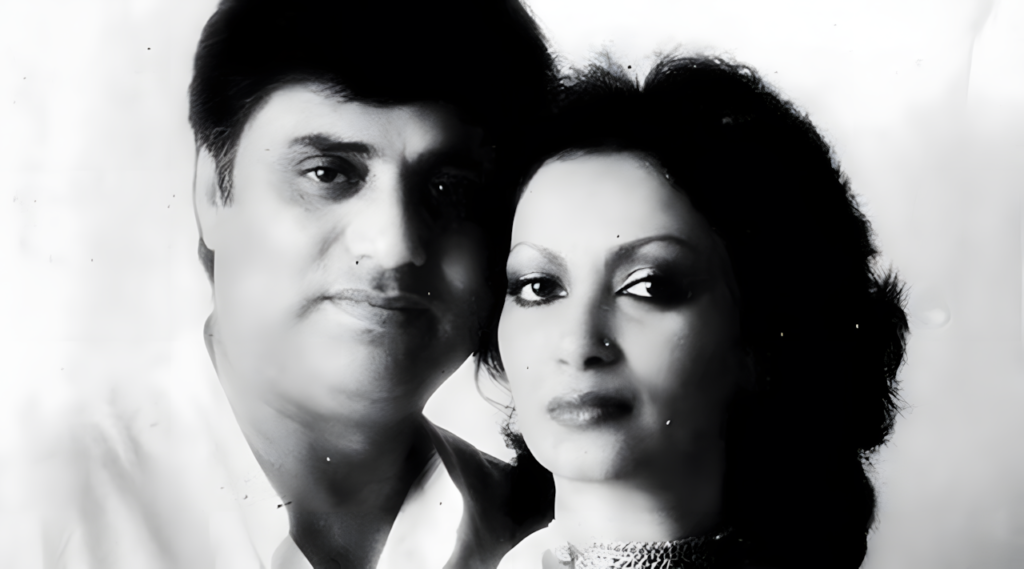
During those grueling days of struggle in Bombay, whilst singing commercial jingles, he first met singer Chitra Dutta at a recording studio in 1967. Apparently, Chitra did not care for his heavy baritone voice at first glance! However, she was soon captivated by the sheer magic of Jagjit’s music and his deeply caring personality, and their bond eventually blossomed into romance. In 1969, spending a mere 30 rupees, the two married in a registry court. Thus began one of the most enchanting duets in the history of Indian music.
When the duo released their historic album ‘The Unforgettables’ in 1976, it sent shockwaves through the music industry. By introducing solo violin, guitar, and electric piano into ghazals for the very first time, they dragged the genre out of aristocratic salons and placed it squarely into the cassette players of the middle class. Amidst this meteoric rise, their home was blessed with their only child, Vivek—whom they doted on and called ‘Babu’.
The Dhaka Craze & The Legendary Bengali Albums
When this legendary duo came to perform in our Dhaka in the mid-1980s, the sheer frenzy it created across the city is hard to fathom without speaking to our parents’ and uncles’ generation. The youth of that time were quite literally obsessed with the duo, particularly Chitra Singh! Her sharp, ethereal features and the velvety melancholy of her voice sent ripples through the hearts of that generation.
Our uncles’ generation was primarily intoxicated by the magic of their timeless Bengali songs and albums. In those days, the popularity of these tracks was so astronomical that their LP records adorned the drawing rooms of connoisseurs, while the spools of these cassettes spun continuously in almost every ordinary middle-class home.

Chitra Singh’s famous solo EP record, released in 1979, wove a profound sense of melancholy into every Bengali heart. Written by Mukul Dutt and composed by Jagjit Singh, all four songs from this record utterly spellbound the youth:
- Pathe Chalite Chalite
- Ki Dile Amay Tumi
- Amar Angina Theke
- Jiboner Ornatate
Shortly after, in 1987, HMV released Jagjit-Chitra’s collaborative album, ‘Onno Pothe’ (A Different Path), which became an ultimate sanctuary for that generation. Written by Pulak Bandyopadhyay and set to the magical compositions of Jagjit Singh, every single track on this album was a monumental hit:
- Tumi Ese Amar Mone
- Bujhini To Ami
- Amake Dekhcho Kemon
- Atordanir Ator Ami
- Baka Choke
- Bedona Modhur Hoye Jay
- Shishu Kande Khelna Cheye
- E Moner Krishna Radhay
The thrill of listening to these songs until the cassette tapes wore out, the treasured family collections of those LPs and cassettes, and the memory of seeing them perform live on stage in Dhaka are still reminisced about today with deep nostalgia by our elders.

Tragedy, Transformation, and Eternal Legacy
However, destiny, it seemed, could not endure this fairy tale. On 27 July 1990, their precious son Babu was killed in a tragic road accident at the tender age of eighteen. This singular blow left Chitra Singh so emotionally shattered that she quit singing forever. Jagjit, too, fell silent. For six long months, he did not utter a single word about music.
Yet, for one whose destiny is melody, a return to music is inevitable. However, after this tragedy, Jagjit’s singing style changed forever. The romantic playfulness, youthful vigour, and sweet, defiant yearning that once defined his voice were replaced by a vast ocean of silence and ascetic grief. When he returned after a long hiatus in 1991 with his epic collaborative album with Lata Mangeshkar, ‘Sajda’, and subsequently ‘Hope’, listeners discovered an entirely redefined, spiritual Jagjit. In this new chapter, he completely stripped away vocal ornamentations and flourishes. The measured, precise pace of the notes became his primary weapon, where every ‘pukar’ and sustained note felt like a heavy sigh. When he sang “Chitthi Na Koi Sandesh, Jaane Woh Kaun Sa Des Jahaan Tum Chale Gaye” for the film Dushman in 1998, it ceased to be mere cinematic playback; it became the heart-wrenching lament of a grieving father for his lost child, moving millions of listeners to tears.
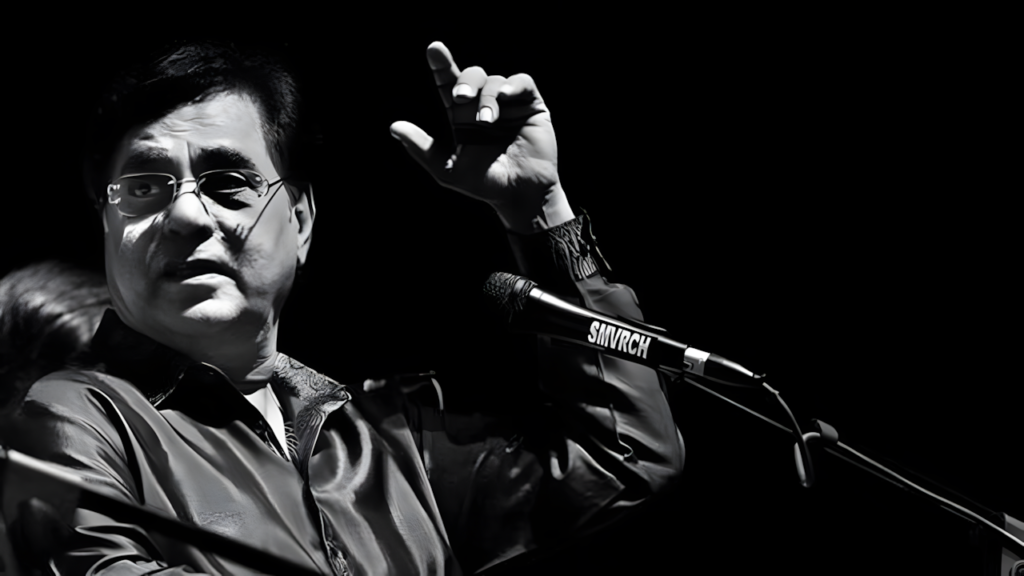
In the world of ghazals, he was not just a singer; he defined an entire era. Through films like Prem Geet, Arth, and Saath Saath, he translated the ghazal into a accessible language that instantly made ordinary people—who had never understood Urdu poetry or shayeri—fall deeply in love with the genre. Over a career spanning four decades, he delivered more than 150 albums, and in 2003, the Government of India honoured him with the ‘Padma Bhushan’, the country’s third-highest civilian award.
In October 2011, he was scheduled to perform a joint concert with Ustad Ghulam Ali. However, just before taking to the stage, he suffered a severe brain haemorrhage. Finally, on 10 October 2011, at the age of seventy, the music of this Emperor of Ghazals fell silent forever. He breathed his last at Lilavati Hospital in Mumbai. Yet, the modern, disciplined, and magical path of melody he single-handedly forged will eternally remain the ultimate solace for every aching heart.
On his birth anniversary today, I pay my deepest respects to him.
See Also: