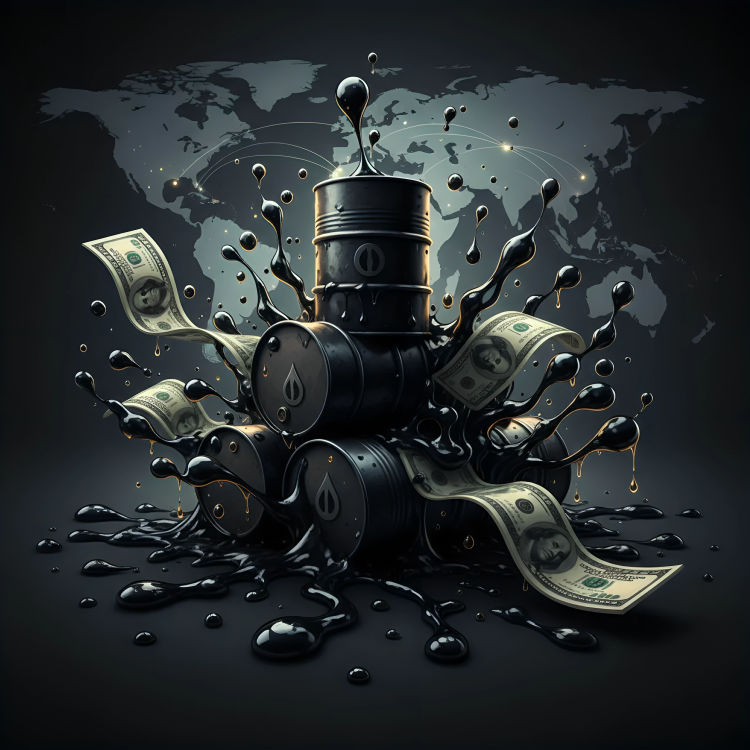
The term “petro-dollar” might sound quite ordinary, but its impact on the global economy is monumental. Simply put, it refers to the revenues oil-exporting nations earn in US dollars. Emerging in the 1970s, this system gradually became the linchpin of the world’s entire financial structure. On the strength of the petro-dollar, the United States successfully established its currency as the world’s primary reserve currency. It is upon this very foundation that America’s economic, political, and military hegemony rests today.
However, the petro-dollar is far more than a mere exercise in economic accounting. Beneath the surface lie grand geopolitical manoeuvres, wars, sanctions, covert intelligence operations, and some of the darkest chapters in international politics. In this essay, we will look at the story from the inside. Drawing on historical documents and research, we will explore the rise of the petro-dollar, the sheer scale of global warfare and instability triggered to preserve it, how the CIA stood guard over it, and what the future holds for the dollar in today’s shifting economic landscape. From this, it will become clear how a single monetary system evolved into the focal point of global geopolitics—and why it remains an immense challenge to world peace.
Table of Contents
The Rise of the Petro-Dollar: The Real Story Behind It
To grasp the story of the petro-dollar, we must revisit the global oil crisis of the 1970s. Following the Second World War, the 1944 Bretton Woods Agreement pegged the US dollar to gold. Under this rule, gold was fixed at $35 per ounce, and all other currencies were valued against the dollar. Consequently, the dollar became the bedrock of the global economy.
By the 1960s, however, the United States began facing severe economic strain. The astronomical costs of the Vietnam War, compounded by rising domestic inflation, led Washington to print dollars relentlessly. The inevitable happened: America’s gold reserves began to plummet. Faced with a crisis, President Richard Nixon announced the “Nixon Shock” on 15 August 1971, unilaterally decoupling the dollar from gold. This marked the birth of the fiat currency era—money backed solely by government decree rather than a physical commodity. The value of the dollar tumbled, triggering massive shockwaves across the global economy.
Amidst this vulnerability, the Yom Kippur War erupted in 1973. In retaliation for Western support of Israel, Arab members of OPEC instituted an oil embargo against the US and its allies. Overnight, oil prices quadrupled. America was pushed to the brink. To salvage the situation, US Secretary of State Henry Kissinger brokered a covert deal with Saudi Arabia. Concluded in 1974 with King Faisal, the terms of this pact were straightforward: Saudi Arabia would price and sell all its oil exclusively in US dollars. In return, the Saudis would invest their vast surplus oil revenues into US Treasury bonds—effectively financing American debt. In exchange, Washington guaranteed the military security of the Saudi kingdom and supplied it with state-of-the-art weaponry.
This very pact gave birth to the “petro-dollar”. Soon, the rest of the OPEC nations were compelled to fall in line. As a result, anyone wanting to buy oil anywhere in the world suddenly needed US dollars to do so. This cycle, known as “petro-dollar recycling”, cemented its grip on the world between 1974 and 1981. This system granted America the extraordinary luxury of printing money at will to fund its budget deficits, safe in the knowledge that global oil buyers had no choice but to accumulate dollars. The surplus cash of oil-rich nations routinely flowed back into American banks, fattening Wall Street and stabilising the dollar. Yet, it had a darker side; this oil diplomacy sowed deep divisions within the Arab world, giving rise to what historians call the “Arab Cold War”. Simply put, the petro-dollar handed Washington an Aladdin’s lamp of virtually limitless borrowing power.
A History Written in Blood and Warfare?
While the petro-dollar secured Washington’s economic kingdom, the rest of the world paid a heavy price. To maintain the dollar’s supremacy, America has systematically crushed any perceived threat—actions that have repeatedly culminated in devastating wars.
Take Iraq, for instance. In 2000, Saddam Hussein announced that Iraq would no longer accept dollars for its oil, switching instead to the Euro. This was a direct strike at the heart of the dollar empire. Exactly three years later, in 2003, the United States invaded Iraq under the false pretext of searching for “Weapons of Mass Destruction” (WMDs). Following the ousting of Saddam, Iraq was promptly reverted to the dollar-based oil pricing system. This conflict claimed the lives of roughly 450,000 people and left the Middle East in ruins—a vacuum of instability that eventually paved the way for the rise of brutal militant outfits like ISIS.
A remarkably similar script unfolded in Libya. In 2009, Libyan leader Muammar Gaddafi championed an initiative to introduce a gold-backed pan-African currency called the “Afro”. The objective was to allow Africa to trade its vast oil and mineral wealth in its own sovereign currency—a mortal threat to the petro-dollar. Sure enough, in 2011, a NATO-backed military intervention was launched, resulting in the brutal assassination of Gaddafi. Since then, Libya has remained trapped in a cycle of chronic lawlessness and civil strife.
We see the same playbook deployed against Venezuela. When Nicolás Maduro began trading Venezuelan oil in Chinese Yuan, Washington retaliated by slapping crushing economic sanctions on the country from 2019 onwards. Even as recently as 2025, there were reports of a CIA-backed coup attempt in Caracas. Consequently, the Venezuelan economy has been thoroughly crippled.
Iran’s “crime” is no different. Whenever Tehran has attempted to bypass the dollar in favour of the Yuan or the Euro, it has faced waves of suffocating sanctions. Even during the Iran-Iraq War (1980–88), Washington backed Saddam Hussein with arms and intelligence to enfeeble Iran. That war ultimately claimed well over a million lives across both sides.
International statistics suggest that between 1973 and 2012, anywhere between 25 to 50 per cent of all major global conflicts were directly or indirectly linked to oil. And where there is oil, there is the petro-dollar. These examples demonstrate that Washington has never hesitated to resort to war, sanctions, and bloodshed to preserve the petro-dollar’s hegemony.
The Silent Guardians: The Role of the US and the CIA
Protecting the petro-dollar is considered a matter of paramount US national security. Since the Saudi pact, Washington has provided oil-producing nations with what amounts to a form of forced military protection. In essence, the unspoken arrangement—”you sell oil in my currency, and I will protect you with my military”—is the life-support machine of the petro-dollar.
Under the National Security Act of 1947, the CIA’s core mandate includes safeguarding America’s economic stability. Because the petro-dollar is the primary pillar of the US economy, Langley has always stood guard over it. Whenever an anti-dollar coalition begins to form in any corner of the globe, or a nation refuses to trade in dollars, the CIA swings into action using covert operations, espionage, or regime-change strategies. From Venezuela to the Iran-Iraq War and the engineered fragmentation of the Arab world in the 1970s, the invisible hand of intelligence is omnipresent. Declassified American documents make no secret of the fact that defending the petro-dollar is viewed as an existential battle.
What Lies Ahead for the Dollar?
Yet, no empire lasts forever. Today, the global economy is steadily drifting towards “de-dollarisation”. In 2016, the dollar accounted for 65 per cent of global foreign exchange reserves; by 2025, that figure had slipped to 58 per cent. The BRICS nations are actively bypassing the greenback, settling bills in their own sovereign currencies or via the Chinese Yuan and Russian Rouble. Currently, nearly 90 per cent of bilateral trade between China and Russia is conducted in Yuan. Even Saudi Arabia—the very nation that birthed the petro-dollar system—has signed agreements to sell oil to China in Yuan.
Compounding this shift, the rise of cryptocurrencies and Central Bank Digital Currencies (CBDCs) poses a formidable challenge to the dollar’s monopoly. Simultaneously, America’s own fiscal house is in disarray, burdened by a staggering national debt of nearly $35 trillion and persistent inflation. According to financial giants like Goldman Sachs, while the dollar’s dominance will not vanish overnight, its grip will continue to erode. Data from 2025 shows the US Dollar Index dropped by roughly 9.5 per cent, while gold—the ultimate safe-haven asset—surged past $3,900 per ounce.
The world is gradually pivoting towards a “multi-currency” framework, which may eventually bring greater equilibrium to the global financial architecture. The petro-dollar may have crowned America as the undisputed global boss for decades, but the world has paid for it in the currency of human lives, war, and humanitarian catastrophe. While Washington has managed to sustain this system through military might and intelligence operations, its longevity looks increasingly uncertain in this rapidly transforming era. If the world manages to break free from the cage of the dollar, it may well pave the way for a more equitable and peaceful global order in the long run.
– Last edited: 2 February 2026
See more: