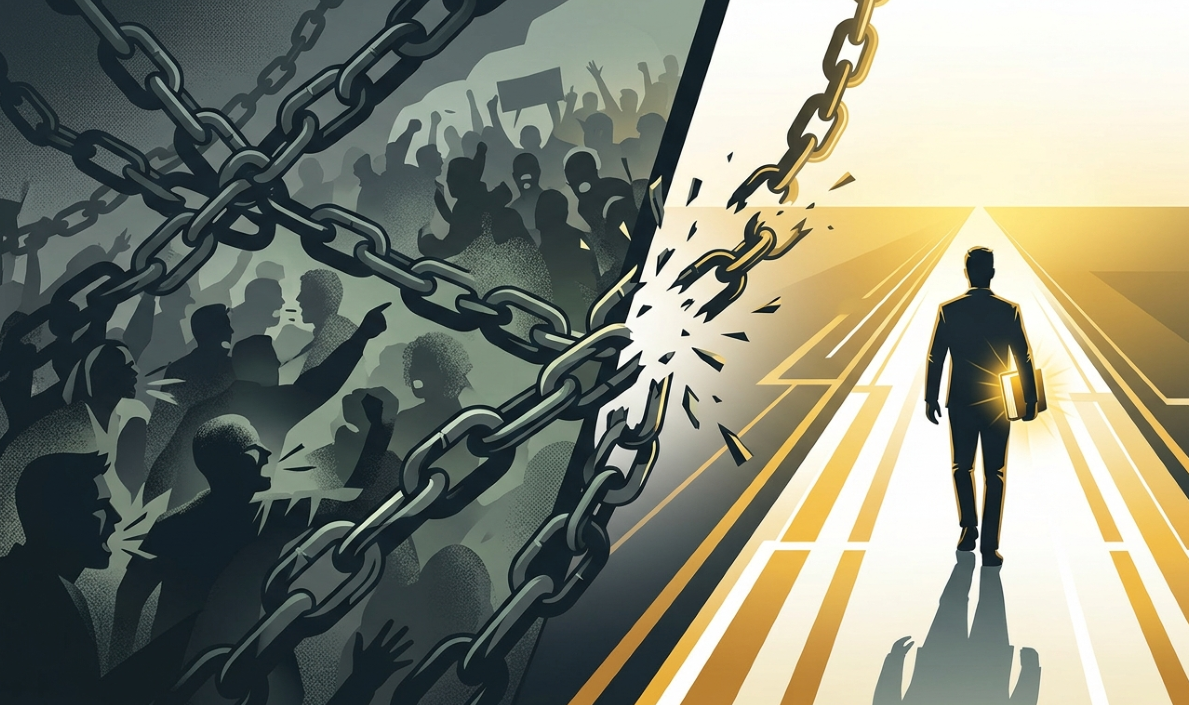
Although in general perception Leftism is viewed merely as a progressive political stream, its classical or foundational base is established not merely on atheism, but on a form of deep anti-religious sentiment. In their view, religion is an opium from which true liberation of humanity is impossible unless freed. Karl Marx, the theoretical guru of Leftism, wrote—
“Religion is the sigh of the oppressed creature, the heart of a heartless world, and the soul of soulless conditions. It is the opium of the people.”
Based on this philosophy, Vladimir Lenin and subsequent Soviet leaders identified religion as a severe obstacle to constructing a socialist state. Their core argument was that religion deters people from protesting against present exploitation and inequality in the hope of an afterlife.
In the practical application of this theory, immediately following the Bolshevik Revolution in 1918, Lenin’s government issued a decree completely separating Church and State. According to this policy, no official or state religion was retained in the state, religious education in schools and educational institutions was banned entirely, and all state funding for religious institutions was halted.
Later, during Joseph Stalin’s era (1920s and 30s), this repression took an even more extreme form. During this time, thousands of Orthodox churches, mosques, Buddhist monasteries, temples, and synagogues were closed or demolished. A vast number of priests, clergy, imams, mullahs, and religious scholars were arrested and sent to Siberian labor camps. Sharia courts were even banned in the Muslim-majority regions of Asia. The current perspective of the Chinese Communist Party (CCP) on religion is established even more rigidly upon this Marxist-Leninist atheism. China officially considers religion not just superstition, but an aggressive tendency to eradicate religion under the guise of control can be observed in some of their policies and actions. Therefore, classical communism is not merely secularism, but specifically an anti-religious ideology.
Table of Contents
South Asian Reality: ‘Fundamentalist Leftists!’
It is commonly assumed that being a Leftist implies being secular, internationalist, and a believer in class-struggle politics. However, looking at the political reality of South Asia shows that this assumption is not always true. In South Asia, we repeatedly see Leftists leaning toward the Right and ideologically swinging like a pendulum between the Left and Right poles.
Here, we observe a class of ‘fundamentalist Leftists’ or radical Leftists who, behind the mask of modern progressivism, become eager to present extremism and fundamentalism under the cap of class struggle. Seemingly, it might appear that atheism and jihad or radical religious fundamentalism belong to two completely opposite poles. However, political sociology and deep psychological analysis reveal an invisible and strong connection between the two.
Extremists can often use Leftism as a relatively acceptable ‘revolutionary shell’ or safe haven. Behind this lie certain mutual similarities and strategic opportunism.
Historical Context: The Pakistan Movement of the 1940s and the Role of the Left
The largest historical example of this pendulum transformation of South Asian Leftism lies in the final phase of British India.
Shift of 1941
During World War II, when Hitler invaded the Soviet Union in 1941, the Communist Party of India (CPI), under the directive of the global communist movement, withdrew itself from the historic anti-British ‘Quit India’ movement and supported the imperialist British government by labeling the war a ‘People’s War’.
Adhikari’s Thesis and Support for the Muslim League
During this time, based on communist theorist Gangadhar Adhikari’s ‘Adhikari Thesis’, the CPI provided theoretical and strategic support to the Muslim League’s communal Pakistan movement. Even prior to the 1946 elections, communist leaders in Punjab and other regions collaborated with the Muslim League.
Correction of Illusion (1947)
Finally, right before the partition in 1947, they came to their senses and realized deep down that the Pakistan movement was actually not a movement for the liberation of workers or the general public; rather, it was a thoroughly reactionary politics of religious division.
Methodological Similarities and the ‘Common Enemy’ Theory
Although there is a disparity in objectives between both extremist streams, there are numerous similarities in tactics:
-
Common Enemy: Both sides view Western US imperialism and capitalism as their primary enemy.
-
State Capture and Hatred for the Democratic System: Both sides harbor extreme hatred toward interim or temporary democratic state power and systems. They want to capture total state power all at once and then forcibly establish their self-styled ideologies.
-
Linear Intolerance: Although extreme Leftism and radical Jihadism appear to be opposite poles, both possess linear intolerance in their psychological framework and a persistence to uproot the existing democratic system.
This is why a large section of frustrated Leftists in our country today has taken refuge in Right-wing politics. Much like the Rightists, a sense of arrogance regarding ‘holiness’ and an intense ‘ideological superiority complex’ operate in their behavior.
Crisis of Imported Ideologies, Existential Anguish, and Guilt
In South Asia, especially in India, Left-wing politics was imported from two established communist superpowers. However, the society and people of this region were deeply attached to religion and culture. Consequently, importing communism into this land of diverse religions and cultures forced them to face various social obstacles.
To survive in the face of these obstacles, they made ideological compromises at various times:
-
Sometimes sheltering fundamentalist forces in the hope of increasing their numbers (with the blind hope that they might reform later).
-
Sometimes falling victim to contemporary political trends or FOMO (Fear of Missing Out), thereby lending support to various movements and struggles of Right-wing groups.
Yet, through none of these could they capture their desired state power or succeed in revolution. On the contrary, their parties gradually shrunk into organizations consisting of a handful of people. This long-term failure and existential crisis or Existential Anguish gave birth to deep frustration among them.
Alongside this, a sense of guilt regarding their own atheism and lifelong anti-religious sentiment operates constantly in their subconscious mind, keeping them mentally unsettled. Out of this intense instability and frustration, they repeatedly merge with fundamentalists, adopt their political language, and align closely with fundamentalists in their expressions of protest.
Blindness of History and Consequences: The Lesson of Iran
But they forget what the consequences of this blind alliance can be. The greatest lesson of history lies hidden in the 1979 Iranian Revolution.
At that time, to bring down the government of Shah Mohammad Reza Pahlavi of Iran, the country’s communist and Left-wing parties (such as the Tudeh Party) entered into a historic alliance with the Islamists led by Ayatollah Khomeini. The Leftists held the naive assumption that by using religious forces merely as a vehicle or tool, they would first establish secular or socialist rule in the country. However, immediately after the revolution succeeded, the Islamists completely liquidated those very Leftists.
This historical event clearly proves that whenever atheists or Leftists join hands with religious extremism out of political greed or desperation, in the end, they themselves become the first victims of that demonic force.