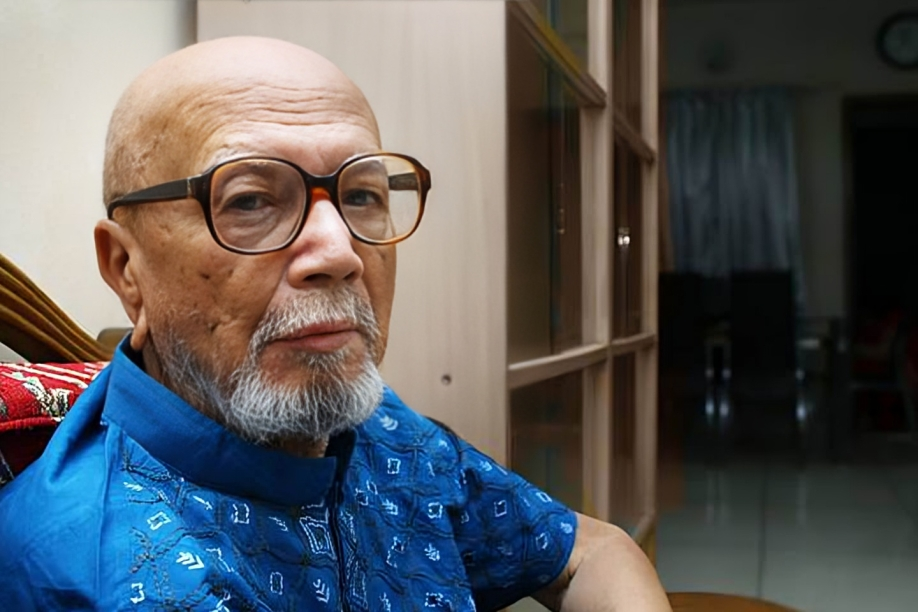
Whenever the poet Al Mahmud shed his ideological skin at every twist and turn of his life to adopt a new identity, he ruthlessly disavowed his own past and principles to legitimise his new persona.
From revolutionary to the Awami League, Jasad, back to the Awami League, or into the court of Zia—by the time he navigated the calculus of power and political realignments, he had repeatedly slain the Al Mahmud who came before. On each occasion, he committed a voluntary suicide of the self, wrapping himself in a fresh mantle to give birth to a new Al Mahmud. The so-called ‘plea of helplessness’ was always deployed as a shield to justify these metamorphoses. Yet the grim reality remains that with every transformation, it was the pure poetic essence within him that was sacrificed. Ambling through the corridors of power, by the time he reached the Ershad era, his primordial poetic soul had been rendered entirely paralysed.
For Which Al Mahmud Do You Weep?
Long before his physical demise, he had settled, both politically and ideologically, as an intellectual for the Jamaat-e-Islami. This was his self-chosen, definitive and final identity—a destiny he embraced through conscious deliberation.
That Al Mahmud was a great poet—a monumental poet of the Bengali language—is an undeniable truth; but it is equally true that he was the executioner of his own poetic genius.
Therefore, for the golden past of Al Mahmud over which a faction of people laments today, the true assassin is Al Mahmud himself. Having strangled his own creation and ideals with his own two hands, it ill-becomes anyone to wail over the remnants.
The question remains: for whom do you mourn?
For the primordial Al Mahmud who was murdered, or for the Al Mahmud who was the murderer?