The arrival of December evokes a profound interplay of emotions within the Bangladeshi consciousness. It brings both the unbridled jubilation of triumph—touching a new dawn under the red-and-green flag—and an enduring grief for those who were lost. Concentrated within this single month is the history of a thousand years of subjugation brought to an end, alongside the bloody genesis of an independent, sovereign nation.
The definitive chapter written on 16 December 1971 at the Suhrawardy Udyan (then the Racecourse Ground) was neither an accidental occurrence nor merely a tale of military conquest. It was the culmination of a protracted political struggle for self-determination, an unyielding journey through rivers of blood, and a masterclass in geopolitical foresight.
Table of Contents
1. From Self-Determination to Independence: A Long Trajectory of Political Struggle
To view the nine-month armed conflict of 1971 in isolation is to overlook its true political gravity. The Language Movement of 1952 was not simply a demand for linguistic recognition; it was the first spontaneous political resistance against the social, cultural, and economic marginalisation imposed by the West Pakistani ruling establishment. From the womb of that movement emerged modern Bengali nationalism.
Over the subsequent two decades, this consciousness matured through pivotal historical phases:
- The 1954 United Front Election and Military Rule: The dismissal of the electorate’s overwhelming mandate in 1954, followed by General Ayub Khan’s imposition of martial law in 1958, demonstrated that democratic rights for Bengalis had no place within Pakistan’s colonial structure.
- The 1966 Six-Point Movement: The Charter of Emancipation: Formulated by the Father of the Nation, Bangabandhu Sheikh Mujibur Rahman, the Six-Point demand served as the charter of survival. It was not merely a plea for regional autonomy, but an uncompromising blueprint to liberate Bengalis from economic exploitation.
- The 1969 Mass Upsurge and the 1970 General Election: The intense popular uprising forged around the Six-Point and Eleven-Point demands brought down the Ayub regime. Subsequently, the historic landslide victory of the Awami League under Sheikh Mujibur Rahman’s leadership in the 1970 election provided absolute democratic and legal legitimacy to the nationalist cause.
- The Epic Address of 7 March: When the military junta—spearheaded by the Yahya-Bhutto nexus—resorted to conspiracy and refused to transfer power, Bangabandhu delivered his immortal address at the Racecourse Ground: “The struggle this time is the struggle for our emancipation; the struggle this time is the struggle for independence.” This single address psychologically and politically mobilized seven and a half crore people for an armed struggle.
2. March to December 1971: The Bloody Path and Armed Resistance
The response to the brutal genocide launched under ‘Operation Searchlight’ on the night of 25 March was written in the blood of the Bengali people. Following Bangabandhu’s official declaration of independence in the early hours of 26 March, Bengali personnel from the Rajarbagh Police Lines, East Pakistan Rifles (EPR), and the East Bengal Regiment mounted the initial armed resistance.
“Since we have given blood, we will give more of it—but we shall free the people of this land, InshaAllah.”
— Father of the Nation, Bangabandhu Sheikh Mujibur Rahman (7 March 1971)
- The Mujibnagar Government and Administrative Foundation: The formation of the Mujibnagar Government on 10 April and its formal swearing-in on 17 April provided the liberation struggle with a clear diplomatic, administrative, and constitutional framework.
- Guerilla Warfare and Sector Management: The country was divided into eleven military sectors, complementing the regular forces with a populace-driven ‘Mukti Bahini’. Comprising farmers, labourers, and students, this guerilla force broke the backbone of the Pakistani military through swift ‘hit-and-run’ tactics.
- Operation Jackpot: On the night of 15 August, daring naval commandos executed coordinated attacks that sank several enemy warships and supply vessels across Chittagong, Mongla, Narayanganj, and Chandpur, astounding the international community with their operational capability.
3. Global Geopolitics and Cold War Power Dynamics
The war of 1971 transcended regional borders, emerging as a critical flashpoint in Cold War geopolitics.
- The Role of the Soviet Union and India: India provided invaluable humanitarian and military assistance by sheltering ten million refugees and offering training and weaponry to the freedom fighters. Meanwhile, the Soviet Union secured the international safety of the Liberation War by repeatedly exercising its veto power in the UN Security Council against US and Chinese-backed cease-fire resolutions.
- The US and Chinese Stance: Disregarding horrific human rights abuses, the Nixon-Kissinger administration extended full diplomatic and military support to the Pakistani junta, going so far as to dispatch the US Seventh Fleet to the Bay of Bengal. However, this strategic pressure was neutralized by the presence of Soviet naval task forces.
- Global Conscience and International Media: Initiatives such as George Harrison and Pandit Ravi Shankar’s Concert for Bangladesh, alongside graphic reporting on the genocide by journalists like Simon Dring and Anthony Mascarenhas, galvanized global public opinion in favour of the Bengali struggle.
4. The Intellectual Annihilation and the Tragedy of 14 December
As defeat became inevitable, the Pakistani military regime and its local collaborator militias—the Razakars, Al-Badr, and Al-Shams—executed a sinister plot to permanently cripple the nascent nation.
On the night of 14 December, death squads abducted prominent university professors, literary figures, journalists, physicians, lawyers, and intellectuals from their homes, executing them at the killing grounds of Mirpur and Rayerbazar. This calculated massacre, carried out barely forty-eight hours before final victory, remains one of the darkest chapters in world history—ensuring that December remains a time for solemn remembrance alongside national celebration.
5. 16 December: Imperishable Victory and the Birth of a Sovereign Nation
By early December, the Joint Command of the Indian Armed Forces and Mukti Bahini launched a coordinated land, air, and naval offensive toward Dhaka. Surrounded on all fronts, the Pakistani forces found their supply lines severed and escape routes blocked.
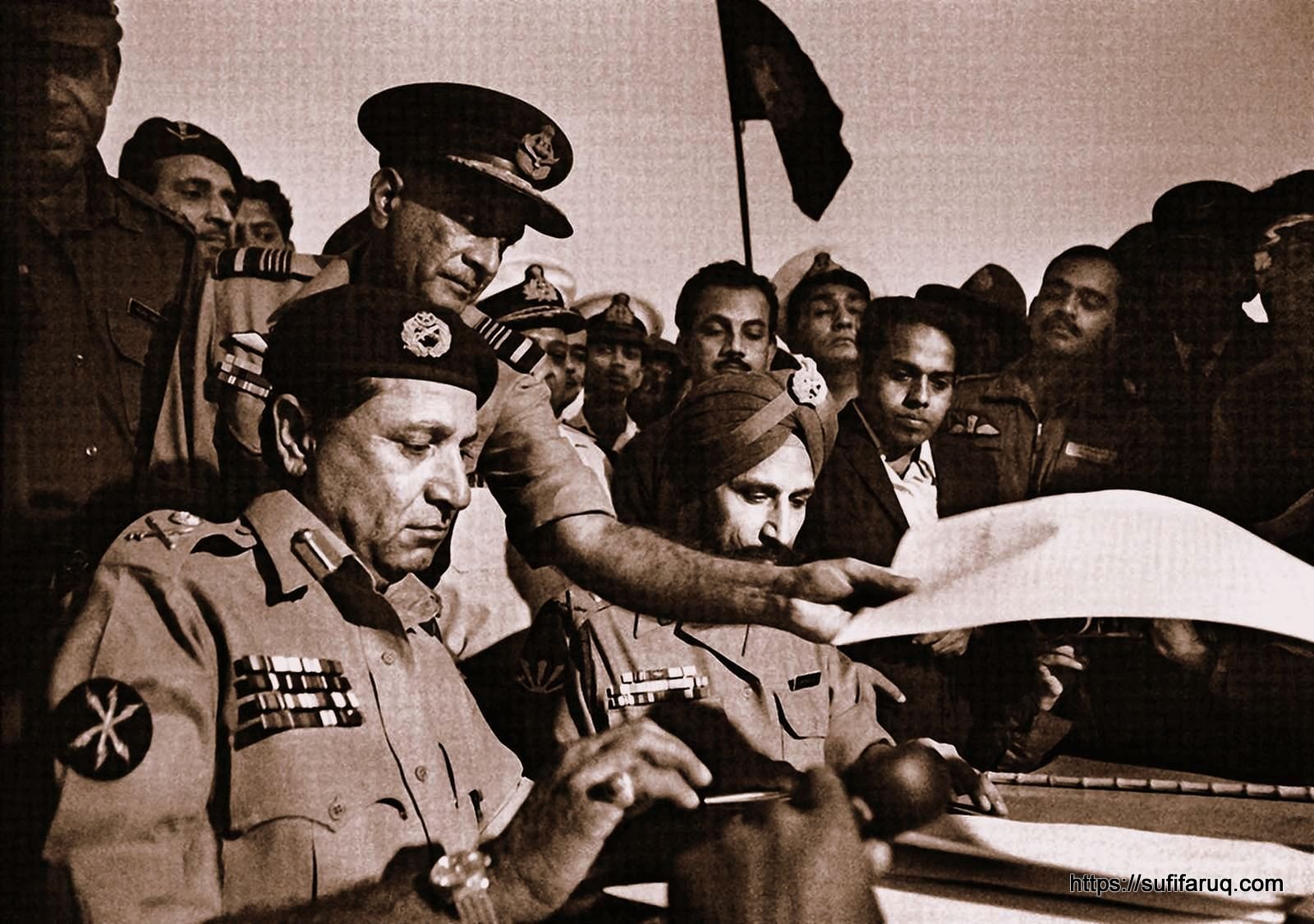
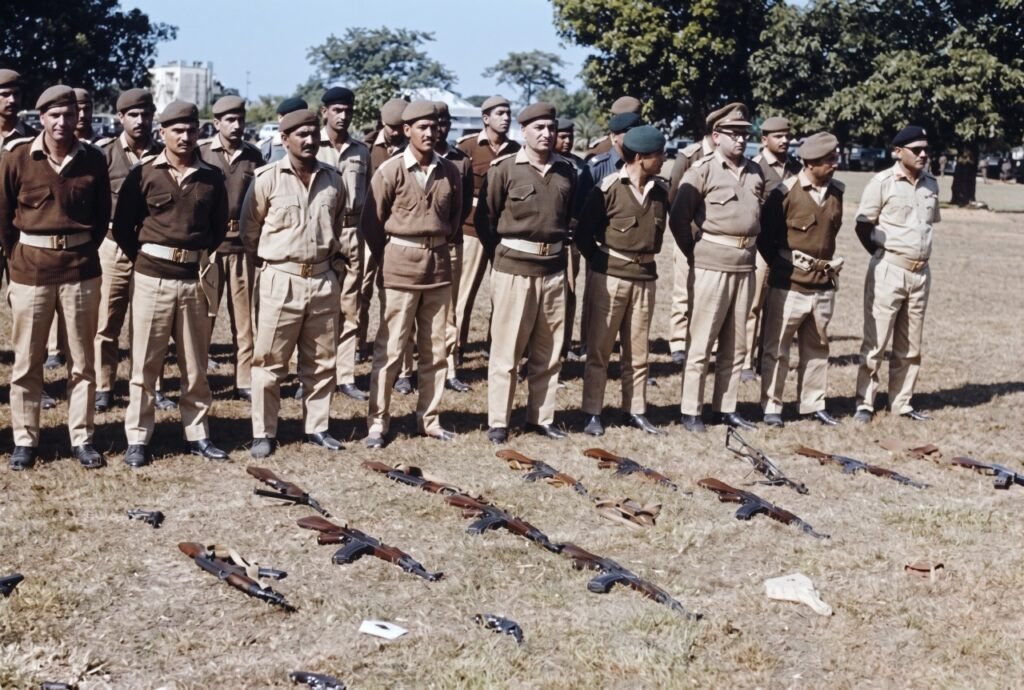
On the afternoon of 16 December, at the historic Racecourse Ground, General A. A. K. Niazi signed the instrument of unconditional surrender alongside over 93,000 armed Pakistani troops, in the presence of Lieutenant General Jagjit Singh Aurora and Group Captain A. K. Khandker. It was the largest military surrender since the Second World War. A new sovereign nation—The People’s Republic of Bangladesh—was etched onto the map of the world.
6. Contemporary Relevance and National Duty
Victory in 1971 was not merely a military milestone; it was a commitment to establishing an egalitarian society anchored in equality, human dignity, and social justice. The spirit of 1971 remains a living philosophy rather than a static historical chapter.
In the modern context, honoring the victory means:
- Safeguarding Sovereignty and Democratic Values: Remaining vigilant in preserving national interests, self-respect, and fundamental civic freedoms.
- Building an Inclusive Society: Fostering economic systems that ensure the fruits of independence reach every citizen.
- Preserving Historical Truth: Transmitting unblemished historical documentation and the legacy of sacrifice to future generations.
Written in blood, the history of December 1971 remains an eternal source of pride and identity for the Bangladeshi nation—a constant reminder that freedom was never granted as a favor, but won through immense sacrifice and courage.