On 16th December 1971, after nine months of the Liberation War, when the sun of victory finally smiled upon the skies of Bengal, what was Dhaka like? How was the jubilation of freedom expressed by a populace besieged for nine long months? Half a century later, many eyewitnesses have departed from this world, yet for those who remain alive, those memories burn as brightly as ever.
One such witness is Anwarul Alim, now in his seventies, who once ran a pharmaceutical business. Retired and residing in Mirpur DOHS, he lived in the Mitford area of Old Dhaka back in 1971. On the afternoon of 16th December, following the surrender of the Pakistani forces, Alim—then a BA examinee—witnessed nightlong victory celebrations across Old Dhaka.
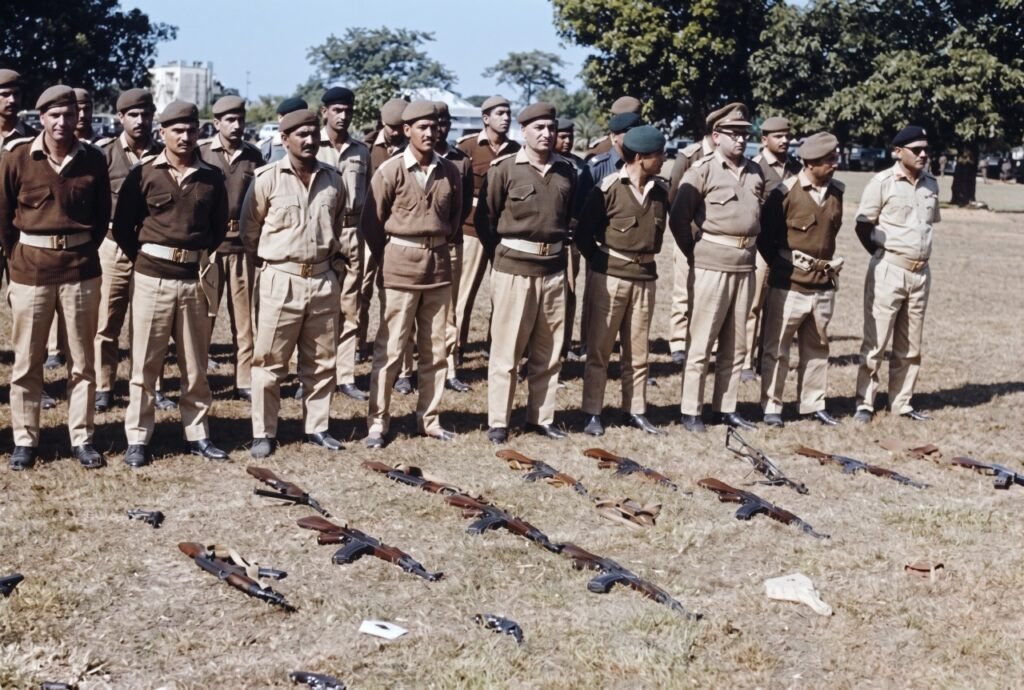
Table of Contents
1. Eyewitness Account: Nightlong Jubilation in Old Dhaka
“Small processions took place all night across Old Dhaka. People celebrated—the raw jubilation of freedom after being held captive for so long! Every Bengali family kept their windows wide open that night and turned on all the lights inside. There were no streetlights, yet the roads were brightly illuminated by the light beaming from inside the houses.”
When asked why every household kept their windows open, he explained that it was universally assumed that anyone keeping their windows shut was opposed to the liberation of Bangladesh.
Following the assault launched by the Pakistani military on the night of 25th March 1971, Bangladesh’s war of resistance commenced. Those who remained in Dhaka were forced to live under a virtual state of siege throughout most of the conflict.
2. Rumors, Curfews, and Helicopters in the Sky
By mid-December, residents began sensing that victory was imminent—that Bangladesh was emerging as a sovereign nation on the world map. Yet, restrictions imposed by the Pakistani forces upon the residents of Dhaka were also reaching a fever pitch. Anwarul Alim recalled:
“Curfew was enforced for the preceding three days, and the city was under total blackout. Around 15th December, I believe we heard on Akashvani that a surrender might take place. We had to listen to the radio very quietly, in secret—mostly Akashvani and occasionally Shadhin Bangla Betar Kendra.”
News of the Pakistani army surrendering was something Alim found difficult to believe while sitting at home, even if he desperately wished for it:
“I didn’t believe the news of the surrender at first. Until it actually materialized, people couldn’t bring themselves to believe it. But the next day—16th December—I remember clearly: I was sitting on the rooftop around 11 AM or 12 PM when I spotted three or four Indian helicopters in the sky. My residence was right opposite Mitford Hospital. Seeing those helicopters, I felt the surrender was truly at hand. After that, I started rounding up my friends.”
Together with his friends, Alim set off toward the Racecourse Ground (now Suhrawardy Udyan), where the stage for the surrender of 93,000 Pakistani soldiers was being set.
“Walking alongside my friends, I too went to the Racecourse. By the time we arrived, the formal surrender ceremony had concluded. Yet, a vast crowd still packed the Racecourse. Everyone was cheering and chanting slogans. All night long, celebrations echoed through neighborhood after neighborhood. The sight still floats vividly before my eyes.”
3. Scenes on the Streets and the Arrival of Freedom Fighters
Sector Commander of the Liberation War and Commander of S-Force, K.S. Shafiullah, was present at that historic victory ceremony. Reflecting on the situation in Dhaka that day, he noted:
“There weren’t many people along the route from the airport to the Racecourse. Even when we brought Niazi, the crowd at the Racecourse wasn’t massive yet. It was only after the formal surrender that crowds poured onto the streets in vast numbers, bringing out massive processions.”
Describing the public’s euphoria, Anwarul Alim remarked:
“Whenever people saw Indian army trucks on the streets, they stopped them to exchange greetings. Many even bought them soft drinks like Fanta and Seven-Up. Processions filled every street. Whenever people caught sight of freedom fighters or Indian soldiers, they erupted in joy. Even on the 17th, Pakistani soldiers were entering Dhaka armed. We expressed our outrage—why should weapons still remain in their hands?”
Young freedom fighter Sohel Ahmed shared that their camp was located at Atibazar in Keraniganj, across the Buriganga River. They entered Dhaka around 11:00 AM on 16th December:
“Several freedom fighters died when one of our boats capsized. We entered the then Pakistan Radio building and hoisted our flag. The sheer joy of liberation was radiant on the faces of the people.”
The day after victory, Alim and his friends stopped by Hotel Intercontinental, where many foreign journalists were stationed:
“On 17th December, a few of us went in front of Hotel Intercontinental. Spotting a Sikh officer, one of us exclaimed, ‘General Aurora!’ What excitement everyone felt! We watched from a distance—whether he was truly General Aurora or not, I cannot say with certainty now. Afterwards, we went to Tejgaon Airport. Pakistani soldiers were there—some standing silently, others weeping.”
4. Escorting Niazi to the Racecourse: Major General Shafiullah’s Account
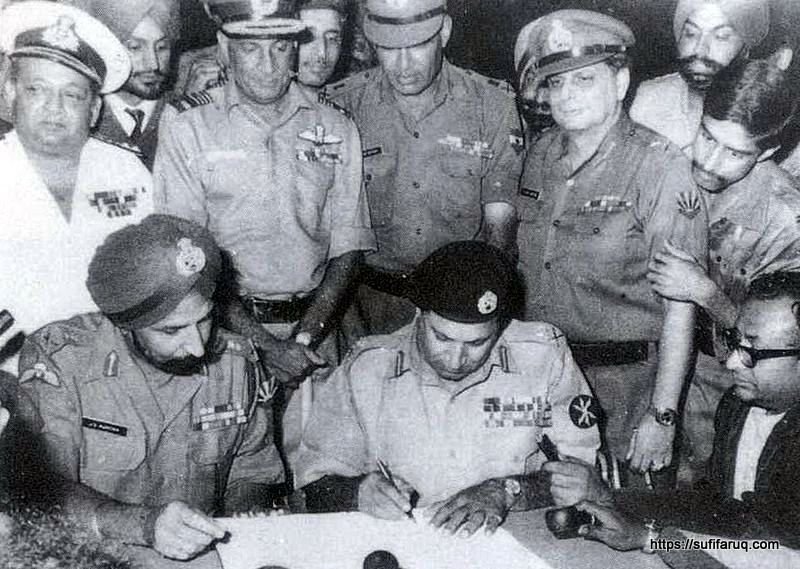
At the Racecourse Ground, the Instrument of Surrender was signed by Lieutenant General A.A.K. Niazi, Commander of the Eastern Command of the Pakistan Army. Signing on behalf of the Allied Forces (comprising the Mukti Bahini and the Indian Armed Forces) was Lieutenant General Jagjit Singh Aurora of the Indian Army.
Major General Shafiullah arrived from Akhaura to participate in that historic ceremony. He recalled:
“My final battle took place at Akhaura. After defeating a Pakistani brigade there, an Indian brigade joined us. I advanced toward Ashuganj along the Sylhet Highway, while the Indian brigade proceeded along the railway line. On 10th December, we set off toward Dhaka from Raipura in Narsingdi. On the 11th, we reached Demra. We fired across the river, and combat ensued at Demra Ghat. On the 14th, the Pakistanis at Demra surrendered.”
Regarding the surrender of the Pakistani high command, he added:
“Immediately after the surrender was finalized, I was instructed to escort General Niazi from the airport to the Racecourse. I had no vehicle—we had been traveling on foot all this time. I instructed the commander of the Pakistani battalion that had surrendered to me at Demra to bring his car. Taking that car, I went to the airport and escorted Niazi to the Racecourse, opposite the Dhaka Club. I stood right where the surrender took place. Niazi signed. When General Aurora signed, he didn’t write his name correctly. I pointed out to him that his name wasn’t written properly, after which he signed again.”
5. Drafting the Surrender: General Jacob’s Unyielding Mandate
The draft of that historic Instrument of Surrender was penned by the Chief of Staff of India’s Eastern Command, Lieutenant General J.F.R. Jacob. Beyond drafting the document, credit belongs to him for compelling Niazi to execute a public surrender.
In a 2008 interview, Jacob reflected on Niazi’s demeanor during those final hours:
“…Then I saw tears in his eyes. Looking at him with pity, I thought to myself: this man has inflicted immense suffering upon the people of Bangladesh. You know what his army did, so there is no need to repeat it. That is why I decided to make him surrender in front of the people of Dhaka. Niazi pleaded again that he would surrender at his headquarters. I said, ‘No, you must surrender at the Racecourse Ground before the people of Dhaka.’ Not only was it a public surrender of a regular army for the first time in history, but I also compelled them to accord a guard of honor.”
Jacob harbored deep concerns that had the surrender been delayed by even a day or two, the United Nations might have enforced a ceasefire order.
According to details in his book Surrender at Dacca: Birth of a Nation, when the draft of the surrender document was read aloud in Niazi’s office, a pin-drop silence descended upon the room. Niazi was weeping. Rao Farman Ali objected to the phrase “Surrender to the joint Indo-Bangladesh Command,” but Niazi interjected that the draft specified an unconditional surrender. Ultimately, Niazi accepted the terms.
6. Representing the Mukti Bahini: A.K. Khandker’s Memories
Deputy Chief of Staff of the Bangladesh Armed Forces, Group Captain A.K. Khandker, represented the Mukti Bahini at the surrender ceremony. In a 2013 memoir, he wrote:
“I was in Kolkata at the time. On the morning of 16th December, I went out for some work and returned around 10:00 AM. Upon returning, I found several people waiting for me. From them, I learned that the Pakistani military would surrender to the Joint Command that afternoon. For that purpose, a small, modest ceremony would take place at the Racecourse in Dhaka, and I was to represent Bangladesh and the Mukti Bahini at that ceremony….”
Describing the organization of the ceremony amidst the jubilation and crowds at the Racecourse Ground, he noted:
“Only a tiny patch of space was kept clear, where a table was set up. Two chairs were brought from the nearby Dhaka Club to arrange seating. General Aurora sat on behalf of the Indian forces, and General Niazi on behalf of the Pakistani forces. Then, both signed the Instrument of Surrender.
Immediately after signing, the Pakistani officers were removed from the spot, because responsibility for their safety fell upon us once they surrendered. Meanwhile, thousands of people surrounding us erupted in joyful jubilation. Many rushed forward and embraced us. Almost everyone was weeping. Tears streaming down, they said, ‘From today, we shall sleep in peace.'”
At the moment of surrender, General Jacob’s watch read 4:55 PM (Indian Standard Time)—or 5:25 PM Bangladesh Time. Dusk was falling over the capital, and no artificial lighting was available at the venue. Yet by then, the people of Bangladesh had already begun tasting the newborn light of a free nation.