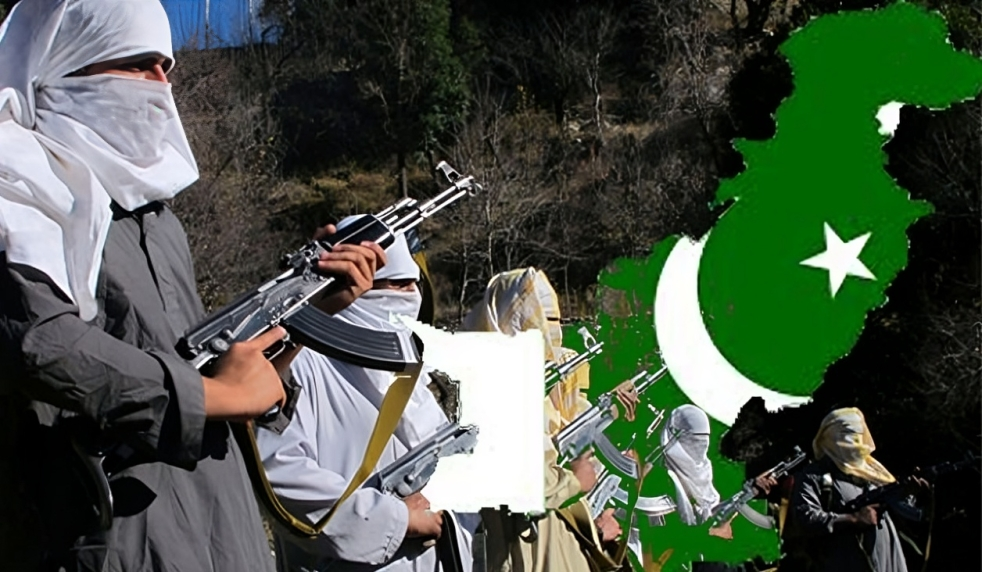
In the mid-twentieth century, following the partition of the Indian subcontinent in 1947, the state of Pakistan was created on the basis of the ‘Two-Nation Theory’. The central premise of this theory was to provide a separate and safe homeland for the Muslims of South Asia based on their religious identity. However, an examination of Pakistan’s history over more than seven decades reveals that the country’s military-bureaucratic establishment has conducted the highest number of military operations, genocides, and crimes against humanity primarily against Muslim populations themselves in order to maintain its political authority, territorial control, and exclusive dominance.
An analysis of various military operations conducted in East Pakistan (present-day Bangladesh), Balochistan, Khyber Pakhtunkhwa (FATA), Jordan, and the Middle East demonstrates that Muslim citizens have been the primary victims of the Pakistani state’s use of force. These geographical and historical contexts need to be analysed in the light of objective data, international treaties, research documents, and reports from human rights organisations.
Table of Contents
1. The 1971 Bangladesh Genocide: Crimes of the Military Junta in East Pakistan
The massacres carried out by Pakistan’s military junta in then East Pakistan (present-day Bangladesh) in 1971 are recognised as one of the most heinous genocides in modern history. Under the pretext of preserving state integrity, the Pakistani ruling establishment launched an all-out military assault on a population of 75 million Bengali Muslims and non-Muslims.
+-----------------------------------------------------------------------------------+
|          Phases of the Genocide Conducted in East Pakistan in 1971                 |
+-----------------------------------------------------------------------------------+
|  1. Operation Searchlight (25 March 1971) --> Dhaka University, Police Lines &    |
|                                              mass murder                          |
|  2. Scorched Earth Policy                --> Arson & indiscriminate killings in   |
|                                              rural areas                          |
|  3. Extermination of Intellectuals       --> Planned targeted killings of         |
|     & Targeted Attacks                       professionals & cultural figures     |
|  4. Atrocities by Auxiliary Forces        --> Mass oppression by Razakars,        |
|                                              Al-Badr & Al-Shams                   |
+-----------------------------------------------------------------------------------+
Outline of ‘Operation Searchlight’ and Institutional Genocide
On the night of 25 March 1971, ‘Operation Searchlight’ was launched under the orders of General Yahya Khan and the direct planning of General Tikka Khan. The primary objective of this operation was to permanently crush the political self-determination movement of the Bengali nation through military force.
- Epicentre of the Initial Attack: On the midnight of 25 March, heavy weaponry, tanks, and automatic rifles were used to attack Jagannath Hall, Jahurul Huq Hall (then Iqbal Hall) of Dhaka University, Rajarbagh Police Lines, and the East Pakistan Rifles (EPR) headquarters at Peelkhana. Thousands of unarmed people were killed on the very first night alone.
- Planned Destruction: Beginning in Dhaka city, these massacres subsequently spread to every district, sub-division, police station, and remote village across the country. Markets, settlements, and residential homes were set on fire, and ordinary citizens were indiscriminately shot dead.
Psychological Racism: Refusing to View Bengali Muslims as ‘True Muslims’
A deep-seated racist and culturally derogatory mindset regarding Bengali Muslims was cultivated among the officers and soldiers of the Pakistan Army.
- Cultural Denigration: The West Pakistani military structure viewed the behaviour, language, and culture of Bengali Muslims as “pro-Hindu” or “pseudo-Islamic”.
- Military Ideology: Soldiers in army cantonments were indoctrinated to believe that harsh bloodshed was required to make Bengalis ‘true Muslims’ or to establish control over them. This extremist outlook granted institutional legitimacy to human rights violations such as physical torture, indiscriminate killings, and mass rape committed against Bengali Muslims.
Casualty and Damage Figures: Academic and Legal Analysis
- Death Toll: According to official accounts of the Bangladesh Government, approximately 3 million (30 lakh) people were killed by the Pakistan Army and its local collaborators during the 9-month Liberation War.
- International Academic Statistics: Renowned international researcher R.J. Rummel noted in his book Death by Government that the number of people killed in the 1971 genocide ranges between 1.5 million and 3 million.
- Physical and Sexual Violence: According to statistics from the world-renowned medical journal The Lancet and the World Health Organisation (WHO), between 200,000 and 400,000 Bengali women were subjected to systematic sexual violence (mass rape/war crime) by Pakistani soldiers and their collaborators. The vast majority of these victims were Bengali Muslim women.
- Refugee Crisis: Nearly 10 million (1 crore) people were forced to seek refuge in India, a massive proportion of whom were ordinary Bengali Muslim farmers and labourers who had lost their homes and hearths.
Formation of Auxiliary Forces: Razakars, Al-Badr, and Al-Shams
In addition to conducting direct military operations, the Pakistan Army formed paramilitary forces with the assistance of radical fanatical political parties to strengthen its local control:
- Razakars: Engaged in indiscriminate killings and looting under the guise of maintaining general law and order and conducting search operations in rural areas.
- Al-Badr and Al-Shams: Composed primarily of members of student wings, these forces played an extremely brutal role in targeting intellectuals, conducting targeted killings, and executing special operations. The massacre of intellectuals on 14 December was the ultimate manifestation of this scheme.
2. The Balochistan Conflict: Seven Decades of Military Operations and the ‘Kill and Dump’ Policy
Since the forcible annexation of the then independent State of Kalat into Pakistan in 1948, military atrocities have continued unabated in the south-western province of Balochistan. Although nearly 100% of the Baloch population is Muslim, they have been subjected to military oppression for over seven decades solely for demanding regional autonomy, resource rights, and ethnic dignity.
+-----------------------------------------------------------------------------------+
|              Timeline of the Five Major Military Operations in Balochistan        |
+-----------------------------------------------------------------------------------+
|  • First Phase (1948)    --> Suppression of Prince Karim Khan's rebellion &       |
|                              occupation of Kalat                                  |
|  • Second Phase (1958)   --> Resistance under Nawab Nauroz Khan & army campaign  |
|  • Third Phase (1963-69) --> Guerrilla suppression campaign under Sher Muhammad   |
|                              Marri                                                |
|  • Fourth Phase (1973-77)--> All-out military offensive during Zulfikar Ali       |
|                              Bhutto's tenure                                      |
|  • Fifth Phase (2005-Present)--> Assassination of Nawab Akbar Bugti & politics of|
|                                enforced disappearances                            |
+-----------------------------------------------------------------------------------+
Enforced Disappearances and the State ‘Kill and Dump’ Policy
From the 2000s onwards, during the regime of then President General Pervez Musharraf, Pakistani intelligence agencies (ISI, MI) and the Frontier Corps (FC) introduced a new form of repression in Balochistan, globally known as the ‘Kill and Dump’ policy.
- Method of Disappearance: Baloch nationalist activists, poets, students, teachers, journalists, and ordinary civilians are abducted in broad daylight or in the dead of night. They are neither produced before any court nor acknowledged as missing.
- Recovery of Bodies: Months or years after their abduction, their torture-mutilated bodies are found discarded in desolate deserts, mountainous regions, or ravines across Balochistan. Most bodies bear gunshot wounds to the head and signs of extreme physical torture.
Casualty and Damage Statistics
- Voice for Baloch Missing Persons (VBMP): According to estimates by Baloch human rights organisations, over 45,000 Baloch citizens have been forcibly disappeared over the past two decades, and more than 5,000 bullet-riddled and mutilated bodies have been recovered.
- Overall Casualties: Since the inception of the conflict, an estimated 300,000+ Baloch citizens have lost their lives or been displaced due to military offensives, air strikes, drone attacks, and rocket artillery.
- Aerial Bombardment: In 1974 and subsequently in 2006, the Pakistan Air Force indiscriminately bombarded Baloch-inhabited mountainous regions using F-16s and fighter jets, resulting in the deaths of numerous women and children.
3. ‘Black September’ (1970): Pakistan’s Military Operation Against Palestinian Muslims in Jordan
A review of Middle Eastern history reveals that just one year prior to conducting genocide in its own country in 1971, the Pakistan Army carried out a brutal massacre of Palestinian Muslims on foreign soil in 1970, an event known in history as ‘Black September’.
[1970: Political Crisis in Jordan (PLO vs King Hussein)]
                         │
                         ▼
[Head of Pakistani Military Mission: Brigadier Zia-ul-Haq]
                         │
                         ▼
[Assumed Command of Jordan's 2nd Division & Military Offensive]
                         │
                         ▼
[10,000 - 25,000 Palestinian Muslims Killed & Refugee Camps Destroyed]
Brigadier Zia-ul-Haq’s Leadership and Military Operations
In September 1970, severe political and military conflict erupted between the Palestine Liberation Organisation (PLO), an armed Palestinian independence movement sheltered in Jordan, and the royal forces of King Hussein of Jordan. At the time, a special Pakistani military mission was stationed there to train the Jordanian army.
- Assuming Command: At the request of King Hussein of Jordan, then Pakistani Brigadier (later President of Pakistan following a military coup) Muhammad Zia-ul-Haq assumed direct command of the 2nd Division of the Jordanian Army.
- Attacks on Palestinians: Brigadier Zia-ul-Haq commanded an all-out military assault using Jordanian armoured vehicles, heavy artillery, and tanks against Palestinian refugee camps (such as Wahdat and Al-Hussein refugee camps) situated in Amman and other cities.
Casualty Figures and Palestinian Perspective
- Yasser Arafat’s Statement: According to then PLO leader Yasser Arafat and international human rights organisations, between 10,000 and 25,000 Palestinian citizens were killed in this operation lasting barely ten days. The vast majority of the deceased were ordinary Palestinian Muslim men, women, and children.
- Moshe Dayan’s Historic Remark: Witnessing the brutality of this operation, Israel’s then Defence Minister Moshe Dayan made a memorable remark:
“King Hussein and Pakistani Brigadier Zia-ul-Haq have killed more Palestinians in just ten days than Israel has killed in the past twenty years.”
4. Khyber Pakhtunkhwa and FATA: Internal Offensives Against Pashtun Muslims
Following the 9/11 terrorist attacks in the United States, the Pakistan military began serving as a primary frontline catalyst in the so-called ‘War on Terror’. Multiple large-scale military operations were launched against its own Pashtun Muslim citizens in the Federally Administered Tribal Areas (FATA) and Khyber Pakhtunkhwa.
+-----------------------------------------------------------------------------------+
|                 Major Military Operations in the FATA Region                      |
+-----------------------------------------------------------------------------------+
|  1. Operation Al-Mizan (2002-2006) --> Initial penetration into South Waziristan  |
|  2. Operation Rah-i-Rast (2009)    --> Displacement of hundreds of thousands      |
|                                        from the Swat Valley                       |
|  3. Operation Rah-i-Nijat (2009)   --> Heavy air strikes in South Waziristan      |
|  4. Operation Zarb-e-Azb (2014)    --> All-out destruction in North Waziristan    |
+-----------------------------------------------------------------------------------+
Destructive Military Methods and Civilian Casualties
- Air Strikes and Artillery Usage: Under the guise of suppressing the Taliban or extremists, the Pakistan Air Force (PAF) regularly deployed heavy bombs and armoured gunship helicopters over villages and marketplaces in the tribal areas. Consequently, thousands of ordinary Pashtun families perished under the rubble of collapsed mud houses.
- Displacement (IDP Crisis): Operation Rah-i-Rast (Swat Valley) in 2009 and Operation Zarb-e-Azb (North Waziristan) in 2014 alone forced over 3 million Pashtun Muslims to abandon their ancestral homes and seek shelter in refugee camps. This stands as one of the largest internal displacement crises in modern history.
- Pashtun Tahafuz Movement (PTM): The Pashtun Tahafuz Movement (PTM), founded under the leadership of Manzoor Pashteen, has alleged that thousands of Pashtun youths have been extrajudicially killed or forcibly disappeared under the pretext of military operations, while children are maimed daily by landmines buried in their agricultural fields.
5. Institutional Sectarianism: Persecution of Shia, Hazara, and Ahmadiyya Muslims
Systematic violence has been unleashed against minority Muslim communities within the state of Pakistan, driven by religious extremism and state sponsorship. This stems directly from the ‘Islamisation’ policies initiated during General Zia-ul-Haq’s regime (1977-1988).
+-----------------------------------------------------------------------------------+
|           Communities Targeted by Sectarian Extremism and State Discrimination   |
+-----------------------------------------------------------------------------------+
|  • Ahmadiyya Community --> Legally declared non-Muslims, places of worship       |
|                             vandalised, and murdered                              |
|  • Shia Muslims        --> Suicide attacks on mosques and processions, targeted   |
|                             killings                                              |
|  • Hazara Shias        --> Ethnic cleansing in Quetta & institutional neglect     |
+-----------------------------------------------------------------------------------+
Constitutional and Legal Persecution of the Ahmadiyya Community
- 1953 Lahore Riots: Religious extremists orchestrated widespread violence in Lahore demanding that Ahmadis be declared non-Muslims. The subsequent Justice Munir Commission Report exposed the aggressive posture of both the state and religious factions.
- Second Constitutional Amendment (1974): Then Prime Minister Zulfikar Ali Bhutto introduced an amendment to Pakistan’s Constitution for political gain, officially declaring the Ahmadiyya community as ‘non-Muslims’.
- Ordinance XX (1984): Promulgated by General Zia-ul-Haq, this ordinance criminalised Ahmadis identifying themselves as ‘Muslims’, calling the Adhan (call to prayer), or referring to their places of worship as ‘mosques’. Due to these legal prohibitions, hundreds of Ahmadi Muslims have been murdered by extremists over recent decades, and their places of worship have been destroyed.
Systematic Massacres of Shia and Hazara Muslims
- Targeted Killings and Sunni Militias: Extremist groups nurtured by Pakistani intelligence agencies—such as Lashkar-e-Jhangvi (LeJ), Sipah-e-Sahaba Pakistan (SSP), and Tehrik-i-Taliban Pakistan (TTP)—have consistently mounted attacks against Shia Muslims.
- Hazara Genocide (Quetta): The Shia Hazara community, an ethnic minority of Mongol descent residing in Quetta, the capital of Balochistan, has long been the target of systematic extermination. Over the past two decades, suicide bombings targeting bazaars, Ashura processions, and Shia mosques have claimed the lives of more than 2,000 Hazara Shias, while state forces have acted as silent spectators instead of providing security.
6. Sindh and Karachi Politics: ‘Operation Clean-up’
During the 1990s, bloody campaigns were executed using military and paramilitary forces in Pakistan’s commercial capital, Karachi, and across Sindh province to achieve political objectives.
- Operation Clean-up (1992): Under then Prime Minister Nawaz Sharif and Army Chief Asif Nawaz, the military and Rangers were deployed to Karachi to suppress political activists of the Muttahida Qaumi Movement (MQM) and Mohajirs (Muslim immigrants from India).
- Extrajudicial Killings: Under the banner of this operation, thousands of Mohajir youths were arrested and subsequently killed in ‘fake encounters’. Military pressure was exerted on Sindhi nationalists alongside Mohajirs, resulting in the deaths of several thousand Muslim citizens on the streets of Karachi alone.
7. Military Intervention in Afghanistan and the Impact of Proxy Warfare
As part of its ‘Strategic Depth’ policy, the Pakistani military establishment has intervened militarily in Afghanistan’s internal politics for over four decades.
- Afghan-Soviet War and the Creation of the Mujaheddin: In the 1970s and 1980s, with US funding and CIA cooperation, Pakistan’s ISI utilised thousands of religious seminaries (madrasas) on Pakistani soil to cultivate radical mujaheddin fighters.
- Rise of the Taliban and Afghan Civil War: In the 1990s, the Taliban seized power in Afghanistan with direct technical and military assistance from the Pakistan Army. Consequently, an estimated 300,000 to 500,000 Afghan Muslim citizens perished over the subsequent three decades due to internal civil war, US bombing campaigns, and terrorist attacks.
8. Comparative Data on Muslims Killed by Pakistani Forces in Various Operations
Below is a historical statistical breakdown by region depicting the Muslim populations killed at the hands of the Pakistani state, its armed forces, and its sponsored proxy groups:
| Region / Event | Period | Primary Target Population | Estimated Death Toll | Methods / Tactics Used |
| Bangladesh Genocide | 1971 (9 months) | Bengali Muslim and Hindu population | 1.5 million – 3 million | Operation Searchlight, indiscriminate shooting, arson, rape, and mass murder |
| Balochistan Conflict | 1948 – Present | Baloch Muslim citizens | 300,000+ (Disappeared & Killed) | Drone strikes, ‘Kill and Dump’ policy, and enforced disappearances |
| Black September (Jordan) | 1970 (September) | Palestinian refugees and citizens | 10,000 – 25,000 | Destruction of refugee camps using tanks and heavy artillery |
| FATA & Swat Region | 2001 – Present | Pashtun Muslim tribes | 50,000 – 80,000 | Air strikes, heavy gunships, internal displacement |
| Shia & Hazara Massacres | 1988 – Present | Shia and Hazara Muslims | 20,000+ | Suicide bombings, targeted killings, drive-by shootings |
| Karachi (Operation Clean-up) | 1992 – 1994 | Mohajir and Sindhi Muslims | 5,000+ | Extrajudicial killings and custodial deaths |
9. References & Bibliography
- Bass, Gary J. (2013). The Blood Telegram: Nixon, Kissinger, and a Forgotten Genocide. Alfred A. Knopf.
- Rummel, R. J. (1994). Death by Government: Genocide and Mass Murder Since 1900. Transaction Publishers. (Chapter on Bangladesh Genocide).
- Jahan, Rounaq (1972). Pakistan: Failure in National Integration. Columbia University Press.
- Hamoodur Rahman Commission Report (2000). Supplementary Report on the 1971 India-Pakistan War and East Pakistan Events. Government of Pakistan.
- Amnesty International (2018). Denying the Undeniable: Enforced Disappearances in Balochistan. Amnesty International Reports.
- Human Rights Watch (2011). “We Can Torture, Kill, or Keep You for Years”: Enforced Disappearances by Pakistan Security Forces in Balochistan. HRW.
- Sayeed, Khalid B. (1980). Politics in Pakistan: The Nature and Direction of Change. Praeger Publishers.
- Cooley, John K. (2002). Unholy Wars: Afghanistan, America and International Terrorism. Pluto Press. (Analysis of Black September and Afghan Intervention).
- Human Rights Commission of Pakistan (HRCP) (2020). State of Human Rights in Pakistan: Annual Report on Sectarian Violence and Missing Persons. HRCP.