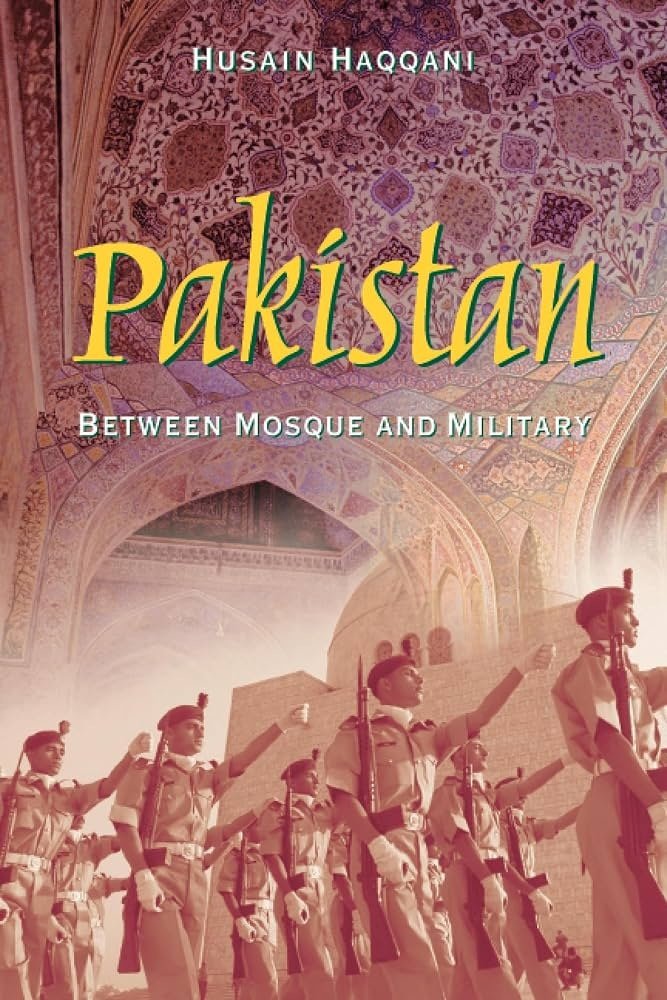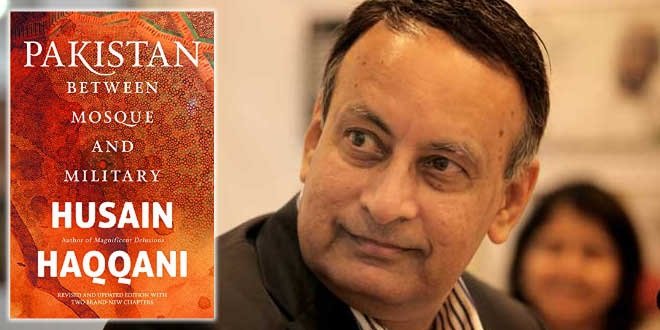
Husain Haqqani’s 2005 seminal work, Pakistan: Between Mosque and Military, is indispensable for comprehending South Asian geopolitics, particularly the intricacies of Pakistan’s domestic political landscape and foreign policy. The book provides a rigorous, historically grounded dissection of how the armed forces and religious extremism have forged a formidable axis since the inception of the Pakistani state.
Table of Contents
About the Author: From Establishment Insider to Fierce Critic
Husain Haqqani is far more than a mere scholar or journalist; he is an insider who witnessed the inner workings of Pakistani politics at close quarters. During his student days at the University of Karachi, he was affiliated with the Islami Jamiat-e-Talaba, the student wing of Jamaat-e-Islami.
He later served as a journalist for the renowned publication Far Eastern Economic Review before emerging in the 1990s as a powerful adviser within Pakistan’s civilian political apparatus. He was a close political and media strategist to two former Prime Ministers: Nawaz Sharif and Benazir Bhutto. Subsequently, from 2008 to 2011, he held the pivotal post of Pakistan’s Ambassador to the United States.
How, then, did a figure situated at the very pinnacle of the state apparatus become one of the establishment’s most outspoken detractors?
The answer lies in his objective appraisal of Pakistan’s historically flawed policies. When Haqqani observed how the Military General Headquarters (GHQ) in Rawalpindi systematically weaponised religious extremism as a tool for proxy warfare to preserve its vested interests—eroding the nation’s democratic foundations in the process—he took a decisive stand against it.
Chapter-by-Chapter Detailed Review
Structured both chronologically and thematically, the book traces the evolution of the military-mullah alliance from partition in 1947 through to 2005 across the following chapters:
Chapter 1: Quaid-i-Azam’s Pakistan and the Roots of Identity Crisis (Origins of the Alliance)
Haqqani opens by interrogating Pakistan’s national identity. Although Pakistan was created in 1947 on the basis of a distinct religious identity, there was a total absence of national consensus regarding its future trajectory. Exploiting the spectre of an ‘existential threat’ from India, the ruling elites deployed Islam as an ideological glue to enforce national cohesion. This chapter illustrates how civilian and military bureaucrats initially co-opted religious factions into the political arena—an approach fundamentally at odds with Quaid-i-Azam Jinnah’s initial secular vision.
Chapter 2: Early Military Rule and the Exploitation of the Religious Card (1947–1958)
In the second chapter, Haqqani analyses the political turbulence of the 1950s. As civilian governance withered, the army progressively asserted its dominance over domestic politics. The text provides a detailed account of how the military capitalised on the 1953 anti-Ahmadiyya riots in Lahore under the pretext of restoring law and order to marginalise civilian authority. It highlights how generals and bureaucrats of the era began instrumentalising religious parties like Jamaat-e-Islami to keep mainstream political outfits in check.
Chapter 3: The Ayub Khan Era and the Myth of Modernisation (1958–1969)
Although Field Marshal Ayub Khan was widely regarded as a Westernised, secular ruler, Haqqani demonstrates how he routinely exploited religion to legitimise his autocratic rule. The chapter details how, during the 1965 war with India, state radio and military propaganda conjured a narrative of ‘Jihadi zeal’ and ‘Islam versus Kufr (unbelief)’. The armed forces weaponised religious fervour to cement their posture as the sole guardians of national security.
Chapter 4: The 1971 East Pakistan Crisis and the Militarisation of Extremism (The 1971 War)
This is a profoundly crucial and sensitive chapter of the book. Haqqani courageously details how General Yahya Khan’s military junta weaponised religious extremism to suppress Bengali nationalism and subvert the democratic verdict in East Pakistan (now Bangladesh). Alongside orchestrating a campaign of genocide against the Bengali population, the Pakistani army raised paramilitary militias—such as Razakars, Al-Badr, and Al-Shams—using Jamaat-e-Islami and its student wing. Haqqani proves that this chapter represented the most gruesome manifestation of joint military-mullah operations in Pakistan’s history.
Chapter 5: Zulfikar Ali Bhutto and the Appeasement of Religious Forces (The Bhutto Era: Appeasing the Mullahs)
Following the defeat in 1971, Pakistan People’s Party leader Zulfikar Ali Bhutto assumed unbridled executive power. Despite his reputation as a cosmopolitan and secular leader, Haqqani expertly analyses how Bhutto capitulated to Islamist forces to secure his political survival. Key concessions—such as amending the constitution in 1974 to declare the Ahmadiyya community non-Muslim, substituting Sunday with Friday as the weekly day of rest, and banning alcohol—were clear attempts by Bhutto to appease the Islamists. Yet, this policy of appeasement failed to save him; instead, it paved the way for his eventual overthrow by the military.
Chapter 6: General Zia-ul-Haq and Institutionalised Islamisation (Zia-ul-Haq: The Apex of Islamization)
This chapter serves as the book’s critical centrepiece. Seizing power in a 1977 coup, General Zia-ul-Haq transformed Pakistan into a full-fledged ‘Jihadi state’. Haqqani meticulously details how Zia:
-
Introduced Jihad fi Sabilillah (Jihad in the path of Allah) into the curriculum for commissioned military officers.
-
Accorded preference to Quranic memorisation and religious education in civil service promotions and university qualifications.
-
Established thousands of madrasas financed and armed by American aid during the Afghan-Soviet War, laying the groundwork for a global jihadi network.
This chapter underscores that under Zia, the ‘mosque and military’ were no longer merely allies; the military establishment had itself morphed into a religious entity.
Chapter 7: ‘Guided Democracy’ of the 1990s and Strategic Depth (The Post-Zia Era & Kashmir/Afghan Jihad)
Following Zia’s death, although Benazir Bhutto and Nawaz Sharif rotated in power across four administrations, real authority resided with the military intelligence agency, the ISI. Haqqani reveals how the military, pursuing its policy of ‘Strategic Depth’, fostered the Taliban in Afghanistan and provided institutional backing to militant outfits like Lashkar-e-Taiba and Jaish-e-Mohammed to wage proxy wars against India in Kashmir. Whenever civilian Prime Ministers sought rapprochement with India, the military-mullah axis systematically derailed the peace initiatives.
Chapter 8: 9/11, Pervez Musharraf, and the Culmination of the Dual Policy (Musharraf Era & The U.S. Factor)
In the aftermath of the 9/11 attacks, General Pervez Musharraf projected himself to the West as the champion of ‘Enlightened Moderation’ and a key partner in the War on Terror, whilst covertly sustaining the Afghan Taliban and extremist groups. Haqqani lays bare Washington’s strategic blindness in this chapter. The book demonstrates how the United States funnelled billions of dollars in military aid to bolster Pakistan’s armed forces, oblivious to the fact that much of these funds and resources were repurposed to nurture the very extremists fighting American forces.
Chapter 9: Conclusion and the Path Forward (Conclusion: Dismantling the Nexus)
In his concluding assessment, Haqqani warns that unless Pakistan dismantles this unholy alliance between the military and religious radicals, it risks sinking into total state failure. He urges Pakistan to discard its paranoid posture towards its neighbours (notably India and Afghanistan), divert funds from the defence budget towards education and economic development, completely sever religious extremism from statecraft, and establish civilian supremacy.
The Four Core Pillars of the Book
-
The Military-Islamist Axis: The armed forces have exploited religion to consolidate domestic power and deployed extremism as a tool of foreign policy.
-
The National Identity Crisis: Capitalising on the existential dread of Indian aggression, the state forged an ideological and militarised apparatus rather than a stable democratic order.
-
The Role of the United States: From the Cold War to the War on Terror, American strategic shortsightedness and military aid inadvertently sustained this pernicious nexus.
-
The Failure of Civilian Leadership: Civilian political leaders repeatedly compromised with military and religious factions out of political expediency, preventing democratic institutions from taking firm root.