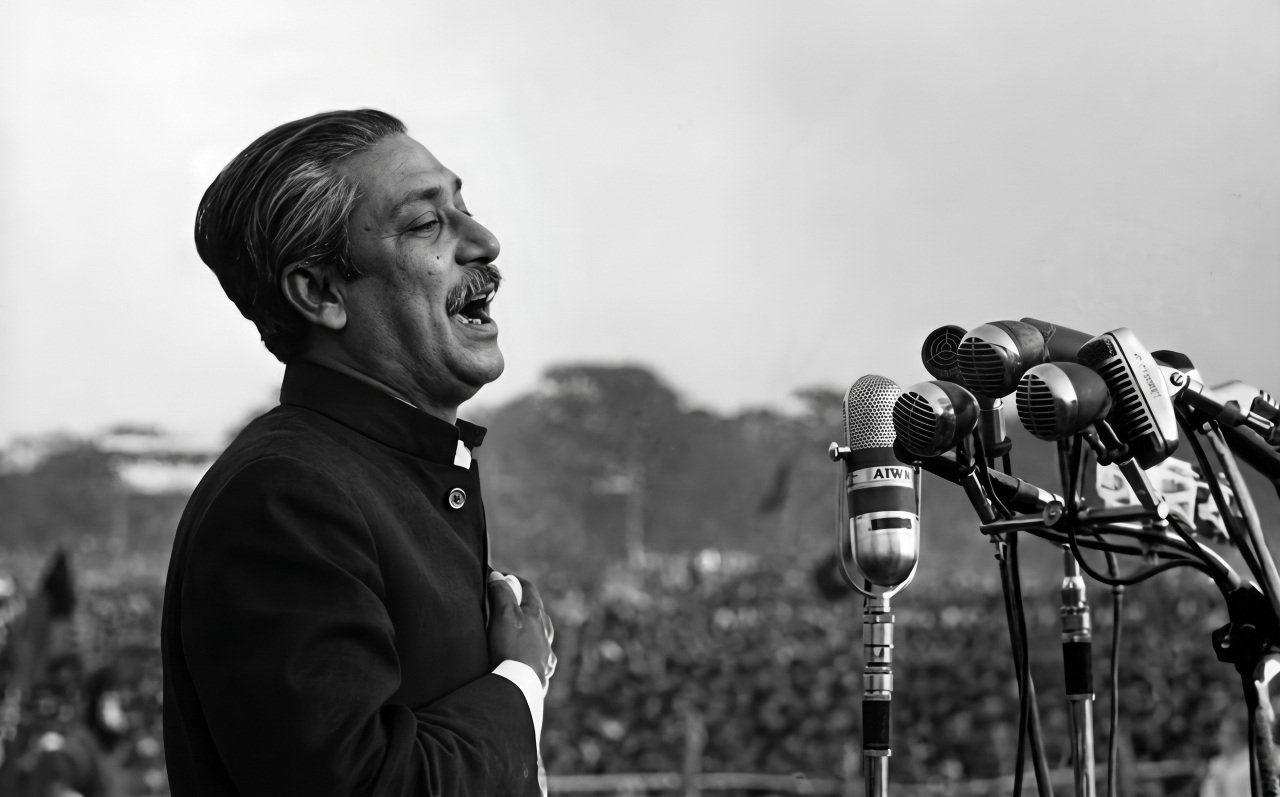
The youth and young demographic account for approximately 30 percent of Bangladesh’s total population. By current demographic estimates, there are over 45 million young men and women in the country. Bangabandhu harboured deep thoughts and grand dreams regarding this vibrant cohort. He envisioned molding every member of the youth into an ‘ideal human being’—a force of uncompromising moral character. By an ideal human, he meant an individual who embodies advanced human virtues and serves as an exemplar for others; someone possessing everything that is socially noble, righteous, sublime, and beneficial.
To become an ideal human being, one requires essential qualities such as honesty, dedication, industriousness, benevolence, empathy, selflessness, humility, and courage. Bangabandhu himself was an idealist par excellence. The liberation of the exploited, persecuted, and oppressed masses of Bengal constituted the primary goal and ideal of his life—a goal for which he struggled continuously throughout his existence.
In raising his voice for the rights of the Bengali people, he endured repeated imprisonment and state persecution. Incarceration and oppression became routine chapters of his life. Bangabandhu’s thoughts, dreams, and actions were devoted entirely to the welfare of his countrymen and the liberation of the motherland. In politics, Bangabandhu stood as a shining example of self-sacrifice rather than self-indulgence. He accorded the highest priority to moral principles in political life. The objective of his politics was never mere ascension to power, but was directed toward securing the rights and national liberation of the Bengalis. He firmly believed that the youth must be empowered through these very ideals.
Bangabandhu chose democracy, socialism, and secularism as his political ideals, ultimately converting them into state principles. He envisioned Bangladesh as an ideal state anchored upon these foundational pillars. In light of this vision, the 1972 Constitution incorporated Nationalism, Socialism, Democracy, and Secularism as the four fundamental principles of state policy.
Table of Contents
1. The Youth as the Architectural Pillars of the Nation
Under Bangladesh’s National Youth Policy, individuals aged between 18 and 35 are designated as ‘youth’. The youth may be described as the foundational pillars of a nation, the architects of its civilization, culture, and progress. Possessing physical and mental vigor, awakened intellect, and revolutionary spirit, young people stand as the vanguard of social and political transformation.
A vast proportion of those who sacrificed their lives in the glorious Liberation War were young. For the young Sheikh Mujibur Rahman, his primary academy was Bengal, the Bengali people, and Bangladesh. He internalized the millennia-old aspirations, agonies, struggles, and heritage of the Bengalis into his consciousness. The youth of Bengal were his very lifeblood.
It was upon the shoulders of the youth that Bangabandhu mapped his blueprint for national success. He lifelong desired that the country’s youth hone their skills, embrace a work-oriented ethos, remain conscious of their duties and responsibilities, and build a ‘Sonar Bangla’ (Golden Bengal).
To properly nurture the youth, Bangabandhu laid the utmost emphasis on education. He advocated for a people-oriented, science-based, and technical education system. Beyond academic pursuits, he urged young people to fulfill their broader societal obligations. Addressing the youth on 19th August 1973, he remarked:
“My children, acquire some education. No matter how much you chant ‘jindabad’ or ‘murdabad’, if you do not study properly, it is of no avail. And in whatever time you find after studying, assist your parents. Do not feel ashamed to hold the plow beside your father simply because you have learned to wear trousers. Look at the world around you. Plant a few eggplant vines, chili plants, gourd trellises, and coconut saplings beside your homes in the villages. Help your parents. Merely passing B.A. or M.A. exams is useless—you must work for the welfare of the country’s people.”
Bangabandhu loved the youth deeply, striving to instill within them the grand vision he harboured for the nation. He constantly guided them to be inspired by patriotic ideals. In his address on the founding anniversary of Chhatra League in 1973, he emphasized:
“The people of Bengal, especially the youth, must know our history. A Bengali youth who remains ignorant of the heritage of his forebears can never become a true Bengali.”
A major chapter of Father of the Nation Bangabandhu Sheikh Mujibur Rahman’s political career was forged during his youth. Deep within his thoughts on youth development lay the philosophy of the ultimate emancipation of Bengal and the Bengalis, enabling them to lead the world with heads held high. He desired that the youth become ‘golden sons’ to construct a ‘Sonar Bangla’. He called upon them to cultivate self-criticism, self-restraint, and self-purification while walking the path of honesty and patriotism.
2. Relevance in the Era of the Fourth Industrial Revolution
Following independence, Bangabandhu initiated various strategic plans toward youth development. The emphasis he placed on technical and vocational education holds even greater relevance today. Bangabandhu’s vision remains crucial for building a skilled youth force equipped for the Fourth Industrial Revolution (4IR).
Navigating the Fourth Industrial Revolution demands a skilled youth workforce proficient in advanced technology, robotics, artificial intelligence, and information technology. However, heighted awareness is required to ensure that this technological shift does not produce a generation driven by superficial or artificial mindsets. In Bangabandhu’s vision, a genuine, skilled, honest, and patriotically inspired youth force rooted in Bengali consciousness constitutes the ultimate asset of the nation.
During the Liberation War, many young people served among the regular forces—the Army, Navy, Air Force, EPR, Police, and Ansar. These fearless youth did not hesitate to embrace death with a smile for the independence of Bangladesh. Fundamentally, the Liberation War stands as monumental proof of the power and spirit of sacrifice inherent in the youth.
Keeping Bangabandhu’s dream at the forefront, the Awami League government continues its efforts toward youth development. Significant emphasis was laid on this domain in the party’s election manifesto. Following a comprehensive review of achievements during its twelve-year tenure in governance, the target framework was structured into five key dimensions:
-
Administrative: Institutional capacity building and structural reforms.
-
Education, Training, and Employment: Provision of demand-driven technical education and skills development.
-
Self-Employment and Youth Entrepreneurship: Fostering startups and enterprise creation.
-
Recreation and Physical Development: Expanding opportunities for sports, physical fitness, and cultural development.
-
Civic and Political Empowerment: Ensuring active youth participation in national decision-making.
The policy commitments outlined in the manifesto include the effective implementation of the National Youth Policy formulated in 2017, the establishment of a separate Youth Division and a dedicated Research Center under the Ministry of Youth and Sports, and an increase in budgetary allocations for the sector. Beyond technical education and training for employment, plans were devised to expand the ongoing National Service Program.
3. Policy Imperatives and the Strategic Path Ahead
While these policy commitments are inspiring, articulating objectives in a manifesto is straightforward, whereas execution remains demanding. Therefore, steadfast institutional commitment from the government is essential. Employment remains the most critical issue for the youth, but making them employable through appropriate skill-building must precede job creation—an area where comprehensive planning has often lagged.
It is true that Bangladesh has raised its literacy rate to a commendable level. However, this achievement has not translated into a proportionate reduction in youth unemployment. The root cause lies in the misalignment between our traditional education system and evolving market demands.
A coherent national strategy must be instituted to ensure that students transition smoothly into employment upon graduation. Work-oriented educational planning will prove instrumental in equipping young people with necessary market skills and job opportunities.
The youth must unequivocally uphold and preserve the spirit of the Liberation War—there can be no compromise on this foundational principle. For numerous reasons, the youth represent an infinite reserve of national energy. This force must be directed toward driving national development and keeping the country on the right trajectory. Ultimately, it is the youth who will build Bangladesh into a prosperous and self-reliant nation.