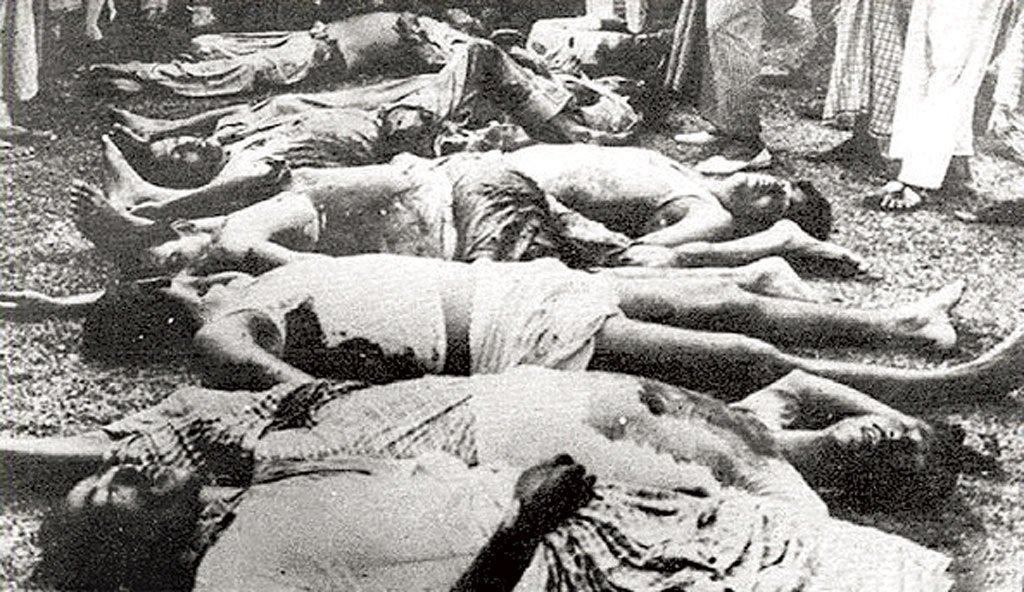
‘Operation Searchlight’ was a deliberate, pre-planned, and institutionalised military campaign of genocide unleashed by the Pakistan Armed Forces on the midnight of 25 March 1971 in then East Pakistan (present-day Bangladesh), aimed at ruthlessly crushing the Bengali nationalist movement for self-determination. In modern military history, such a barbaric and horrific instance of a country’s regular armed forces launching a surprise assault on its own unarmed, sleeping, and innocent civilian population with tanks, artillery, and automatic weapons is exceedingly rare. This military operation formally marked the inception of the nine-month Bangladesh Liberation War of 1971 and one of the largest post-Second World War genocides.
+---------------------------------------------------------------------------------------------------+
|                     Strategic Guidelines and Timeline of Operation Searchlight                     |
+---------------------------------------------------------------------------------------------------+
|  • 22 March 1971  : Final draft approved at Dhaka Cantonment (Farman Ali and Khadim Raja)         |
|  • 25 March 11:30 PM: Armoured vehicles and heavy artillery convoys depart cantonment ('Zero Hour')|
|  • 25 March 11:40 PM: First armed resistance by Bengali police personnel at Rajarbagh Police Lines|
|  • 26 March 01:30 AM: Bangabandhu Sheikh Mujibur Rahman arrested from Dhanmondi 32 & Independence |
|                       declared                                                                    |
|  • 26 March Dawn    : Massacre of thousands of civilians at Dhaka University, Peelkhana, and      |
|                       Old Dhaka                                                                   |
+---------------------------------------------------------------------------------------------------+
Table of Contents
Political Backdrop of March 1971: Delaying Power Transfer and Military Deception
The backdrop to Operation Searchlight was not merely confined to the events of a single night on 25 March; behind it lay twenty-four years of political discrimination, economic exploitation, and a deep-seated colonial mindset on the part of the Pakistani state to rule the Bengali population through brute military force.
The 1970 General Election and the Democratic Mandate
In the first general election of Pakistan, held in December 1970, the Bangladesh Awami League, under the leadership of the Father of the Nation, Bangabandhu Sheikh Mujibur Rahman, secured an absolute majority (167 out of 169 seats) in the National Assembly. According to political and constitutional norms, Sheikh Mujibur Rahman was entitled to become the Prime Minister of Pakistan. However, the military-bureaucratic ruling clique of West Pakistan, alongside the leader of the Pakistan People’s Party, Zulfikar Ali Bhutto, refused to hand over power to the victorious Bengali leadership.
The Non-Cooperation Movement of March and Military Preparations Under the Guise of ‘Political Dialogue’
In response to this refusal, the historic Non-Cooperation Movement commenced on 3 March 1971. The entire civil administration, courts, banks, and communication systems across East Pakistan began operating directly under the directives of Sheikh Mujibur Rahman. Compelled by these circumstances, the President, General Agha Muhammad Yahya Khan, arrived in Dhaka and initiated a sham political dialogue with Bangabandhu on 15 March.
In reality, this dialogue was a calculated delaying tactic engineered by the Pakistani military establishment. While the charade of talks continued in Dhaka, heavy weaponry and ammunition were transported to Chittagong Port via the Bay of Bengal aboard the arms-laden vessel MV Swat. Simultaneously, thousands of West Pakistani troops and commandos dressed in civilian attire were airlifted to East Pakistan aboard commercial flights operated by Pakistan International Airlines (PIA).
Important Note: By mid-March 1971, the Pakistan Army significantly stockpiled food, fuel, and war material. The sole objective of this exercise was to crush the Bengali demand for self-determination once and for all through the ultimate application of military force.
The Military Blueprint and Strategic Scheme of ‘Operation Searchlight’
On 17 March 1971, sitting at Dhaka Cantonment, the then Military Governor of East Pakistan and head of Eastern Command, Major General Khadim Hussain Raja, along with the Zonal Martial Law Administrator, Major General Rao Farman Ali, jointly drafted the initial blueprint for this military campaign.
+---------------------------------------------------------------------------------------------------+
|                         Command Structure of Operation Searchlight                                |
+---------------------------------------------------------------------------------------------------+
|  • Commander-in-Chief                      : President General Agha Muhammad Yahya Khan           |
|  • Overall Military Supervisor (Governor/GOC): Lieutenant General Tikka Khan ('The Butcher of Bengal')|
|  • Chief Planner for Dhaka City            : Major General Rao Farman Ali (Civil Affairs)         |
|  • Planner for Outer Regions               : Major General Khadim Hussain Raja (GOC 14 Division)  |
|  • Field Executor (Dhaka Field Strike)     : Brigadier Arbab (53 Brigade Commander)              |
+---------------------------------------------------------------------------------------------------+
Final Approval and Strategic Objectives
After the plan was transcribed into a handwritten document, it was submitted to the new Commander of Eastern Command, Lieutenant General Tikka Khan, on 19 March 1971. On 20 March, General Yahya Khan approved the scheme. On 22 March, during a high-level meeting at the Quartermaster General’s office in Dhaka Cantonment, the final operational directives were formally ratified under the code name ‘Operation Searchlight’.
The primary tactical objectives of this operation were:
- Neutralising Central Leadership: To arrest or liquidate the top-tier political leadership of the Awami League, including Sheikh Mujibur Rahman, in a single night.
- Destroying Bengali Armed Capacity: To disarm and massacre Bengali personnel stationed at the East Pakistan Rifles (EPR) headquarters in Peelkhana, the Rajarbagh Police Lines, and those serving within the regular armed forces through sudden, coordinated strikes.
- Eliminating the Epicentre of Resistance: To launch a military offensive on Dhaka University—regarded as the core intellectual and ideological bastion of the Bengali nationalist movement—and eliminate student leaders, faculty members, and the youth.
- Controlling Communications and Media: To seize the Dhaka radio station, television centre, telephone exchanges, General Post Office (GPO), and postal networks, thereby severing East Pakistan’s international communications with the rest of the world.
- Scorched Earth and Terror Tactics: To execute widespread arson in Old Dhaka, Hindu-majority residential areas, and major commercial hubs to instil terror among the civilian populace.
The Black Night of 25 March: ‘Zero Hour’ and the Main Sequence of Genocide in Dhaka
At 11:30 PM on 25 March, armoured vehicles, tanks, and heavy artillery convoys belonging to the 57th Brigade of the Pakistan Army rolled out from Dhaka Cantonment towards the heart of the city. Although the designated ‘Zero Hour’ was set for 1:00 AM, artillery fire erupted across various points in the city as early as 11:45 PM after the armoured convoys encountered street barricades erected by Bengali students and civilians in the Farmgate area.
+---------------------------------------------------------------------------------------------------+
|                               Primary Military Targets on 25 March                                |
+---------------------------------------------------------------------------------------------------+
|  1. Dhaka University (Iqbal Hall, Jagannath Hall, Rokeya Hall, Faculty Quarters)                  |
|  2. Rajarbagh Police Lines (Central Police Armoury and Barracks)                                 |
|  3. Peelkhana East Pakistan Rifles (EPR HQ - 3rd & 4th Wings)                                     |
|  4. Dhanmondi 32 (Residence of Bangabandhu Sheikh Mujibur Rahman)                                 |
|  5. Old Dhaka, Shankhari Bazaar, Tanti Bazaar, and Adjoining Residential Colonies                 |
+---------------------------------------------------------------------------------------------------+
The Dhaka University Massacre: Shelling Free Thought and Intellect
Pakistani forces, comprising multiple companies from the 22nd Baluch Regiment, 32nd Punjab Regiment, and the 3rd Commando Battalion, encircled Dhaka University from all directions. Heavy tanks, rocket launchers, and 5.7mm machine guns were deployed to shell the residential halls.
Iqbal Hall (now Sergeant Jahurul Huq Hall) and Salimullah Hall
Pakistani troops assaulted Iqbal Hall using ladders and rocket launchers. Hundreds of resident students and political activists associated with the independence movement were dragged out of their rooms into the corridors and quadrangles and executed by firing squad. Artillery shells reduced the roof and numerous dormitories to ashes.
Jagannath Hall: Planned Racial Genocide
The slaughter perpetrated at Jagannath Hall was among the most horrific. As a dormitory primarily housing non-Muslim (Hindu) and general students, Pakistani troops breached the hall and executed students at point-blank range. By morning, surviving students were forced at gunpoint to drag the corpses of their peers into open grounds and dig mass graves. Once the graves were dug, these surviving students were shot dead and thrown over the pile of bodies. Eyewitness accounts of these mass graves were later published internationally through dispatches by British journalist Simon Dring and declassified US Embassy cables.
Murder of Academics and Intellectuals
The assault was not limited to students; a primary objective of the Pakistani military was the systematic liquidation of the university’s eminent faculty members. On the night of 25 March, soldiers broke into faculty residences and brutally murdered:
- Dr Govinda Chandra Dev (G. C. Dev): Head of the Department of Philosophy and world-renowned humanist philosopher.
- Dr Jyotirmoy Guhathakurta: Senior Professor of English and specialist in classical literature.
- Professor Fazlur Rahman: Lecturer in Mathematics.
- Dr Ataur Rahman Khan Khadim: Lecturer in Physics.
- Dr A. N. M. Munim: Professor of English.
Rajarbagh Police Lines: First Armed Resistance of Independent Bangladesh
When the Pakistani strike force advanced towards Rajarbagh Police Lines with heavy armoured vehicles at 11:40 PM on 25 March, the Bengali police officers and constables stationed there immediately sounded the emergency alarm bell (PAGLA GHANTA).
Equipped only with outdated .303 bolt-action rifles from their limited armoury, the Bengali policemen mounted an armed defense from the rooftops and barracks against the heavily armed Pakistani battalion. This event marked the first formal armed military resistance by Bengalis against the Pakistani occupation forces during the 1971 War of Liberation. However, subjected to intense barrage from rocket launchers and heavy artillery, the barracks were reduced to flames after hours of sustained combat, resulting in the martyrdom of hundreds of police personnel.
Attack on the EPR Headquarters at Peelkhana
To prevent the large contingent of Bengali East Pakistan Rifles (EPR) personnel stationed at Peelkhana from organizing armed resistance, the 3rd and 4th Punjab Battalions launched a surprise artillery assault on the compound at midnight. Unarmed Bengali soldiers sleeping in their barracks were indiscriminately gunned down. Risking their lives, Bengali operators from the EPR Signals Corps transmitted emergency warnings to regional commanders before hundreds of surviving personnel mounted heroic tactical rearguard actions and escaped to join the nationwide liberation struggle.
Dhanmondi 32: The Arrest of Bangabandhu Sheikh Mujibur Rahman and the Declaration of Independence
At approximately 1:30 AM on 26 March, a commando unit of the Special Service Group (SSG) surrounded the residence of Bangabandhu Sheikh Mujibur Rahman at Road 32, Dhanmondi. After firing indiscriminately at the house from all directions, they breached the premises.
Moments prior to his arrest, at 12:20 AM (at the onset of 26 March), the Father of the Nation, Bangabandhu Sheikh Mujibur Rahman, transmitted the formal Declaration of Independence of Bangladesh via wireless (utilizing the EPR signal frequency):
“This may be my last message, from today Bangladesh is independent. I call upon the people of Bangladesh wherever you might be and with whatever you have, to resist the army of occupation to the last. Your fight must go on until the last soldier of the Pakistan occupation army is expelled from the soil of Bangladesh and final victory is achieved.”
This historic declaration was relayed to leaders of the Chittagong Sangram Parishad, the Agrabad Signal Centre, and broadcast via telegram and wireless across the nation. Shortly thereafter, the Pakistani commando unit arrested Bangabandhu, transported him to Dhaka Cantonment, and subsequently incarcerated him in West Pakistan.
Regional Spread of Operation Searchlight: Atrocities Beyond Dhaka
Although Dhaka City was the primary focal point on the night of 25 March, the operational footprint of Operation Searchlight extended simultaneously across all strategic districts, cantonments, and the key port city of Chittagong.
+---------------------------------------------------------------------------------------------------+
|                        Key Regional Centres of Military Operations                                |
+---------------------------------------------------------------------------------------------------+
|  • Chittagong (EBRC, Agrabad, Port Road) --> Mutiny of Bengali troops under Captain Rafiq        |
|  • Comilla (Comilla Cantonment)           --> Mass civilian killings by 53rd Infantry Battalion    |
|  • Jessore and Rangpur                    --> Armed resistance movements by EPR and Bengal Regiment|
|  • Saidpur and Nilphamari                 --> Localised massacres executed with non-Bengali Biharis|
+---------------------------------------------------------------------------------------------------+
Chittagong: Resistance at EBRC and the Port City
In Chittagong, Pakistani forces under Brigadier Ansari executed a strategy on the night of 25 March to disarm and eliminate hundreds of Bengali troops stationed at the East Bengal Regiment Centre (EBRC) and the Eighth East Bengal Regiment. However, alerted by signal communications, senior Bengali officers Captain Rafiq-ul-Islam (later Bir Uttam) and Major Ziaur Rahman revolted. Intense battles raged for three and a half days to prevent the offloading of arms from the Pakistani ship MV Swat and to maintain control over the city.
Regional Massacres in Saidpur and Nilphamari
In Saidpur Cantonment and its surrounding regions, Pakistan Army personnel, in collusion with local non-Bengali Bihari militias, rounded up hundreds of local Bengali families, lining them up to be executed or slaughtered. Following 25 March, this wave of military terror swept across nearly the entirety of North Bengal.
Psychology of Genocide and Pakistani Military Policy: The ‘Scorched Earth’ Strategy
Operation Searchlight was not a conventional operation aimed at restoring law and order; it was the brutal application of racial chauvinism and a ‘Scorched Earth’ military policy.
‘Want the Land, Not the People’: Tikka Khan’s Military Mindset
Major General Khadim Hussain Raja noted in his memoir, A Stranger in My Own Country, that General Tikka Khan’s core objective upon assuming command was the complete subjugation of the Bengali population through extreme force. A statement attributed to Tikka Khan gained wide currency in political and diplomatic circles at the time:
“I want the land, not the people.”
In executing this mandate, Pakistani troops set fire to entire swathes of Dhaka city and surrounding rural villages, opened fire with machine guns on fleeing women and children, and engaged in systemic looting.
+---------------------------------------------------------------------------------------------------+
|      Extremist Military Psychology and Institutional Policy of the Pakistani Forces                |
+---------------------------------------------------------------------------------------------------+
|  • Racial Chauvinism      : Denigrating Bengali physical traits, language, and culture.          |
|  • Religious Extremism    : Issuing edicts branding Bengali Muslims as "insufficiently Islamic".   |
|  • Gender-Based Violence  : Utilizing institutional mass rape to systematically break society.     |
|  • Demographic Cleansing  : Forcing Hindu populations and nationalist Bengalis to flee the country.|
+---------------------------------------------------------------------------------------------------+
International Reactions, Eyewitness Accounts, and Diplomatic Dispatches
On the night of 25 March, the Pakistani junta took precautions to ensure that no foreign journalists remained in Dhaka. Approximately 35 foreign correspondents staying at the Hotel InterContinental were detained at gunpoint and deported by aircraft the following morning.
Simon Dring’s Historic Dispatch
British journalist Simon Dring evaded detection by hiding on the roof and in the kitchens of the Hotel InterContinental, witnessing firsthand the atrocities in Dhaka on 25 March. With the assistance of the Daily Mail, his landmark report was published in The Daily Telegraph on 30 March 1971 under the headline: “Tanks Crush Revolt in Pakistan”. Through his reporting, the global community learned that the Pakistan Army had slaughtered between 7,000 and 10,000 civilians in Dhaka in a single night.
Archer Blood and ‘The Blood Telegram’
“Our government has failed to denounce the suppression, violence, and genocide executed by the Pakistani military in East Pakistan…”
Anthony Mascarenhas’s Investigative Report
Pakistani journalist Anthony Mascarenhas, who had been sent to East Pakistan by the military regime to write a whitewashed account of the situation, fled to London after witnessing the horrors firsthand. On 13 June 1971, his explosive eight-page exposé published in The Sunday Times turned international public opinion decisively against Pakistan and in favour of the Bangladesh Liberation War.
Casualty Figures, Overall Losses, and Global Democide Data
Scholars and international genocide researchers classify Operation Searchlight and the subsequent nine-month campaign of atrocities as one of the most egregious crimes against humanity of the twentieth century.
| Location / Sector | Primary Target Group | Medium / Weapons Used | Estimated Casualty Count (25–26 March) |
| Dhaka University | Students, faculty, and staff | Armoured vehicles, rocket launchers, automatic machine guns | 1,000 – 1,500 |
| Rajarbagh Police Lines | Bengali police personnel | Artillery, rocket launchers, infantry assaults | 700 – 1,000 |
| Peelkhana EPR HQ | East Pakistan Rifles troops | Surprise heavy artillery barrage, automatic rifle fire | 1,500 – 2,000 |
| Old Dhaka & Shankhari Bazaar | Civilian Hindu population & traders | Arson, indiscriminate firing, explosive shelling | 3,000 – 5,000 |
| Outlying Districts (Chittagong, Comilla) | Bengali soldiers, police, & civilians | Direct rocket strikes, executions by firing squad | 2,000 – 3,000 |
R. J. Rummel’s Democide Statistics: Prominent genocide researcher R. J. Rummel, in his seminal work Death by Government, estimated that between 1.5 million and 3 million people were killed by the Pakistan Armed Forces during the 1971 genocide in East Pakistan, an campaign launched directly by Operation Searchlight.
Political and Strategic Failure of Operation Searchlight
The Pakistani military junta operated under the assumption that ‘Operation Searchlight’ would swiftly suppress the Bengali population through brutal force, compelling total submission within weeks. However, this proved to be a catastrophic strategic miscalculation.
[Pakistani Assumption: A single night's blitzkrieg will extinguish the Bengali movement]
                               │
                               ▼
[Reality: Nationwide resistance, armed mutiny, and the launch of the Liberation War]
                               │
                               ▼
[Outcome: 3 December Indo-Pak War, Joint Command Offensive, and Surrender on 16 December]
The atrocities of Operation Searchlight severed any remaining prospects for political compromise. The demand for regional autonomy was transformed overnight into an unyielding war for total national independence. The very Bengali soldiers and police personnel the military sought to eliminate crossed borders to form the core of the Mukti Bahini (Liberation Forces). On 17 April 1971, the Provisional Government of the People’s Republic of Bangladesh was formally sworn in at Baidyanathtala (Mujibnagar), Meherpur. Following nine months of heroic armed struggle, 93,000 personnel of the Pakistan Armed Forces surrendered unconditionally on 16 December 1971, giving birth to the sovereign nation of Bangladesh.
References & Bibliography
-
Rahman, Hasan Hafizur (ed.), History of Bangladesh War of Independence: Documents (Volumes 8 & 9), Ministry of Information, Government of the People’s Republic of Bangladesh.
-
Hasan, Moyeedul, Muldhara ’71, The University Press Limited (UPL), Dhaka.
-
Raja, Major General Khadim Hussain, A Stranger in My Own Country: East Pakistan, 1969-1971, Oxford University Press, 2012.
-
Salik, Siddiq, Witness to Surrender, Oxford University Press, 1977.
-
Bass, Gary J., The Blood Telegram: Nixon, Kissinger, and a Forgotten Genocide, Alfred A. Knopf, 2013.
-
Rummel, R. J., Death by Government: Genocide and Mass Murder Since 1900, Transaction Publishers, 1994.
-
Payne, Robert, Massacre: The Tragedy at Bangla Desh and the Phenomenon of Mass Slaughter Throughout History, Macmillan, 1973.
-
Mascarenhas, Anthony, The Rape of Bangla Desh, Vikas Publications, 1971.
-
Hamoodur Rahman Commission Report, Supplementary Report on the 1971 War, Government of Pakistan, 2000.