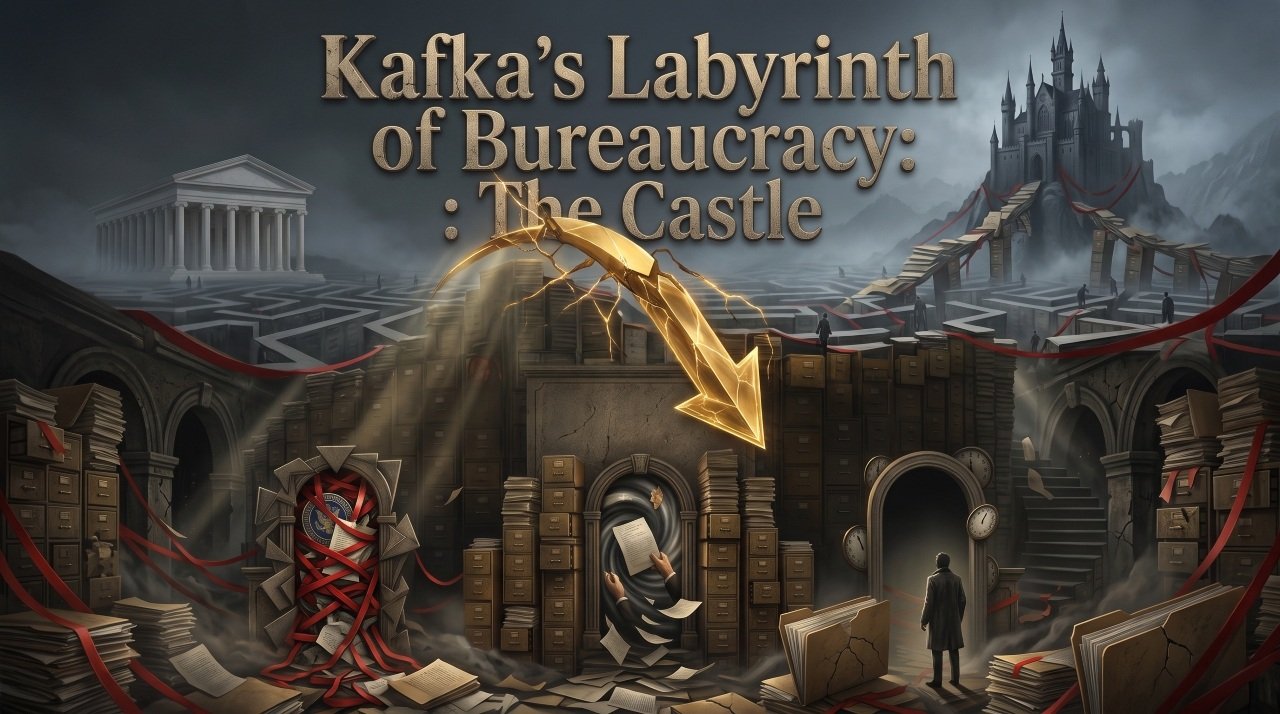
The theoretical framework of bureaucracy imparted through hefty textbooks on sociology or political science pales in comparison to the intense, haunting, and visceral portrayal found in Franz Kafka’s seminal novel, The Castle (German: Das Schloss). Published posthumously in 1926 following Kafka’s untimely death, this masterpiece extends far beyond the realm of classic literature; it serves as one of the most profound and analytical dissections of the modern global order, administrative complexity, the tyranny of red tape, and institutional mechanisms.
To comprehend how the state apparatus or corporate entities strip an individual of their agency—reducing human identity to a mere file or case number—and how they erect mountains of regulations to permanently alienate people from their fundamental rights, The Castle stands as the supreme literary testament in world literature.
Table of Contents
1. Kafka’s Personal Life and the Theoretical Context of the Work
The suffocating bureaucracy depicted in The Castle is no mere fictional fantasy; it is the direct product of Kafka’s personal life experiences. Professionally, Kafka served as a senior official at the Workers’ Accident Insurance Institute in Prague. On a daily basis, he was compelled to navigate hundreds of files, compensation claims, rejected applications, legal clauses, and bureaucratic appeals.
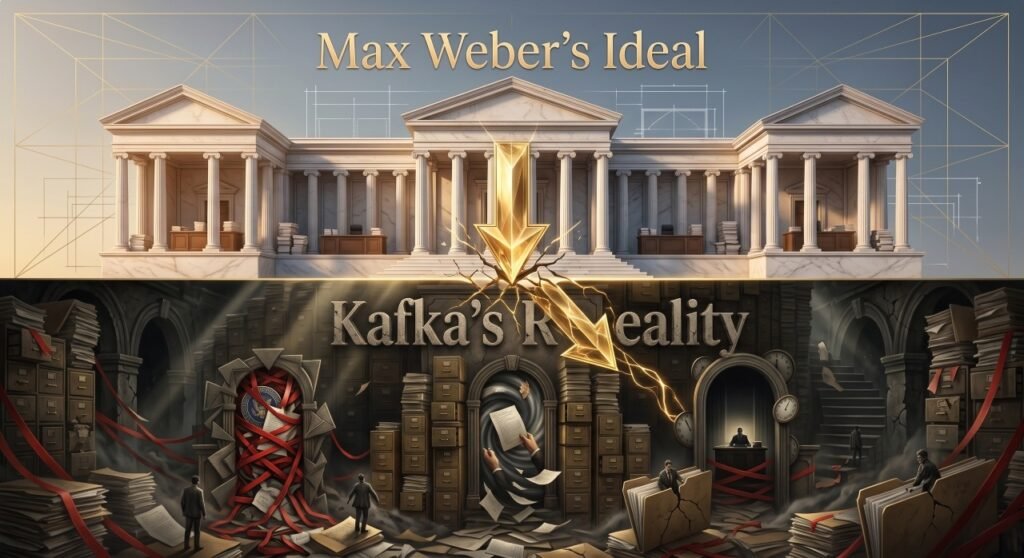
Where the sociologist Max Weber defined bureaucracy as the most “rational, efficient, and solid structure” of human civilisation (Rational-Legal Bureaucracy), Kafka demonstrated in his novel how this very ‘rationality’, when pushed to its absolute extreme, devolves into utter absurdity. Weber observed the polished exterior of the bureaucratic frame, whereas Kafka ventured inside to examine its soulless, cold, and crippled machinery.
2. Narrative Arc: The Arrival of ‘K’ and the Initial Clash with the Structure
The protagonist of the novel is identified merely by a single letter—’K.’. K. is neither a mythical hero nor a superhuman figure; he is an ordinary proxy like any of us, seeking to establish his professional identity and competence.
At the outset of the story, on a dark and bitterly cold winter night, K. arrives at an inn in an unfamiliar village. Perched directly above the village on a mountain sits a mysterious ‘Castle’. K. claims that he has been summoned by the Castle’s central administration to serve as a ‘Land Surveyor’.
However, the moment he sets foot in the village, his conflict with the system begins. The village chairman informs him that remaining in the village overnight without the Castle’s explicit permission is illegal. When K. invokes his official appointment, communications from the Castle via telephone or letter alternately confirm that “Yes, he has been appointed,” only to assert moments later that “No such post exists.”
The entirety of the novel unfolds around K.’s futile and relentless efforts to gain entry into this inscrutable, unreachable Castle and to secure an audience with Klamm, the official wielding absolute power over the domain.
3. Anatomy and Operational Mechanics of Kafkaesque Bureaucracy
In this novel, Kafka uncovers several specific mechanisms through which bureaucracy functions—or pretends to function:
(a) Documentation, Files, and Mountains of Data
One of the finest scenes in the novel occurs during K.’s first formal meeting with the village Mayor (Vorsteher). Bedridden and ailing, the Mayor explains to K. the origin of the administrative blunder regarding his appointment. He reveals that many years prior, an administrative notice regarding the recruitment of a land surveyor named K. was mistakenly routed from one department to another.
What followed was a bureaucratic carnival of paperwork. The file circulated amongst various desks for years, generating thousands of documents and prompting the formation of numerous sub-committees. Eventually, it was determined that the post was entirely unnecessary. The catch, however, was that the cancellation notice had been misplaced before it could reach K.
By gesturing towards his room overflowing with files and document cabinets, the Mayor inadvertently exposes the core truth of bureaucracy: its primary objective is not to resolve human problems, but to generate files, hoard data, and lose the living individual beneath a mountain of paperwork.
(b) The Infinite Chain of Command for Evading Responsibility
Within the administrative framework of The Castle, no single individual ever assumes responsibility for a decision. Every desk is manned by an official who claims to be merely following “orders from above”. Yet, who or where is this ‘superior authority’?
Whenever K. attempts to approach a higher-ranking official, he is informed that he has failed to follow due process. He is directed from Counter 1 to Counter 5, from Counter 5 to Counter 10, and from Counter 10 back to Counter 1. This represents a cyclical self-preservation mechanism wherein the centre of power remains perpetually invisible, even whilst its oppressive presence is felt everywhere.
(c) The Fluidity and Illusion of Power
No one in the village has ever seen Klamm—the chief bureaucrat and supreme authority of the Castle—in person. All that the villagers know about him is based entirely on rumours and conjectures.
Some describe Klamm as a stout, solemn gentleman; others claim he is young; whilst some insist he appears utterly unremarkable. Kafka demonstrates here that bureaucratic authority does not reside in the individual person; rather, it relies upon the blind fear and reverence that people project onto the seat of power. Klamm is not a mere man; Klamm is an illusion generated by the system.
4. Examples of Bureaucratic Loops and Institutional Blindness
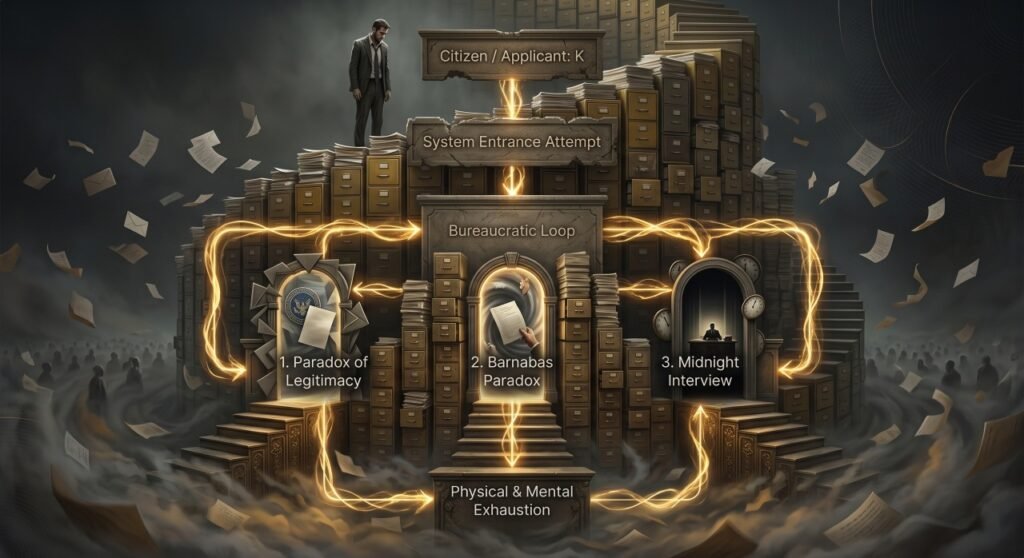
Loop 1: The Paradox of Legitimacy
The prerequisite for entering any bureaucratic system is legitimacy. Yet, the authority to confer that legitimacy rests exclusively with the bureaucracy itself. When K. arrives in the village, he is told he is not a legitimate surveyor because the Castle has not directly endorsed him. Conversely, when he attempts to leave the village, he is informed that he cannot depart because he constitutes a ‘pending case’ belonging to the Castle!
In short, the system will neither grant you a place within its confines nor permit you to live peacefully outside them. You are held in a state of perpetual limbo.
Real-Life Example: Have you ever attempted to rectify an error on your National Identity Card (NID) in Bangladesh? The NID Wing of the Election Commission will instruct you to first amend your ‘Online Digital Birth Registration Certificate’. When you approach the City Corporation or Union Parishad to amend your birth certificate, they will inform you: “Your birth certificate cannot be amended because your parents’ names do not match their NIDs! You must amend their NIDs first.” When you then accompany your elderly parents to the Election Commission to correct their NIDs, you are met with the response: “Parents’ NIDs cannot be amended without their online birth registration certificates!”
The outcome? Your NID remains trapped in your birth certificate file, your birth certificate remains stuck on the desk handling your parents’ NIDs, and your parents’ NIDs remain frozen in another digital database. Entire families circle indefinitely in an infinite bureaucratic vortex, as no single department is willing to take the first step or relax its procedures. Kafka’s K. was trapped in precisely this suffocating cycle.
Loop 2: The Barnabas Paradox
A messenger named Barnabas is dispatched from the Castle to K., delivering a letter bearing Klamm’s signature. K. believes he has finally established a direct line of communication with the Castle. Later, however, Barnabas’s sister, Olga, reveals the sobering truth to K.
Barnabas himself has no idea whether he is a genuine messenger of the Castle! He stands in a vast hall inside the Castle packed with thousands of hopeful messengers. An anonymous clerk tosses a bundle of letters from above, and whichever messenger catches a letter sprints off with it. Whether the letter delivered to K. was actually penned by Klamm, or was merely the mistake or whim of some minor clerk, remains entirely unknowable.
Real-Life Example: Consider the automated text messages or helpline responses you receive after submitting an application for an e-passport, driving licence, or NID. Suppose a message suddenly arrives on your mobile phone reading: “Your application #102345 is currently under processing at the Head Office”, or when calling a government helpline, the operator politely informs you: “Sir, your file is currently with the Director’s office for final approval.”
Reassured by the message or call, you assume that your file is progressing and that you have received an official update. But what is the grim reality behind the scenes? The helpline agent who spoke to you is not a government official at all; they are an outsourced employee at a private call centre who has never laid eyes on the Director’s office at regional or central headquarters. They are merely reading a canned script or ‘system status’ off a computer screen.
Whether your file has actually reached the Director’s desk, is gathering dust behind a filing cabinet, or a junior clerk pressed an ‘In-Process’ button simply to meet his daily quota—neither the agent nor you can ever know. You have been provided with an official piece of information, yet no meaningful connection has been established with the authority who holds the power of signature. The system creates a calming illusion of communication whilst no actual progress occurs. The ‘letter from Klamm’ delivered by Barnabas is precisely this sort of hollow processing notification.
Loop 3: Informal Punishment and Social Ostracisation (The Amalia Story)
One of the most poignant and vital subplots in the novel is the story of Barnabas’s sister, Amalia. Sortini, a high-ranking Castle official, sends Amalia a crude and offensive letter one evening, ordering her to report to his quarters immediately. Outraged and possessing deep self-respect, Amalia tears the letter to pieces and hurls it back into the messenger’s face.
What were the repercussions? The Castle issued no formal legal punishment against Amalia or her family, dispatched no police officers, and imposed no prison sentence. The Castle simply maintained absolute silence. Observing this silence, the villagers collectively ostracised Amalia’s family socially and economically.
Desperate to appease the Castle, Amalia’s father sold all his possessions and spent his days sitting outside the Castle gates, begging for a grain of forgiveness. Yet the Castle never even acknowledged that it harboured any grievance against Amalia! Without ever specifying a crime, the entire family was left to wither and decay.
Real-Life Example: In corporate workplace environments, when an employee refuses to comply with an unethical directive or acts as a whistleblower, they are rarely terminated outright. Instead, they are quietly stripped of key projects, isolated, and subjected to an environment designed to compel their eventual resignation.
Loop 4: The Midnight Interview and the Tragedy of the Loophole
Towards the conclusion of the novel, K. is inadvertently summoned at 3:00 am to the quarters of a Castle official named Bürgel. Bürgel lies in bed, half-asleep.
In his drowsy state, Bürgel inadvertently divulges a supreme administrative secret or loophole. He explains that when an official of the Castle is asleep or off-duty, should an applicant unexpectedly enter his room and present a petition, the official is legally bound by administrative regulations to grant the request! In that moment, all the daytime barriers of bureaucracy dissolve.
Herein lies Kafka’s tragic irony: after battling the Castle’s maze day in and day out, K. is so utterly exhausted in body and mind that as Bürgel discloses this monumental opportunity, K. slumps beside Bürgel’s bed and falls fast asleep! The system has so thoroughly drained K. of his vitality that when the window of opportunity finally opens, he no longer possesses the energy or consciousness to seize it.
5. Character Allegories and Elements of Bureaucracy
| Character | Institutional Allegory & Bureaucratic Role |
| ‘K.’ | The ordinary citizen/employee who seeks to establish his civic or professional rights through rational means, only to be crushed by the machinery. |
| Klamm | The supreme bureaucrat or centre of power. Inaccessible, visibly inactive, yet controlling everyone through fear and fascination. |
| The Mayor (Vorsteher) | Middle management. His primary role is to eloquently rationalise and justify the systemic flaws of the institution. |
| Frieda | Klamm’s former mistress and barmaid. Represents an unethical conduit or ‘lobbying route’ through which K. attempts to gain access to the Castle. |
| Arthur & Jeremias | K.’s two assistants assigned by the Castle. Rather than assisting, they conduct surveillance. They represent modern corporate surveillance and monitoring mechanisms. |
| Amalia | The sole character who refuses to submit to institutional wrongdoing. She suffers total social isolation as the price for her defiance. |
6. Max Weber versus Franz Kafka
-
According to Weber: Hierarchy of Authority accelerates operational efficiency.Kafka Demonstrated: Hierarchy does not expedite work; rather, it creates an endless series of pretexts for evading responsibility.
-
According to Weber: Impersonality ensures impartial treatment for all.Kafka Demonstrated: Impersonality does not yield neutrality; it dehumanises individuals and permanently extinguishes empathy.
-
According to Weber: Written Documents guarantee transparency.Kafka Demonstrated: Written documents obscure the truth and elevate scraps of paper above human lives.
7. A Century On: Modern Digitisation and Digital Bureaucracy
One might assume that because Kafka wrote this novel in the 1920s—an era of typewriters and physical filing cabinets—bureaucracy was inherently more cumbersome. Has bureaucracy fundamentally changed in today’s digital age of laptops, algorithms, and software?
The answer is unequivocally no: the core soul of bureaucracy has remained entirely unchanged; only its medium has evolved.
What we encounter today may be termed the ‘Digital Castle’:
- When your bank transaction is automatically frozen, customer service agents cannot provide a clear explanation, and the algorithm merely displays “System Generated Error”—that is Kafka’s Castle.
- When a job application submitted through an online portal vanishes for months without a trace, leaving no human being with whom to speak—that is ‘Barnabas’s letter’.
- When a visa application is rejected under an ambiguous clause like “Section 212(g)” despite uploading endless digital documentation, with no defined recourse for appeal—you are Kafka’s K.
Technology has rendered bureaucracy more automated, more unfeeling, and even more unreachable. The invisible walls of power drawn by Kafka have been reinforced by today’s algorithms and artificial-intelligence-driven institutions.
8. The Incomplete Conclusion: Kafka’s Tragic Truth
Franz Kafka died before he could complete the novel, leaving the story broken mid-sentence. However, his close friend and literary executor, Max Brod, revealed the tragic and profound conclusion Kafka had envisioned verbally.
According to Kafka’s plan, K. would succumb to physical and mental exhaustion, dying in a dilapidated room in the village after his long struggle against the Castle. Immediately following his death, a royal decree would arrive from the Castle stating:
This posthumous “permission” represents the ultimate satire of bureaucracy. While living, the individual is denied all fundamental rights; but once crushed and consumed by the apparatus, an official stamp is affixed to his corpse merely to close the file.
The Castle is not merely a work of fictional literature; it is a stark, realistic metaphor for human confinement within the modern global order. It warns us that when systems or institutions established to serve humanity pivot to rule over it, they transform into soulless monsters.
Every one of us, at some juncture in our lives, finds ourselves standing before a ‘Castle’—be it a government bureau, a corporate bank, or a multinational entity. Standing outside those closed doors, we continue to fight, much like K., demanding legitimacy for our existence, our competence, and our identity. No author in world literature has exposed this reality with greater precision, rigour, or eloquence than Franz Kafka.