My attraction to art and culture dates back to my childhood. Even without formal training or education in the arts from an early age, I devoured songs, poems, stories, essays, plays, and films. I understood some of it; perhaps I didn’t understand most of it. But today, when I sift through the happy memories of my life, I realize that it was art and culture that infused true colors of joy into those moments. Without various books, songs, poems, films, or discussions around them, those memories would not have been nearly as complete or colorful.
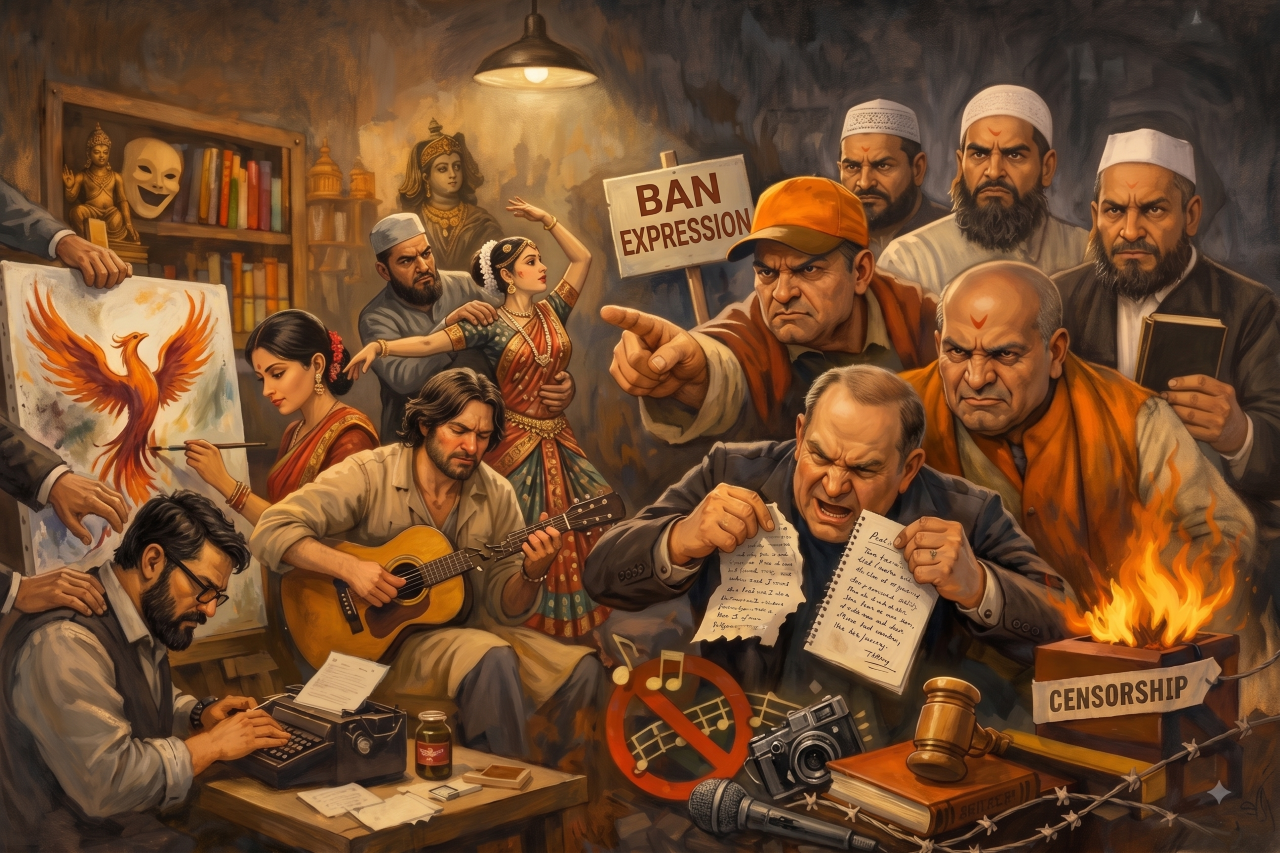
On the other hand, being born into a highly conservative family, I had the opportunity to interact with various right-wing reactionary individuals from a young age. I observed bizarre contradictions in them. In their personal lives, they hardly embrace, savor, enjoy, or internalize art and culture. In the eyes of most, art and culture are nothing but a waste of time, affectation, or intellectual pretension. Even if some enjoy them, they despise the creators of these works. The majority openly and unabashedly express this dislike. The rest try to hide it, but eventually, it slips out. Yet, a strange eagerness to establish rights and ownership over art and culture operates within them. They are always ready to fight (which is, of course, their forte) for it.
I always say—why can right-wing reactionaries contribute nothing to art and culture? Many progressive friends call this the culture of “outright rejection” or “canceling.” In their words, such an absolute rejection is radical and incorrect. I would tell them—before passing this verdict, take some time to think deeply and put the puzzle pieces together. You will not be able to disagree with me. Let’s look at the calculations today as to why you won’t be able to.
In this piece, I will place right-wingers, reactionaries, and fundamentalists in the same basket when it comes to art and culture. Although they may have different roles in society and politics, their stance on art and culture is almost identical. Therefore, when reading this piece, if you see one of these terms, consider the others implied.
To clarify further, I do not call a devoutly religious person a fundamentalist. So, please do not drag in examples of people like Bismillah Khan Sahib. I label those as fundamentalists who want to impose their own religion, opinions, or paths onto others. Those who harbor hatred for other religions or views, are anti-personal freedom, anti-women, envious, compromising, suffer from an inferiority complex, are hypocritical and opportunistic, and seek validation for all this in the name of religion.
Friends also harbor another misconception—they assume that just because someone has enlisted in a progressive group, that person is inherently progressive. That is not the case at all. You will find fundamentalists among those enlisted in centrist or leftist groups. They are no less dangerous than outwardly identified fundamentalists. In fact, they are assassins in disguise, which in the long run is more dangerous than an open enemy. I have seen countless fundamentalists involved in leftist politics. Therefore, merely being a member of a progressive political party does not make someone progressive. Progressiveness is judged by one’s daily lifestyle, actions in society, and especially by their deeds when they attain power. Measure people by that standard—the equation will become clear. Now, let’s return to the main topic.
If you notice carefully, none of the Hamd-Naat or other songs and poems created by fundamentalists are original. They create their music by copying lyrics and melodies from the original musical and literary works of various people. Creating something original is impossible for them. The primary reason for this inability is that they never train in music or literature with respect, nor do they practice (riyaz). Therefore, that creative intellect never develops within them. Just as a tree without roots bears no fruit, original creation is also impossible for them. Yet, their efforts to produce fruit on a male tree never cease.
Right-wingers harbor intense hatred for living people who lead lifestyles like Kazi Nazrul Islam or Mir Mosharraf Hossain, considering their way of life and thoughts worthy of execution (“Kabile-Gardanjani”). The various tortures fundamentalists inflict on them during their lifetimes serve as proof. Yet, after the death of those two, fundamentalists are ready to go to war, if necessary, to claim them as their own. Their beliefs do not allow them to embrace a living artist, and their inferiority complex does not let them abandon the greed to establish ownership over a dead one.
If they were to encounter someone today with the personality of Al Mahmud during his peak poetic years, they would not be able to tolerate him (they couldn’t back then, either). Had his personality or poetic genius remained intact, he would have been a terribly disliked figure among right-wingers while alive. He received respect from right-wingers during his lifetime only because he murdered that poetic genius and became a right-winger himself.
In short, almost all those—including Syed Farrukh Ahmad—around whom right-wingers make posters and boast “we have them too,” were on the progressive path and part of progressive circles right up until they became great artists. In most cases, it has been observed that after moving to the right, they were unable to produce anything significant.
In Bangladesh, poets like Shamsur Rahman, Jasimuddin, Syed Shamsul Haque, Helal Hafiz, Abul Hasan, Asad Chowdhury, Rafiq Azad, Mohammad Rafiq, Shahid Qadri, and others are not right-wingers. They are generally centrists or leftists. I am only speaking of poets with Muslim names here because the relationship of Bangladeshi right-wingers with poets of other religions is irrelevant. On the other hand, right-wing male and female writers have written and are writing endlessly. Their poems have even been included in textbooks, meaning there has been no lack of promotion. But the question is—in your opinion, how “relevant to everyday life” are their poems, stories, or other literature?
Beyond poetry, if you look at other literature, drama, or film, it is impossible to show any significant contribution from right-wingers. Yet, they will not relinquish this claim of rights. They will conveniently place a cap on the heads of the deceased to pull them into their fold and claim ownership. They will even try to convert bards like Lalon and Kabir—who opposed religion and caste—into Muslims, attempting to make them sectarian bards.
Outside of romantic “you-and-me” themes in Bangladeshi band music, none of those who achieved popularity by writing and singing about society were right-wingers. And our traditional folk music has always fought battles against social backwardness and religious bigotry. Therefore, among popular works of art, you will not find an artist who was a right-winger or fundamentalist during the creation of their best work.
Now let’s look beyond national borders. For millennials like us, the influence of Kabir Suman as a poet, lyricist, composer, and artist is perhaps the most widespread. He has changed his religion a few times in his life, yet all of his finest creations stand in opposition to right-wing ideology. If some of his works were presented to fundamentalists, it would be akin to sprinkling salt on an earthworm.
Similarly, look at the songs, poems, and films (Hindi and Urdu, beyond Bengal) that you have loved since childhood. You will see that a large portion of those beloved poets, storytellers, lyricists, composers, singers, musicians, and film writers (scripts, screenplays, dialogues) emerged from two specific movements of leftist philosophy: the Progressive Writers’ Movement (PWM) and the Indian People’s Theatre Association (IPTA). The Bengal mass theatre movement was a part of IPTA.
From these progressive movements emerged Salil Chowdhury, Hemant Mukherjee, Sukanta Bhattacharya, Bhupen Hazarika, Mohitlal Majumdar, Birendra Chattopadhyay—and so many other names! Look at Hindi-Urdu literature and culture. Munshi Premchand, Faiz Ahmed Faiz, Saadat Hasan Manto, Krishan Chander, Rajinder Singh Bedi, Ismat Chughtai, and Kaifi Azmi also came from them. Even if the political views of other popular figures of that time were not public, none were at least right-wingers (some became so much later, but that is a different discussion).
Thus, you will see that not only in this country but also in India, right-wingers have not been able to contribute anything significant to art and literature. Even right-wingers like Atal Bihari Vajpayee, who gained some fame as a poet, were criticized as ‘liberal’ by right-wingers themselves.
The core truth is—when one leans to the right, art and literature die. Excellence in art cannot be achieved without unhindered transformation. And as long as art, artists, and patrons of art themselves define the boundaries of that transformation, art exists. When that doesn’t happen, art dies. In a world where change is the only constant truth, right-wingers deny this truth as much as possible. Right-wing ideology defines the boundaries of reformative thought and expression, and that boundary is inherently narrow. Creating great art within those boundaries is impossible. Therefore, even if they try, they cannot make any contribution.
Art and literature are not company shares that become yours just by buying them. Art and literature are matters of a lived experience. Art and literature will belong to those who live them. Creation will emerge from among them; they will be its bearers and carriers. And if you do not bear it, why fight so hard for its ownership?