
The country is moving forward with the vision of developing Bangladesh into the ‘Sonar Bangla’ (Golden Bengal) dreamt of by the Father of the Nation, Bangabandhu Sheikh Mujibur Rahman, and transforming it into a hunger- and poverty-free, middle-income country by 2021. After forming the government in 2009 under the leadership of Prime Minister Sheikh Hasina, the Bangladesh Awami League initiated a comprehensive transformation of the nation through the implementation of ‘Digital Bangladesh’ and ‘Vision-2021’.
Following the formation of the government again in 2014, she gave the highest priority to poverty and hunger eradication, housing, education, healthcare, and social security to ensure the fundamental rights of all citizens. At the same time, Prime Minister Sheikh Hasina launched 10 Special Initiatives aimed at delivering digital services to people’s doorsteps, empowering women, ensuring electricity in every household, protecting the environment, and boosting investment. These initiatives currently serve as the primary driving force behind the country’s development.
Table of Contents
Prime Minister Sheikh Hasina’s 10 Special Initiatives

Even amid various global economic crises during the COVID-19 pandemic, relentless government efforts enabled Bangladesh to achieve a GDP growth rate of 5.24% in the recently concluded financial year, which is currently the highest in Asia. During the same period, the per capita income of the population rose to USD 2,064, and the central bank’s foreign exchange reserves stood at USD 41 billion.
The Father of the Nation, Bangabandhu Sheikh Mujibur Rahman, had said, “Every person in my country will get food, will get shelter, will get education, and will enjoy an improved life—this is my dream.” It is with the objective of turning Bangabandhu’s dream into reality that Prime Minister Sheikh Hasina undertook these ten special initiatives. Through the implementation of these initiatives, the nation is marching forward with firm determination towards establishing a hunger-free, middle-income Bangladesh by 2021 and a developed nation by 2041.
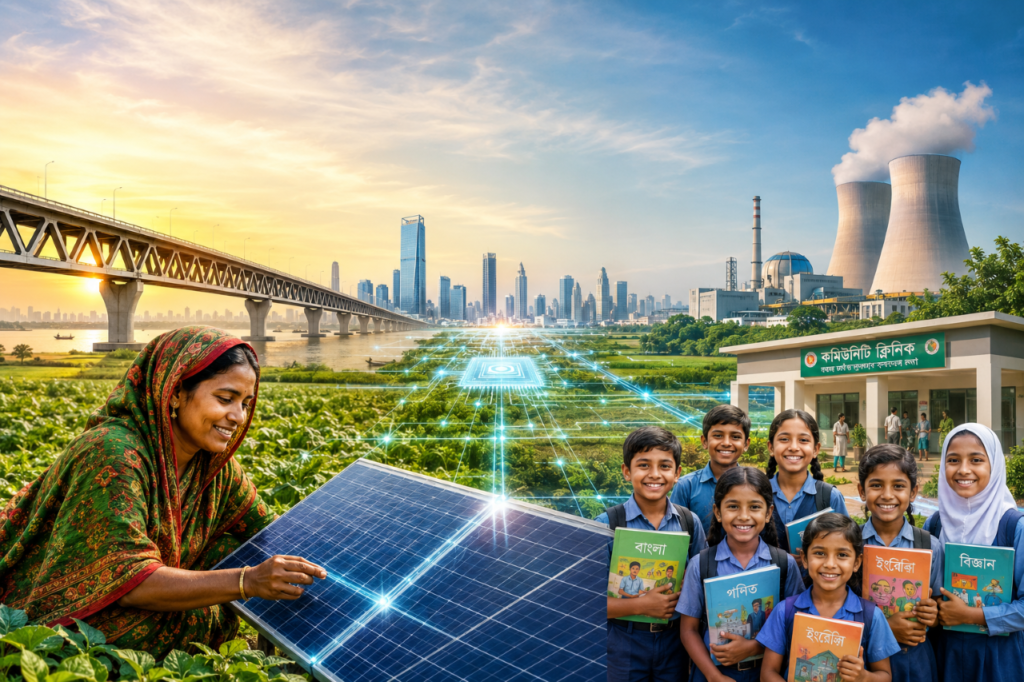
Initiative-1: My House My Farm & Palli Sanchay Bank
Poverty Alleviation and Sustainable Development: The ‘My House My Farm’ project (formerly the ‘One House One Farm’ project) has now become a successful model for transforming the fortunes of the rural poor. The core vision of this project is to turn every household into a hub of economic activity, generate independent capital, provide savings grants through courtyard meetings, boost agricultural production via micro-investments, and ensure sustainable livelihoods.
The Historic Journey of Palli Sanchay Bank: To provide sustainability to this project and offer institutional protection for savings, the ‘Palli Sanchay Bank Act’ was passed in 2014. Consequently, ‘Palli Sanchay Bank’ commenced its formal banking operations on 1 July 2016. The funds of field-level cooperative societies, members’ savings, and project assets are being transferred to this specialised bank. The rural poor who benefit from the project own 49% of the bank’s total shares, while the government owns the remaining 51%.
Financial and Social Success (2020-21): This cooperative-based micro-savings model has significantly increased the annual income of participating families alongside building their own capital. According to government evaluations, the proportion of low-income or extreme-poor families in the project areas has dropped substantially from 15% to a mere 3%. Millions of people are directly reaping the benefits of this financial inclusion through over a hundred thousand village development societies nationwide.
Initiative-2: Ashrayan Project
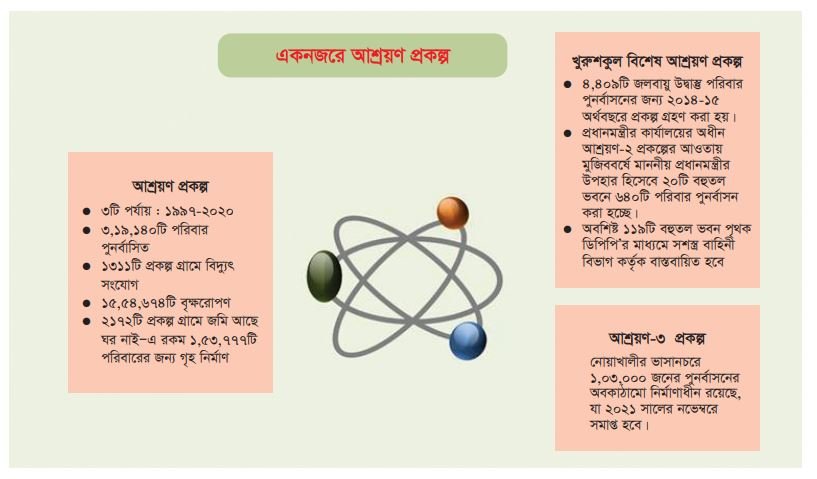
Rehabilitation of Rootless and Landless People: The primary objective of the ‘Ashrayan Project’ is the permanent rehabilitation of destitute, landless, homeless, and rootless families affected by cyclones, river erosion, and natural disasters. It does not merely guarantee housing; rather, it establishes people’s fundamental rights and social dignity.
Historical Background: On 20 February 1972, the Father of the Nation, Bangabandhu Sheikh Mujibur Rahman, initiated the ‘Guchchhagram’ (Cluster Village) project at Char Poragachha in the then Noakhali (now Ramgati Upazila under Lakshmipur District) to rehabilitate cyclone-affected people. Following that visionary precedent, Prime Minister Sheikh Hasina set up the ‘Ashrayan Project’ in May 1997 to sustainably rehabilitate families left homeless by a devastating cyclone that struck Cox’s Bazar and adjacent coastal areas.
Joint Execution by the Armed Forces and Local Administration: This project is being implemented under the direct supervision of the Prime Minister’s Office and through the comprehensive coordination of the local district and upazila administrations. The complex and challenging task of constructing physical infrastructure and barrack-based rehabilitation is being carried out highly successfully by the Bangladesh Armed Forces (Army, Navy, and Air Force).
Loans, Training, and Self-Reliance: The responsibility does not end with merely providing a house to the rehabilitated poor families. Reclaimed men and women receive technical training for various productive and income-generating activities. Concurrently, incorporating them into cooperative societies and providing interest-free microloans to make them economically self-reliant is a key feature of this project.

Initiative-3: Digital Bangladesh
Hassle-Free and Transparent Services at the Doorstep: The core goal of this vision is to deliver IT-based state services (e-Services) to the doorsteps of the citizens. This brings dynamism to government operations and ensures citizen benefits with total transparency, in the shortest possible time, and at an affordable cost, entirely free from harassment, corruption, or the influence of middlemen.
Infrastructure and Internet Services: Under this initiative, the expansion of the nationwide optical fibre network and 4G technology has brought mobile and high-speed internet services within reach of the common man. To extend the benefits of information technology to the grassroots, a ‘Union Digital Centre’ (UDC) has been established in every union of the country.
Information Portal and National Helpline: To consolidate all government information, forms, and services onto a single platform, the ‘National Web Portal’ (bangladesh.gov.bd)—one of the largest portals in the world—has been launched. Furthermore, through toll-free national helplines such as 333 (National Information and Service), 999 (Emergency Services), and 105 (National Identity Card Services), citizen services and the right to information have been given institutional shape.

Initiative-4: Education Assistance Programme
Historical Continuity in the Expansion of Education: The Father of the Nation, Bangabandhu Sheikh Mujibur Rahman, gave the highest priority to education, and under his directives, 36,165 primary schools were nationalised simultaneously in war-ravaged independent Bangladesh in 1973. Maintaining that historical continuity, Prime Minister Sheikh Hasina launched the special ‘Education Assistance Programme’ initiative to secure the academic life of poor and meritorious students deprived of education due to a lack of funds.
Financial Inclusion and Gender Equality: The primary objective of this programme is to bring 100% of school-aged children into classrooms, prevent dropouts, and provide stipends to students. To achieve this goal, the Prime Minister’s Education Assistance Trust (PMEST) was established. It ensures tuition-free education for female students up to the twelfth grade, provides general stipends at the secondary and higher secondary levels, and offers stipends and tuition fees to underprivileged, meritorious students at the undergraduate (Pass) and equivalent levels.
Digital and Modern Education System: Alongside upgrading conventional institutional frameworks, an IT-driven modern education system has been introduced in the country. Under this framework, ‘Sheikh Russell Digital Labs’ have been set up in thousands of secondary and higher secondary educational institutions, and classrooms have been equipped with multimedia and internet connectivity.
Book Festival and Development of Plains-Based Small Ethnic Groups: Since 2010, the historic ‘Book Festival’ has been ensured on 1 January every year, delivering completely free textbooks to all students from pre-primary to secondary levels. Consequently, the literacy rate of the country rose to 74.66% during that period. Additionally, under a special programme titled “Development Assistance for Special Areas (excluding CHT)” executed by the Prime Minister’s Office, large-scale grants are being directly distributed to students from small ethnic groups in the plains for education scholarships, bicycles, and educational materials.

Initiative-5: Women’s Empowerment
Establishment of Rights and Partnership in Decision-Making: The core objective of this initiative is to eliminate all forms of discrimination in social, economic, and political spheres, thereby creating equal rights and opportunities for women to participate in the mainstream of national life. Women’s involvement in family and social decision-making is being increased, and their political empowerment is being ensured at policy-making levels, from local government to the National Parliament.
Legal and Policy Protection: To ensure the comprehensive and sustainable development of women and to prevent all forms of violence against them, the government has created a groundbreaking legal framework. Notable among these are the ‘National Women Development Policy 2011’, the ‘Domestic Violence (Prevention and Protection) Act 2010’, the ‘Domestic Violence (Prevention and Protection) Rules 2013’, the ‘Deoxyribonucleic Acid (DNA) Act 2014’ (which aids in offender identification), and the ‘Child Marriage Restraint Act 2017’.
Rural Mother Centres and Microloans: To empower underprivileged women in rural and marginal areas, operations are being conducted through 12,956 ‘Rural Mother Centres’ (RMC) across the country. Through these centres, rural mothers are made aware of education, health, nutrition, maternal and child care, and reproductive health, while interest-free microloans are provided for small businesses and self-employment.
Maternity Benefits and Gender Budgeting: Paid maternity leave for working women has been successfully extended from 4 months to 6 months. Furthermore, to ensure equal rights and gender parity in every sector of the state and all spheres of public life, the current government has been progressively formulating and implementing a ‘Gender-Responsive Budget’ since the 2009-10 financial year.

Initiative-6: Electricity in Every House
Socio-Economic Development and Rural Economy: Achieving national growth (GDP), rapid industrialisation, poverty alleviation, and socio-economic and human resource development has driven the government to accord the highest priority to bringing electricity to every household. Beyond providing illumination, this programme serves as the primary engine for expanding Small and Medium Enterprises (SMEs) and modern irrigation systems in rural areas.
Production Capacity and 100% Electrification (2021 Context): Since assuming office in 2009, the far-sighted and resolute leadership of Prime Minister Sheikh Hasina has brought about an unprecedented and revolutionary transformation in the country’s power generation, transmission, and distribution systems. Including captive power and renewable energy, the country’s power generation capacity has touched the milestone of 25,000 MW. By combining both grid and off-grid (hilly and riverine island/char areas) methods, it has been possible to bring 100% of the population under the electricity network.
Expansion of Renewable Energy: Alongside conventional fossil fuels (gas and coal), over 6 million ‘Solar Home Systems’ have been installed in off-grid char areas and remote regions under eco-friendly and renewable energy policies. Additionally, a green energy network is being developed through windmills in coastal regions and biogas technology on various farms.
Entering the Era of Nuclear Power: To meet the growing energy demand of the country and as part of energy diversification, the construction of the mega project ‘Rooppur Nuclear Power Plant’ in Ishwardi, Pabna, is progressing at a rapid pace. Through this, Bangladesh is set to attain the proud distinction of joining the prestigious ‘Nuclear Club’ as its 33rd member country on the international stage.

Initiative-7: Community Clinics & Mental Health
A Revolutionary Model of Primary Healthcare: The main purpose of this programme is to ensure integrated primary healthcare, maternal care, and nutrition at the doorsteps of the rural poor and marginalised populations. This innovative model by Prime Minister Sheikh Hasina has been acclaimed worldwide and has received recognition from the United Nations as an exemplary public health model.
Integrated Medical Services and Referral System: Through these clinics, antenatal care (ANC) and postnatal care (PNC) for expectant mothers, as well as the distribution of modern reproductive health and family planning methods, are ensured. Furthermore, the registration of newlyweds and pregnant mothers, birth and death registration, and counselling on nutrition (including micronutrients) for mothers and children are provided. A well-defined ‘Referral System’ has been introduced to send patients to Upazila Health Complexes or District Sadar Hospitals for advanced treatment should complex health issues arise.
Grassroots Network and Free Medicines: To provide healthcare within arm’s reach of rural people, nearly 14,000 (13,861 functioning at the time) community clinics are being successfully operated nationwide. Working on a Public-Private Partnership (PPP) model, there is one community clinic for roughly every 6,000 people in rural areas, from which about 30 different types of life-saving and essential medicines are provided completely free of charge to the underprivileged rural population.
Mental Health Awareness and Index Improvement: Mental health and autism awareness have now been integrated into this initiative, securing primary understanding and care regarding mental health at the grassroots level. As a direct result of this intensive healthcare network, the maternal mortality ratio in the country has dropped from 194 to 169 per hundred thousand live births, the infant mortality rate has decreased significantly, and the average life expectancy of the population has risen to 72.8 years.

Initiative-8: Social Security Programme
Inclusive Growth and Poverty Alleviation: In light of the philosophy of the Father of the Nation, Bangabandhu Sheikh Mujibur Rahman, the primary objective of all economic and development activities of the government is poverty alleviation. Following the assumption of office by the government under the leadership of Prime Minister Sheikh Hasina in 2009, policy strategies aimed at achieving ‘Inclusive Growth’ were adopted. Consequently, the momentum of the country’s macroeconomy accelerated over the past decade, alongside a steady decline in the poverty rate.
Historic Statistics of Poverty Reduction: According to the Household Income and Expenditure Survey (HIES) by the Bangladesh Bureau of Statistics (BBS), the overall poverty rate in the country fell from 31.5% to 24.3% between 2010 and 2016. During the same period, the extreme poverty rate dropped from 17.6% to 12.9%. Following this trend, estimates from the ‘Sustainable Development Goals (SDG): Bangladesh Progress Report 2020’ indicate that the overall poverty rate came down to 20.5% and the extreme poverty rate to 10.5% in 2019.
Eradication of Inequality and Strategic Wisdom: During the transition period of graduating from a Least Developed Country (LDC) to a developing economy, there is commonly a risk of widening disparity between the rich and the poor. To tackle this challenge and integrate poor and marginalised populations into the mainstream of society, the Prime Minister demonstrated wisdom and foresight by including the social security programme in her list of priorities. Various independent evaluations have shown that without this well-organised Social Safety Net, the poverty rate in the country would have been at least 1.5% higher.
Budget Allocation and Ensuring Equity: Since 2009, the government has consistently increased the coverage, number of beneficiaries, and budget allocation for social security programmes. In the 2020-21 financial year, approximately BDT 95,574 crore was allocated to activities under the social security sector, representing 16.83% of the total budget and 3.01% of the GDP. This programme does not merely provide cash or food assistance; rather, it prioritises various productive ‘Employment Generation’ programmes to prevent beneficiaries from becoming averse to work. Alongside this, regional disparity is being mitigated by ensuring area-based equity.
National Social Security Strategy (NSSS): To ensure effective coordination, good governance, and social equity across all social security operations, the government formulated the ‘National Social Security Strategy’ (NSSS) in 2015. The core foundation of this strategy is the formulation and execution of a ‘Life-Cycle Based Social Security Programme’ to address specific risks from birth to old age. Research shows that if this life-cycle model is fully implemented, the poverty rate can be reduced by an additional 4.7%. With this objective, the government has digitalised various schemes—including old-age allowances, allowances for widows and deserted women, and allowances for the financially insolvent disabled—delivering them directly to beneficiaries’ bank or mobile accounts via the ‘G2P’ (Government-to-Person) system.

Initiative-9: Investment Advancement
Investment-Friendly Environment and Groundbreaking Policies: Owing to its geographical position and massive domestic market, Bangladesh is a country of immense potential. Upon assuming office, Prime Minister Sheikh Hasina took several groundbreaking steps to attract domestic and foreign investment through legal reforms, policy support, and improvements in the Ease of Doing Business index.
Mega Infrastructure and New Horizons of Connectivity: Exceptional development in the power, ICT, and communication sectors has opened new doorways for investment. To contribute to the country’s GDP growth, construction work is advancing rapidly on numerous small and large infrastructural projects. These include the country’s largest-ever mega-project, the Padma Multipurpose Bridge, the Dhaka Mass Rapid Transit (Metro Rail), the Dhaka Elevated Expressway, the ‘Bangabandhu Sheikh Mujibur Rahman Tunnel’ beneath the bed of the Karnaphuli River in Chittagong, and the Payra Port, the nation’s third seaport.
Ensuring Energy Security: To ensure an uninterrupted supply of gas and fuel to industrial factories, the implementation of the country’s first two floating LNG terminals (FSRU—each with a daily capacity of 500 million cubic feet) has already been successfully completed at Maheshkhali in Cox’s Bazar.
Modernising the Communication Network: Major economic corridors and highways in the country have been upgraded to four lanes. Alongside this, to add a new dimension to the country’s transport system, the ‘Father of the Nation Bangabandhu Sheikh Mujibur Rahman Highway’ (Expressway)—the nation’s first international-standard expressway—has been constructed from Dhaka to Bhanga in Faridpur. To modernise the rail network, 330 km of new railway lines have been constructed and 1,135 km of railway lines have been renovated or rebuilt over the past decade. Consequently, freight transport and logistics system management have become significantly easier both internally and for import-export purposes.
State-of-the-Art Seaports and Blue Economy: The country’s primary gateways, Chittagong Seaport and Mongla Seaport, have been developed into state-of-the-art and automated terminals, functioning as transit hubs for regional trade.
Economic Zones (EZ): With a view to planned industrialisation, the establishment of 100 special economic zones across the country is underway. Under the Bangladesh Economic Zone Authority (BEZA), industrial production has already commenced in 13 economic zones, while a further 15 are under construction. Additionally, 20 industrial enterprises have successfully begun commercial production in private economic zones.
Historic Milestone in Foreign Direct Investment (FDI): As a benefit of economic stability, Foreign Direct Investment exceeded USD 1 billion (100 crore) for the first time in 2009. Reflecting long-term continuity, it surpassed USD 2 billion in 2015, and according to recent data from Bangladesh Bank and BIDA, the annual FDI inflow currently stands at a peak of USD 3.89 billion.

Initiative-10: Environmental Protection
Sustainable Environment and Ecosystem Conservation: The central objective of this initiative is to ensure a habitable and safe environment through the conservation of ecosystems and biodiversity, environmental pollution control, addressing climate change risks, scientific research, plant surveys, and the development of sustainable forest resources.
Scientific Management and Climate Resilience: A climate-resilient environment is being built for the present and future generations through the application of scientific and appropriate technologies. Under this framework, activities aimed at expanding total forest coverage, constructing a coastal green belt, identifying biodiversity, alleviating poverty through social forestry, and preventing environmental pollution have been energised.
Statistics on the Growth of Forest Land and Tree Coverage: According to official data published by the Forest Department, effective government policies have increased the extent of state-controlled forest land from just 7–8% in 2005-06 to 15.58% of the country’s total area. Furthermore, as a result of an extraordinary expansion of social forestry, roadside and embankment plantations, and homestead trees, 22.37% of the country’s total geographical area has been successfully blanketed in tree coverage.
International Recognition and Leadership: In recognition of her visionary and pioneering role on the global stage in addressing climate change risks, environmental protection, and sustainable development, the United Nations Environment Programme (UNEP) bestowed its highest environmental accolade, the ‘Champions of the Earth’ award, upon Prime Minister Sheikh Hasina in 2015. Moreover, Bangladesh set a unique example on the world stage by establishing the ‘Bangladesh Climate Change Trust Fund’ (BCCTF) using its own domestic resources.
Overall
These 10 Special Initiatives of Prime Minister Sheikh Hasina directly guarantee the fundamental rights of the ordinary people of this country, such as food, clothing, shelter, education, and healthcare. Concurrently, by integrating an uninterrupted power supply and information technology, they streamline and modernise public services, delivering them straight to citizens’ doorsteps. Institutional steps have been taken to eliminate discrimination at every stratum of society through the groundbreaking expansion of social security programmes and the political and economic empowerment of women.
Alongside these efforts, development of mega-infrastructure and investment-friendly services are attracting foreign direct investment (FDI), generating massive employment opportunities across the country and playing a central role in rapidly reducing the poverty rate. Furthermore, because climate resilience, sustainable environmental development, and ecosystem conservation are given special prominence in each of these initiatives, they significantly advance Bangladesh towards achieving the United Nations ‘Sustainable Development Goals’ (SDGs) by 2030. These 10 special initiatives are currently playing a pivotal role in attaining the ultimate objectives of becoming a dignified middle-income country by 2021 and a developed, prosperous Bangladesh by 2041.
See Also: