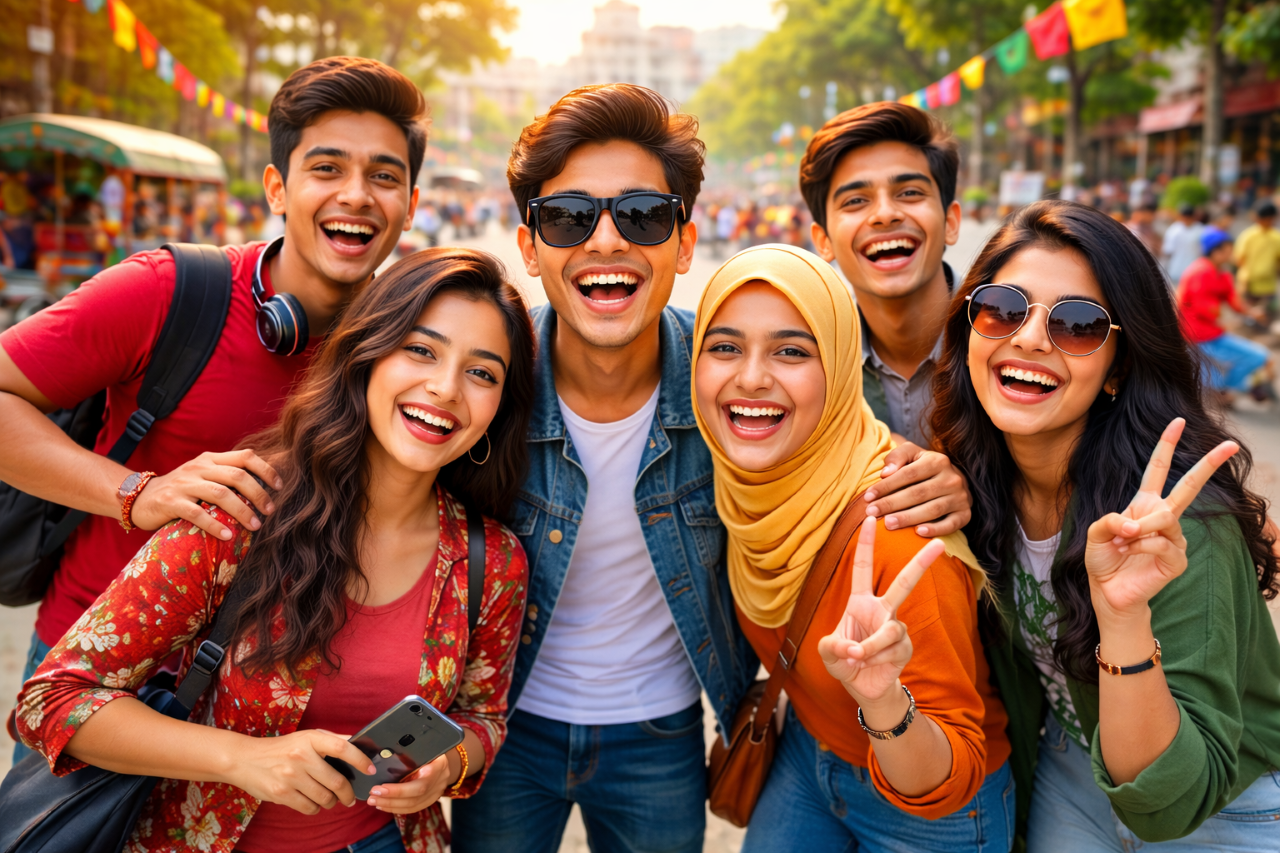
Whenever discussions arise about youth culture in Bangladesh, a familiar accusation quickly surfaces: “Indian cultural aggression.” This claim has been repeated so often that it has almost hardened into an unquestioned truth. Yet, in reality, it frequently fails to explain the actual cultural behaviour of today’s young people. In the everyday lives of Bangladeshi youth—their language, taste, entertainment, clothing, and even patterns of thought—it is increasingly difficult to find traces of classical Indian culture. More often than not, this accusation functions as a convenient excuse, allowing us to shift responsibility for our own cultural decline, educational crisis, and erosion of taste onto an external “other”.
This raises an uncomfortable but necessary question: is Indian culture really the dominant force shaping Bangladeshi youth today, or are we living under a different, deeper, and far more dangerous form of cultural hegemony?
Table of Contents
Cultural Hegemony: Rule by Consent, Not Force
Cultural hegemony refers to a form of dominance that operates not through coercion, but through consent. The Italian Marxist thinker Antonio Gramsci famously articulated this concept, arguing that ruling groups maintain power by shaping how people think, what they desire, and what they come to see as “normal” or “modern”. Under hegemony, people are not forced to comply; rather, they willingly internalise dominant values, believing them to be natural, inevitable, or aspirational.
In the contemporary world, cultural hegemony works most effectively through media, education systems, entertainment industries, and above all, digital platforms. The images, narratives, lifestyles, and languages that young people encounter relentlessly begin to construct their mental landscapes. Over time, these influences quietly redefine their sense of identity, aspiration, and belonging.
Who Are the Hegemons Today?
In today’s globalised order, hegemony is no longer exercised solely by states. Instead, it is driven by global corporations, social media platforms, pop-culture industries, and religious–political influence networks. Algorithms on Netflix, Instagram, YouTube, and TikTok play a decisive role in determining what young people watch, listen to, desire, and imitate. As a result, access to alternative cultural practices—or deeper, reflective cultural engagement—gradually shrinks.
Bangladesh is no exception. However, the nature of cultural hegemony here is neither uniform nor linear. It is fragmented and deeply shaped by class.
Class-Based Cultural Dominance
Among affluent and upper-middle-class Bangladeshi youth, everyday cultural life is overwhelmingly shaped by Western pop and consumer culture. Hollywood films, streaming-platform series, global brand lifestyles, and Instagram-driven beauty standards have become markers of modernity. Meanwhile, a large segment of economically disadvantaged youth inhabits a different ecosystem—one dominated by Facebook and TikTok—where virality itself is the ultimate achievement, and speed and spectacle matter far more than substance.
Between these two spheres lies yet another powerful influence: a visually driven religious culture shaped by Arab, Pakistani, and Bollywood aesthetics. Hijabs, niqabs, Pakistani lawn fabrics, and heavy stylised makeup increasingly function as symbols of identity. Yet these trends rarely emerge from a deep engagement with religious or historical traditions; rather, they are mediated, stylised imitations circulated through screens.
Indian Culture: Real Influence or Convenient Villain?
So where does Indian culture actually stand in all this? The truth is that most Bangladeshi youth today are largely disconnected from India’s classical cultural traditions—its music, literature, theatre, or philosophical heritage. Rabindranath Tagore, Kazi Nazrul Islam, or modern Indian literary figures are virtually absent from their reading worlds. What is often labelled “Indian influence” is primarily Bollywood’s globalised pop culture, which itself is a hybrid consumer product with only superficial connections to India’s deeper cultural roots.
Yet blaming Indian culture remains politically and emotionally convenient. It spares us from the more difficult task of confronting our own cultural failures.
The Most Dangerous Hegemony: The Rule of Ignorance and Crudeness
The most rapidly expanding form of cultural hegemony in Bangladesh today is not rooted in any foreign civilisation. It is, rather, the elevation of ignorance and cultural crudeness as something “authentic”, “real”, or even “resistant”. Reading books is increasingly dismissed as elitist, refined language is mocked as pretentious, while profanity-laden speech, vulgar humour, and exaggerated performance are celebrated as honest and relatable.
What makes this phenomenon especially alarming is the way it is often justified in the name of resisting Indian cultural influence. As if studying, cultivating artistic sensibility, or preserving linguistic elegance automatically means submission to foreign dominance. In this logic, intellectual refinement itself becomes suspect.
This is not cultural resistance; it is cultural self-sabotage.
Ignorance Is Not Culture
Ignorance has no nationality. It has no relationship to Indian, Pakistani, or Arab culture. The behaviour of uneducated populations in any country does not constitute culture, heritage, or tradition—nor is it something worth emulating. Culture is built through literature, music, philosophy, language, and sustained intellectual labour. Depth is not accidental; it must be cultivated.
Yet today, a significant portion of Bangladeshi youth neither reads Tagore nor Nazrul, neither Syed Shamsul Haq nor even Farrukh Ahmad. Those who claim to represent “Islamic culture” often do not know Arabic, have never engaged with contemporary Arabic literature, and possess little understanding of Islam’s intellectual tradition. Urdu is frequently imagined as an “Islamic language”, yet many cannot read Nastaliq script, understand classical Urdu poetry, or name a single marsiya or afsana.
Similarly, admiration for qawwali often remains superficial. There is little understanding of its musical grammar—its ragas, taals, bols, or lyrical philosophy. What exists is not cultural practice but symbolic imitation, stripped of knowledge.
As a result, young people fail to become genuine carriers of any culture at all.
Western Pop and Consumer Culture: A False Image of Modernity
If one examines the everyday lives, aspirations, and tastes of youth from affluent Bangladeshi families, it becomes clear that the most dominant cultural force shaping them is American and Western pop-consumer culture. Here, culture does not appear as humanistic practice, but as a bundle of commodities, brands, and lifestyles.
What to wear, what to eat, what to watch, how to speak—even how to express emotion—is dictated by global marketing and digital media. Modernity becomes synonymous with English accents, Western fashion, streaming-platform aesthetics, and brand-based identity. Ironically, due to shallow engagement, even this “modernity” is often poorly understood and weakly internalised.
The problem emerges when this borrowed modernity begins to devalue local language, literature, and artistic expression. Listening to Bangla music or reading Bangla books is framed as outdated, while binge-watching Netflix series for hours is perceived as progressive.
It is important to note that this Western influence carries little philosophical or ethical depth. It is fundamentally consumerist—teaching young people how to consume, but not how to think.
Social Media Algorithms: Factories of Poor Taste
Alongside Western pop culture, social media algorithms now function as the most aggressive cultural educators of Bangladeshi youth. Instagram Reels, YouTube Shorts, and TikTok are no longer merely platforms of entertainment; they actively shape cultural values and linguistic norms.
Algorithms reward content that captures attention quickly—often vulgar, sensational, or hateful. Young users learn, almost unconsciously, that profanity, sexual innuendo, ridicule, and public humiliation attract likes and followers. Gradually, a dangerous equation forms: shock equals success.
This process systematically erodes linguistic refinement. Once, speaking polished Bangla was considered a marker of dignity. Today, it is often ridiculed as artificial or insincere, while coarse, slang-heavy speech is celebrated as “real”. This is not organic cultural evolution—it is algorithmic conditioning.
K-pop and K-drama: Not Just Innocent Entertainment
The popularity of K-pop and K-dramas is often dismissed as harmless fun. In reality, it represents a highly structured cultural export strategy—one actively promoted by the South Korean state as a tool of soft power. Its impact on Bangladeshi urban youth is undeniable.
The issue is not listening to K-pop or watching Korean dramas. The issue arises when this fandom displaces local cultural engagement entirely. Beauty standards, emotional expression, romantic expectations—even self-worth—begin to align with foreign templates, while Bangla music, poetry, and theatre remain unexplored.
As local cultural roots weaken, fictional idols and imported narratives rush in to fill the void.
Where Did Bangla Culture Lose Its Ground?
Amid all these competing influences, the most tragic outcome has been the steady disappearance of Bangla and Bengali cultural dominance from the lives of young people. In the 1990s, Bangladeshi band music played a defining role in shaping youth consciousness. Lyrics addressed social frustration, political disillusionment, love, resistance, and identity. Solo artists were household names. Songs were not background noise; they were part of public conversation.
Television drama was equally powerful. Characters such as Bakar Bhai, Helal, Shimu Bhabi, Nilu, Arman Bhai, or Mofiz were not merely fictional figures; they became social reference points. People discussed them in tea stalls, living rooms, and classrooms. Drama once produced living metaphors through which society understood itself.
Today, much of that influence has evaporated. A large section of today’s youth does not even recognise these names. Bangla drama has largely lost its ability to create culturally resonant characters, while music struggles to compete with algorithm-driven global content. This is not simply a technological shift; it reflects a deeper erosion of cultural ecosystems.
The Collapse of Middle-Class Cultural Life
At the heart of this decline lies the collapse of middle-class cultural institutions. There was a time when learning music, painting, recitation, or participating in debate clubs and theatre groups was considered an essential part of upbringing. Schools and colleges functioned as centres of cultural preparation, not merely examination factories.
Annual cultural programmes, literary gatherings, drama festivals, and institutional debates once demanded months of preparation. These activities cultivated discipline, taste, patience, and collective creativity. Today, much of that infrastructure has either disappeared or become ceremonial.
The middle-class household itself has changed. Cultural training now appears expendable, while digital consumption fills the void. The result is a generation highly exposed to images but poorly equipped to interpret them.
Culture Requires Preparation, Not Just Access
One uncomfortable truth must be acknowledged: good culture demands effort. Appreciating music requires listening skills. Understanding literature requires reading. Theatre requires patience. Art requires trained perception. None of these are instant.
Yet the dominant cultural environment teaches young people the opposite—that everything should be quick, effortless, and visually impressive. As a result, culture becomes performance rather than practice. Books are photographed, not read. Concerts are recorded, not experienced. Cultural identity is displayed, not cultivated.
This shift explains why symbolic gestures now replace genuine engagement. Cultural consumption has become shallow, aestheticised, and transactional.
Anti-India Rhetoric as Cultural Shortcut
In this context, attacking India—or Pakistan or the Arab world—becomes a convenient shortcut to perform nationalism. It requires no intellectual labour, no cultural creation, no engagement with one’s own history. Loud rejection replaces thoughtful construction.
Critiquing Indian state policy or political dominance is entirely legitimate. But equating cultural refinement with foreign submission is intellectually dishonest. Rejecting Rabindranath Tagore does not produce a new Bengali culture. Mocking linguistic sophistication does not create authenticity.
What emerges instead is a cultural vacuum—quickly filled by vulgar humour, aggressive language, and borrowed aesthetics.
Religion as Performance, Not Knowledge
Another deeply troubling development is the use of religious identity to legitimise cultural illiteracy. Many who claim to represent Islamic culture lack even basic familiarity with Islam’s intellectual heritage. Arabic is not understood, contemporary Arabic writers remain unread, and classical Islamic philosophy is largely unknown.
Urdu is often romanticised as a sacred language, yet few can read Nastaliq script or understand classical poetry. Qawwali is admired, but its musical structure and poetic depth remain unexplored. What exists is not religious culture but surface-level symbolism.
This reduction of faith into visual markers and slogans weakens both religion and culture.
The Real Loss: Intellectual Confidence
Perhaps the greatest casualty of this entire process is intellectual confidence. When a society loses faith in its ability to think, read, debate, and create, it becomes dependent on borrowed identities. Young people oscillate between Western consumerism, social media vulgarity, imported pop culture, and empty nationalism—without anchoring themselves anywhere.
The tragedy is not that Bangladeshi youth are exposed to global culture. The tragedy is that they are not equally grounded in their own.
The Way Forward: Building a New Cultural Hegemony
Cultural hegemony cannot be dismantled by slogans; it must be replaced. If Bangla culture is to regain influence, it must be reintroduced as intellectually vibrant, modern, and dignified. This requires deliberate effort.
Bangla must function as a language of contemporary knowledge. Literature must be made relevant to young lives. Music, theatre, and visual arts must return to public spaces. Cultural confidence must be rebuilt—not through hostility toward others, but through creative excellence.
Patriotism is not proven by insulting neighbours. It is proven by enriching one’s own language, art, and thought.
The Choice Before Us
Bangladesh’s youth stand at a crossroads. One path leads toward deeper immersion in ignorance disguised as authenticity. The other demands effort—reading, learning, creating, and cultivating taste.
Cultural hegemony will exist regardless. The only question is which one we choose to live under.
If we want a future that is intellectually alive, emotionally mature, and culturally confident, we must consciously construct a refined, creative, and educated Bengali cultural hegemony. There is no easier alternative—and no more urgent task.