An Index of Raga and Their Musical Notes

In various treatises and scholarly studies on Hindustani classical music, the names of over 1,800 rāgas can be found. With …
Asurer Suralok Jatra (Journey of an Untrained Soul into the Realm of Melody) is a reflective and exploratory series by Sufi Faruq Ibne Abubakaer, documenting his personal journey into the world of Indian classical music. Originally conceived under the title “Gaan Kheko” (“The Song Devourer”), the series evolved into a broader attempt to make the vast and often intimidating universe of classical music approachable for curious listeners.
Rather than presenting itself as an academic treatise, the series reads like a listener’s diary—a candid account of discovery, confusion, fascination, and gradual understanding. Drawing from his own experience as a late learner and devoted listener, the author explains how one might begin to listen to, recognise, and enjoy Hindustani classical music, even without formal training.
Throughout the series, Sufi Faruq Ibne Abubakaer introduces readers to the fundamentals of raga, tala, gharana, musical forms, and listening practices, while also sharing stories, references, and personal reflections gathered during his musical exploration. His goal is not to teach classical music in the traditional sense, but to guide fellow listeners—especially beginners—towards developing an attentive ear and a deeper appreciation of the art.
In essence, Asurer Suralok Jatra is both a personal musical pilgrimage and a listener’s guide, inviting readers to embark on their own journey into the rich and intricate world of Indian classical music.
In various treatises and scholarly studies on Hindustani classical music, the names of over 1,800 rāgas can be found. With …

Hindustani Classical Music Therapy ‘Index Insomnia Abhogi Bageshri Malkauns Darbari-Kanada Hindustani Classical Music Therapy Index Stress Relief Yaman Abhogi Marwa …
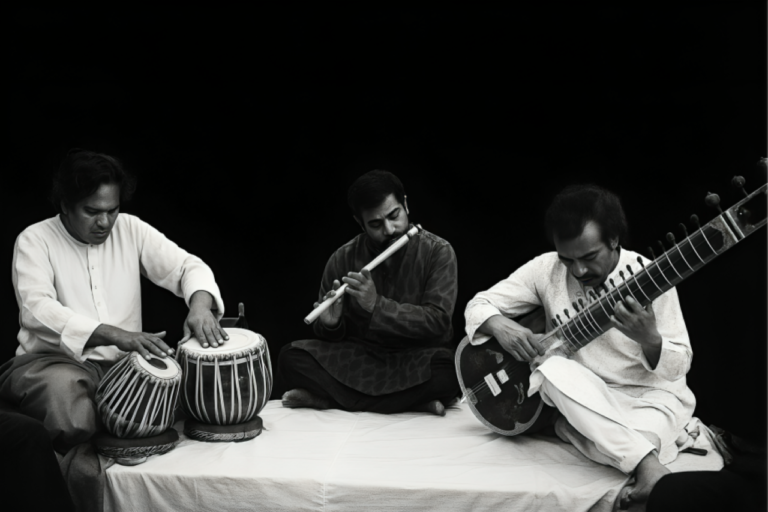
In Indian classical music there is a well-known saying: “Taal is the father, and melody is the mother of music.” …
Indian Classical Music is an unfathomable ocean, where every wave conceals a unique Raga. These Ragas are not merely a …
I consider myself a happy person. In the balance sheet of life—in the accounting of fulfilment—the small two-syllable word happiness …
Why should one listen to classical music? This question may well have crossed your mind, just as it once crossed …
What does it truly mean to listen to classical music? In the simplest possible terms, the answer is: you listen …
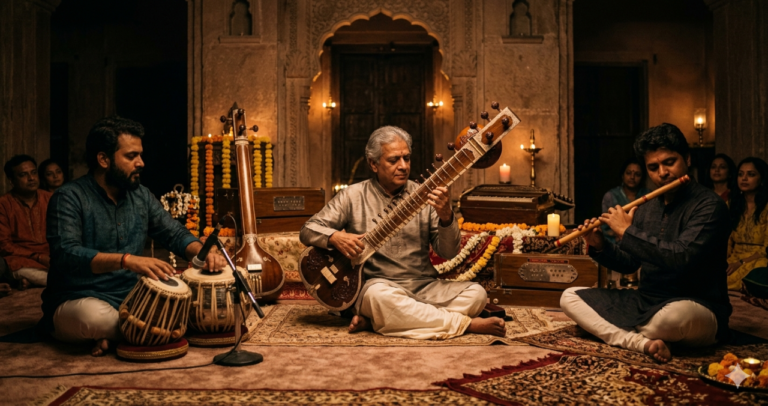
The soul of music lies in the swara (musical note). Without swara, music itself would be inconceivable. Just as language …
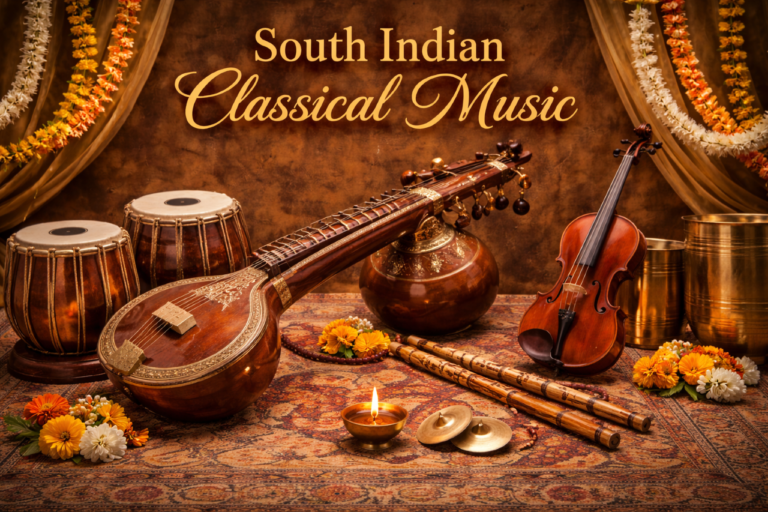
South Indian classical music is commonly known as Carnatic music. While the musical system that evolved in North India came …
In the vast world of music, the intricate weaving of melody rests upon a fundamental structure known as the octave, …