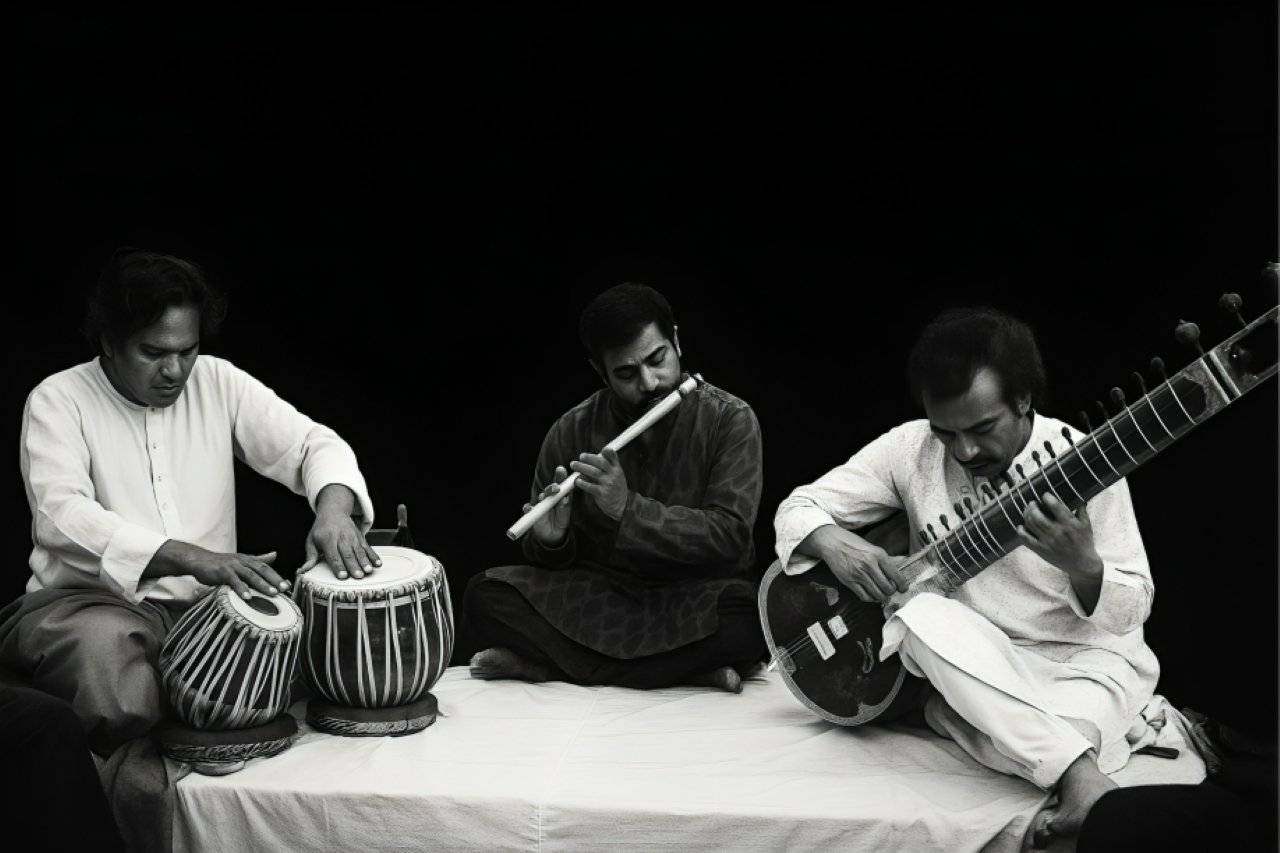
In Indian classical music there is a well-known saying: “Taal is the father, and melody is the mother of music.” In other words, while melody breathes life into music, taal provides it with discipline and structure. At the heart of taal lies laya, or tempo. Understanding the intricate theory of rhythm is not essential for simply enjoying a piece of music; however, for those who wish to appreciate the deeper workings of the art, familiarity with these ideas can be greatly rewarding. Knowledge of the various rhythmic classifications is not strictly necessary for listening, but readers who are curious may certainly explore them.
Table of Contents
Taal, Theka, and Laya
What is Taal?
Taal is the fundamental rhythmic framework of Indian classical music and dance. It divides musical time into measured and recurring units and determines the relative weight or emphasis of different parts of a rhythmic cycle. Simply put, taal is the structured organisation of musical time, through which melody and rhythm advance in a regulated flow.
Laya (Tempo)
The speed or movement of music is known as laya. How swiftly or slowly a composition unfolds depends upon its tempo. Traditionally, laya is divided into three principal categories:
- Vilambit Laya – slow tempo
- Madhya Laya – medium tempo
- Drut Laya – fast tempo
Madhya laya is generally considered to move at roughly twice the pace of vilambit and half the speed of drut. Some scholars, however, recognise more nuanced subdivisions of tempo—such as aar, kuar, and biar—which are formed through fractional divisions of the basic rhythmic unit.
Matra (Beat)
The smallest unit used to measure musical time or tempo is called a matra, or beat. The interval between each matra remains equal and consistent. A number of such rhythmically organised matras together form a taal cycle.
In essence, taal is the arrangement of a fixed duration of time into evenly spaced smaller units, organised rhythmically and repeated through the playing of percussion instruments.
Rhythm and Nature
If one observes the natural world, it becomes evident that everything unfolds in rhythm. The alternation of day and night, the changing of the seasons, even the beating of the human heart—each follows an invisible rhythmic order. Perhaps this is why rhythm feels so natural and pleasing to us.
A simple example may be found in travel by train. The steady, repetitive sound of the train’s movement often lulls passengers into sleep because its motion follows a consistent rhythmic pattern. Yet when the brakes are suddenly applied, we are startled, for the rhythm is abruptly broken. In much the same way, taal is the lifeblood of music, and any disruption of it can feel unsettling to the listener.
Divisions of Taal: Sam and Khali
The total number of matras in a taal is divided into several sections or divisions, which may consist of two or more beats.
- The first beat of the first division of a taal is known as sam.
- Sam is usually marked with the symbol + or X, and it carries particular emphasis during performance.
In certain divisions, the first beat is designated as khali (literally “empty”). This is indicated by the symbol 0. Instead of clapping on a khali beat, the performer marks it with a wave of the hand.
Those divisions whose first beat is marked by a clap are known as taali (or bhari, meaning “full”). In other words, all divisions except the khali begin with a clap.
Avartan (Cycle)
When a rhythmic pattern is performed from the first beat of the taal to the final beat and then returns once again to the beginning, it completes one avartan, or rhythmic cycle. During musical performance, the continuous repetition of these cycles sustains the flow of the taal.
Even-Divided and Uneven-Divided Taals
According to the structure of their internal divisions, taals are generally classified into two categories.
Even-Divided Taal (Samapadi Taal)
Taals whose sections are composed of equal numbers of beats are known as samapadi taals (even-divided rhythmic cycles).
For example, Dadra Taal (6 beats):
Dha Dhi Na | Na Ti Na
Here the beats are divided evenly as 3 + 3.
Other examples of even-divided taals include Kaharba, Teentaal, and Chautal.
Uneven-Divided Taal (Bishamapadi Taal)
Taals whose sections contain unequal numbers of beats are called bishamapadi taals (uneven-divided rhythmic cycles).
For instance, Teora Taal (7 beats):
Dha Dhi Na | Dhi Na | Dhi Na
Here the beats are divided unevenly as 3 + 2 + 2.
Other examples of such taals include Jhaptal and Dhamar.
Tihai
A tihai is a rhythmic phrase or pattern that is repeated three times consecutively and resolves precisely on the sam (the first beat of the cycle). It is considered an important rhythmic ornament in both instrumental and vocal performance.
There are two principal types of tihai:
- Damdaar Tihai – where there is a slight pause or space for breath between the repetitions.
- Bedamdaar Tihai – where the three repetitions are performed continuously without any pause.
Throughout the history of Indian music, countless taals have been created, and many have also faded into obscurity over time. Likewise, there exist numerous forms of percussion instruments associated with these rhythmic systems. However, for a beginner it is not necessary to learn everything at once. Becoming gradually familiar with a few commonly used taals is more than sufficient at the outset. Such familiarity slowly opens the door to the deeper and more fascinating world of rhythm in music.
Various Types of Taal
The rhythmic system of Indian classical music is remarkably rich and varied. Through different arrangements of beats, divisions, and rhythmic patterns, countless taals have been developed over time. Some of these are widely used across many forms of music, while others are less common or largely confined to particular traditions. Below is a brief introduction to several important taals.
Teentaal
Teentaal is one of the most widely used rhythmic cycles in Hindustani classical music. It is a 16-beat even-divided taal, consisting of four sections, each containing four beats (4/4/4/4).
Teentaal includes three claps (taali) and one wave (khali). Because of its three claps, it is often referred to as Teentaal or Tintal, and sometimes also as Tetala.
Distribution of Taali and Khali
- Sam (1) – Clap
- 5 – Clap
- 9 – Khali (wave)
- 13 – Clap
Theka (Basic Rhythmic Pattern)
Dha Dhin Dhin Dha |
2 Dha Dhin Dhin Dha |
0 Na Tin Tin Ta |
3 Tete Dhin Dhin Dha ||
Kaharba Taal
Also known as Kaherwa or Karfā, this taal is extremely popular in lighter forms of music. While Teentaal is often used for 4–4 rhythmic structures in classical performance, Kaharba is the most frequently used rhythm for light music, including folk songs, modern songs, and film music.
It is an 8-beat even-divided taal with a 4 + 4 structure. It contains one clap and one khali.
Theka
Dha Ge Na Ti |
0 Na Ka Dhi Na ||
Another common variation:
Dha Ge Te Te |
0 Na Ka Dhi Na ||
Dadra Taal
Dadra is a 6-beat even-divided taal with a rhythmic structure of 3 + 3. It contains one clap and one khali. The clap falls on the first beat, and the khali occurs on the fourth beat.
Theka
Dha Dhin Na |
0 Na Thun Na ||
Another common form:
Dha Dhi Na |
0 Na Ti Na ||
Khemta Taal
Khemta is also a 6-beat taal, similar in structure to Dadra. It likewise contains one clap and one khali.
Theka
Dhage Kat Ta |
0 Dhage Dhin Dhādha ||
Teora Taal
Teora, sometimes called Teot, is a 7-beat uneven-divided taal. Its sectional structure is 3 + 2 + 2. It usually contains three claps and no khali.
Theka
Dha Den Ta |
2 Tit Kata |
3 Gadi Ghin ||
Another common variation:
Dha Kat Ta |
2 Dhin Dha |
3 Treke Dhin ||
Rupak Taal
Rupak is also a 7-beat uneven-divided taal, with the sectional structure 3 + 2 + 2. However, unlike Teora, Rupak begins with a khali (wave). Typically, it contains two claps and one khali.
Theka (Basic Pattern)
0 Ti Ti Na |
1 Dhi Na |
2 Dhi Na ||
Another variation:
0 Tin Tin Tak |
1 Dhin Dhage |
2 Dhin Dhage ||
Jhaptal
Jhaptal is a 10-beat rhythmic cycle. Its usual sectional arrangement is 2 + 3 + 2 + 3. It contains three claps and one khali.
Theka
Dhin Dha |
3 Dhin Dhin Dha |
0 Kat Ta |
1 Dhin Dhin Dha ||
Ektal
Ektal is a 12-beat even-divided taal. It appears in several forms, including:
- Dvimatrik Ektal (two-beat subdivisions)
- Trimatrik Ektal (three-beat subdivisions)
- Chaturmatrik Ektal (four-beat subdivisions)
When performed in vilambit (slow) tempo, each beat of Ektal may be stretched considerably, sometimes giving the impression of 48 beats. However, the underlying structure remains that of a 12-beat cycle.
Theka (one common form)
Dhin Dhin |
0 Dhage Terekete |
2 Tu Na |
0 Kat Ta |
3 Dhage Terekete |
4 Dhi Na ||
Chautal
Chautal is a 12-beat even-divided taal consisting of six sections, each containing two beats (2 + 2 + 2 + 2 + 2 + 2). It includes four claps and two khalis.
Theka
Dha Dha |
0 Den Ta |
2 Kat Tage |
0 Den Ta |
3 Tete Kata |
4 Gadi Ghene ||
Some Less Common Taals
Indian music also features several less frequently used rhythmic cycles, including:
- Khamsa Taal – 8 beats; 5 claps and 3 khalis
- Pattal – 4 beats; 1 clap and 1 khali
- Mohan Taal – 12 beats; 7 claps and 5 khalis
- Dobahar Taal – 13 beats; 9 claps and 4 khalis
- Dhamar Taal – 14 beats; 3 claps and 1 khali
Video Resources
Shruti Jauhari – Rhythm & Tempo (Laya & Taal), Part 1
https://www.youtube.com/watch?v=U8faahFF8bw
Sarita Pathak – Tutorial on Taal
https://www.youtube.com/watch?v=1Mag3hinBeU
Further Reading on Rhythm and Taal
-
Tala or the Pulse of the Raga: Indian Classical Music
See Also