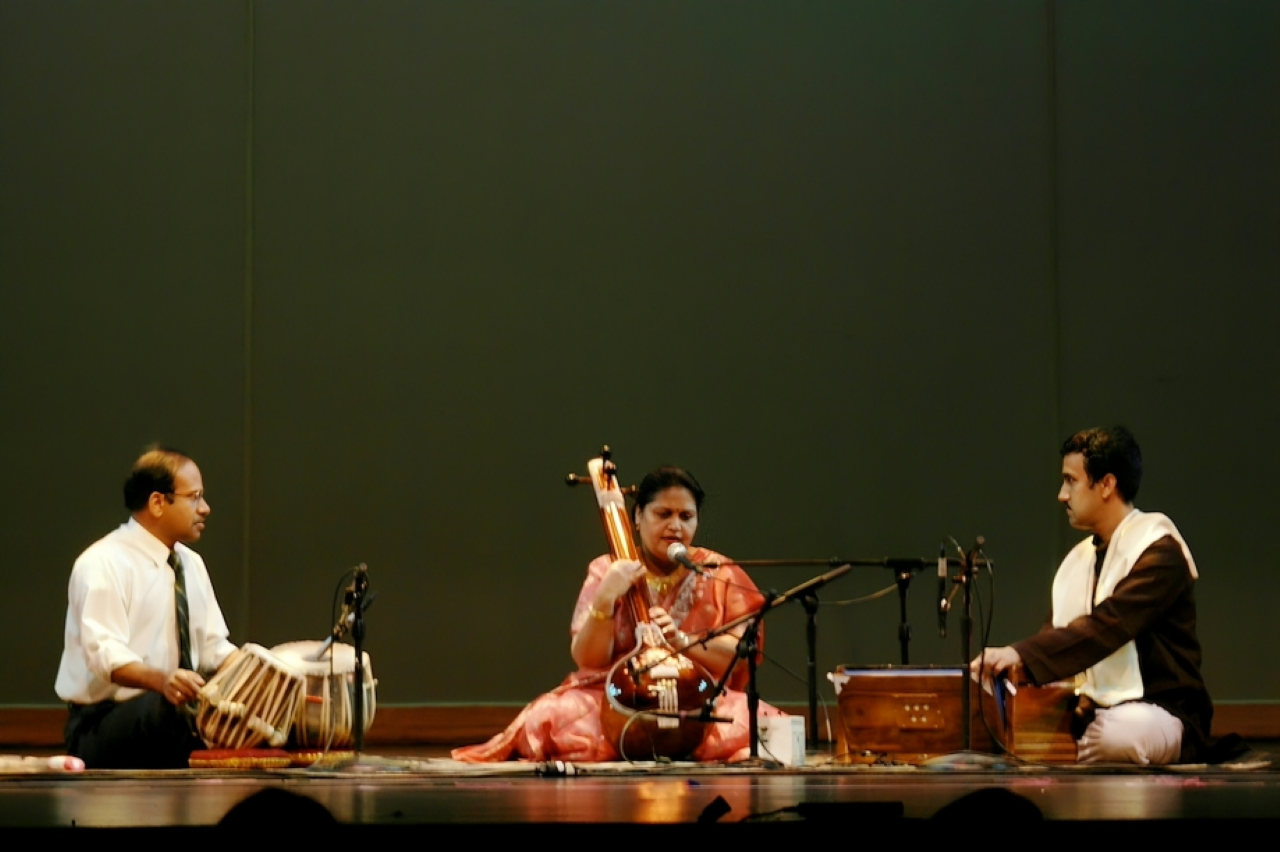
Today’s discussion focuses on how Hindustani classical music is performed.
A raga can be presented simply by singing or playing vowel sounds—such as aa, ee, oo—or through sargam syllables like sa–re–ga–ma. Even with these basic elements, the full shape and character of a raga can be established. In earlier times, this was largely the principal method through which classical music was presented.
Over the centuries, however, musicians gradually embellished and refined the art of performance, introducing various aesthetic and structural elements to make it more expressive and engaging.
Great masters—pandits and ustads—developed different styles of singing and instrumental presentation, such as dhrupad and khayal. At the same time, influences from regional folk traditions contributed additional stylistic features to classical music. The distinctive creative approaches of eminent musicians eventually gave rise to various gharanas, or musical schools and lineages.
Within these gharanas, artists composed numerous beautiful bandishes—structured compositions in different ragas and performance styles. As a result, the enjoyment of classical music lies not only in the raga itself but also in the diversity of interpretative styles.
For this reason, the same raga can evoke very different impressions when heard in different styles, with different nuances, and through the voices of artists belonging to different gharanas.
In Hindustani classical vocal music, two principal traditions have become firmly established:
Dhrupad and Khayal.
Among the semi-classical forms, Thumri is perhaps the most popular and widely appreciated style. In addition, the rich world of instrumental music forms an essential and vibrant part of the Hindustani classical tradition.
Table of Contents
The Baithaki Performance Tradition
First, Let Us Speak About the Baithaki Style
Earlier we discussed listening to recorded music. However, the traditional way of experiencing Indian classical music is through the baithaki performance, an intimate concert setting. For those who wish to experience the music in its fullest depth, there is truly no substitute for the baithaki atmosphere.
Baithaki performances follow certain established conventions and traditions. To fully enjoy such a performance, it helps to understand these underlying principles.
The rules of presentation may vary depending on the genre of music. Not every form is performed in the same sequence. Furthermore, there are certain differences between vocal performances and instrumental recitals.
In this brief note, we shall discuss two examples of baithaki performance:
- Khayal in vocal music, and
- A typical instrumental recital.
The Structure of the Baithak
All forms of Indian classical music are traditionally performed in a baithaki style. The performance is generally solo-oriented, meaning that the entire presentation revolves around a principal vocalist or instrumentalist.
The main artist leads the musical journey through voice or instrument, while the accompanying musicians provide support.
In the case of jugalbandi (duet performances), there may be two principal artists. Even though improvisation is an essential part of the performance, the artists usually establish a mutual understanding beforehand and remain within that shared framework during the recital.
To provide a continuous tonic drone, one or two tanpura players accompany the main performer. These musicians are often disciples of the principal artist. A percussionist is also present—usually playing tabla or pakhawaj—to maintain the rhythmic cycle (tala).
For instrumental music, these accompaniments are generally sufficient.
In vocal performances, the singer’s hands are usually free, although sometimes the vocalist may hold a tanpura or a surmandal. To support the melodic atmosphere of the performance, a sarangi player or harmonium player often accompanies the singer. These accompanists follow the vocalist closely, echoing and sustaining the melodic contours that the singer creates.
Seating Arrangement
In a traditional baithaki setting:
- The principal artist sits at the centre, facing the audience.
- Tanpura players sit slightly behind the main performer.
- The tabla player sits to the right.
- The sarangi or harmonium player sits to the left.
In a jugalbandi, the two principal artists sit side by side. Sometimes seating arrangements may also reflect seniority or artistic hierarchy.
From Intimate Gatherings to Modern Stages
Traditionally, such performances took place in small, intimate gatherings or mehfils, where both the artist and the audience sat on the floor at the same level. This setting allowed for a subtle exchange of emotion and expression between performer and listener.
In modern times, however, concerts often take place in larger venues to accommodate bigger audiences. Sound systems are used, and raised stages are constructed so that the performers can be clearly seen and heard by everyone present.
Detailed discussion of Dhrupad performance can be found in the article titled “Dhrupad”.
Detailed discussion of khayal performance can be found in the article titled “Khayal”.
The sequence I have described here should be taken as a general guideline rather than a rigid rule. It may not apply exactly to every gharana or every artist. In practice, performers often adapt the order and emphasis of different sections according to their stylistic tradition, the context of the performance, the audience, and the moment itself.
At times, an artist may even divide a particular section into two contrasting tempos, or rearrange certain elements to suit the unfolding mood of the recital. Such flexibility is, in fact, an integral part of the living tradition of Hindustani classical music.
However, once you develop a basic understanding of the overall structure of a performance, recognising and appreciating these variations becomes much easier and far more enjoyable.
The Ashtanga Khayal Performance
The Ashtanga (eight-limbed) structure of Khayal refers to the traditional eight components that together form the complete architecture of a khayal performance. This approach originated in the Gwalior gharana, the birthplace of khayal. Today only a small number of artists still perform khayal strictly following this eight-part framework.
It should also be noted that not every gharana or artist follows this structure exactly. Nevertheless, understanding the concept of the Ashtanga is extremely helpful for anyone who wishes to grasp the deeper logic of khayal gayaki.
1. Bandish Nayaki
The first stage of the Ashtanga khayal is Bandish Nayaki, which establishes the foundation of the entire performance.
At this stage, the artist presents the original bandish (composition) and outlines the basic emotional and melodic framework of the raga. The structure of the bandish—composed by the original creator—is preserved faithfully. This respect for the original composition ensures the authenticity and purity of the raga tradition.
The performer may introduce subtle variations in phrasing, ornamentation, or tonal emphasis, but the words and essential melodic structure remain unchanged.
Through this step, the listener begins to recognise the principal notes, characteristic movements, and emotional essence of the raga. Bandish Nayaki is usually rendered in a slow tempo, allowing the vocalist to maintain control over breath and tone while preparing the ground for the later stages of elaboration.
Here the artist employs gentle melodic phrases, light ornamentation, and selective use of the bandish text, inviting the listener into the raga’s musical atmosphere.
2. Bandish Gayaki
The second stage is Bandish Gayaki, where the artist begins to explore the composition more fully.
While maintaining the original bandish, the performer gradually introduces personal interpretation, rhythmic nuance, and subtle ornamentation. At this point the singer’s individual artistry begins to emerge more clearly.
Bandish Gayaki thus becomes the primary expressive mode of khayal, where the artist’s technical skill and creative personality start to unfold.
3. Bistar / Bol-Bistar / Barhat
Bistar is the most significant section of khayal performance.
In this phase, the artist slowly expands the raga using notes and textual phrases (bol), gradually revealing its melodic richness and emotional depth. This is the stage where the raga’s beauty and character become fully apparent to the listener.
Some online sources refer to this as alap or bol-alap, but it is more appropriate to call it bistar in khayal. The reason is simple: bistar is rhythmically bound, whereas traditional alap is rhythmically free.
4. Behlawa (Very Slow Aakar Taan with Meend)
In the Behlawa stage, the artist performs extremely slow aakar taans enriched with meend (gliding between notes).
Each note is touched delicately and explored deeply, creating a meditative musical atmosphere that allows the listener to feel the emotional weight of the raga.
5. Bol-Baant
In Bol-Baant, the words of the bandish are broken and rearranged within different melodic patterns.
The artist reshapes the lyrics through varied note patterns and ornamentation, revealing new shades of the raga’s melodic possibilities. This stage highlights the creative interplay between text and melody.
6. Bol-Taan
During Bol-Taan, the vocalist performs rapid melodic passages using the lyrics of the composition.
Here the rhythmic energy increases, and the artist demonstrates agility and control while maintaining alignment with the tala.
7. Taan
Taan represents the section of fast melodic runs and intricate note patterns.
The performer moves swiftly across the scale, weaving complex melodic shapes that display both technical brilliance and emotional intensity.
8. Laykari
The final stage is Laykari, where the artist plays with rhythmic variations and tempo relationships within the tala.
Through rhythmic manipulation and melodic phrasing, the performer gradually brings the performance to its conclusion, leaving the audience with a strong aesthetic and emotional resonance.
Additional Notes
Sargam is not considered an essential element of khayal. However, some artists employ it as a ninth component to further elaborate the raga.
For example:
- Pandit Ulhas Kashalkar rarely uses sargam in his performances.
- Pandit Ajoy Chakrabarty, on the other hand, sometimes includes sargam beyond the traditional eight elements.
Similarly, alap was not originally a formal component of khayal. Over time, the bistar section began to resemble an alap in its gradual melodic unfolding.
It is said that Ustad Faiyaz Khan was among the first to introduce alap-like passages into khayal, after which short auchar alap became common in the Gwalior and Sahaswan traditions.
Although some musicians refer to khayal’s expansion as alap or swar-bistar, it remains fundamentally rhythmically structured, where melody and text combine to reveal the full personality of the raga.
Some Important Elements of Performance
Alap
A khayal performance traditionally begins with the alap. This is one of the most important sections in both khayal and dhrupad presentations.
The alap usually starts at a very slow tempo, known as ati-vilambit or vilambit laya. If time is limited, however, it may sometimes begin in a medium tempo (madhya laya).
During the alap, there is no accompaniment from percussion instruments. The artist explores the raga using vowel sounds (aakar) or occasionally meaningless syllables such as nom or tom. The melodic exploration generally begins from the shadja (Sa), the tonic note, although in some cases the artist may begin from the vadi (principal note) of the raga.
From the tonic, the artist often moves gradually into the lower octave, presenting the notes characteristic of the raga in that register. After exploring the lower range, the performance slowly ascends to the upper octave, introducing the higher notes before eventually returning again to the tonic.
In this stage, the artist introduces the raga gently and deliberately. Each note is revealed one by one to the listener. The most important notes—especially the vadi and samvadi—are carefully established, and the characteristic musical phrases of the raga begin to unfold.
It is much like watching a painter work on a canvas: with each stroke, the outline of the portrait gradually emerges.
This portion of the performance is often the most challenging for the performer. The alap tests both the artist’s depth of understanding of the raga and their ability to present it convincingly. A skilled musician can establish the essence of the raga beautifully through the alap, allowing the listener to begin sensing its emotional presence.
For new listeners, however, this section may not always seem immediately engaging. Yet as one becomes more familiar with the raga, the pleasure of listening to the alap grows immensely.
In today’s fast-paced musical culture, the tradition of extended alap has gradually become less common. Many khayal singers now move quickly from the alap into the bandish or gat. It is primarily dhrupad musicians who continue to preserve the tradition of long and detailed alap performances.
For a more detailed discussion of alap singing, you may refer to the article “Alap-Gaan” in the “Genres of Music” section of this series.
Bandish
After the alap, the performance usually proceeds to the bandish. The bandish is also known as cheez or gat. In vocal music it is called bandish, whereas in instrumental music it is commonly referred to as cheez or gat.
This section may appear at various points within a performance; however, it must be completed before the final taans are rendered.
A bandish/cheez/gat is essentially a composed musical piece. It is written within the framework of a specific raga and set to a particular tala (rhythmic cycle). Because both the melody and the rhythmic structure are fixed, the scope for improvisation within the bandish itself is relatively limited.
Since most listeners are naturally accustomed to composed musical forms, this section of the performance is often the most accessible and communicative. For that reason, audiences—regardless of their level of familiarity with classical music—usually find it easier to connect with the bandish.
At the same time, the bandish is also one of the most important elements of khayal performance.
In khayal, a bandish generally consists of two sections:
- Sthayi – the opening section, usually centred around the lower and middle registers.
- Antara – the second section, which typically explores the upper register.
In dhrupad, the composition traditionally contains two additional sections beyond these:
- Sanchari
- Abhoga
Over time, various gharanas have developed their own distinctive repertoires of classic bandishes, many of which have become signature compositions associated with particular traditions. Although contemporary musicians continue to compose new bandishes, the older compositions remain the most widely performed and cherished within the tradition.
Taan
Toward the end of a performance, the artist usually presents taans. In this section, the performer moves rapidly across the notes of the raga, weaving intricate melodic patterns in different rhythmic shapes. Through these swift melodic passages, the performance gathers momentum and is brought to a dramatic and engaging conclusion.
Several types of taans are commonly recognised, including:
- Bol Taan
- Sapaat or Shuddha Taan
- Koot Taan
- Mishra Taan
- Gamak Taan
In addition, various gharanas have developed their own distinctive taan styles over time, such as Palta Taan, Halk Taan, Jhatka Taan, Gitkari Taan, and others.
Bol Taan is constructed using selected words from the bandish, integrating the lyrical text with rapid melodic movement.
Sapaat Taan follows a straight and linear melodic path, typically moving swiftly through the ascending and descending notes of the raga across two or three octaves.
In contrast, Koot Taan does not follow such a direct or predictable pattern; its movement is more complex and angular.
This section of the performance often reveals the technical preparedness and vocal control of the artist. While the earlier sections emphasise the artist’s understanding and interpretation of the raga, the taan section highlights the agility, strength, and mastery of the performer’s voice or instrument.
Some listeners particularly enjoy the excitement of taans, especially in lighter or more energetic performances. However, in very serious or contemplative recitals, excessive use of taans may sometimes disrupt the intended depth or gravitas of the presentation.
See also: