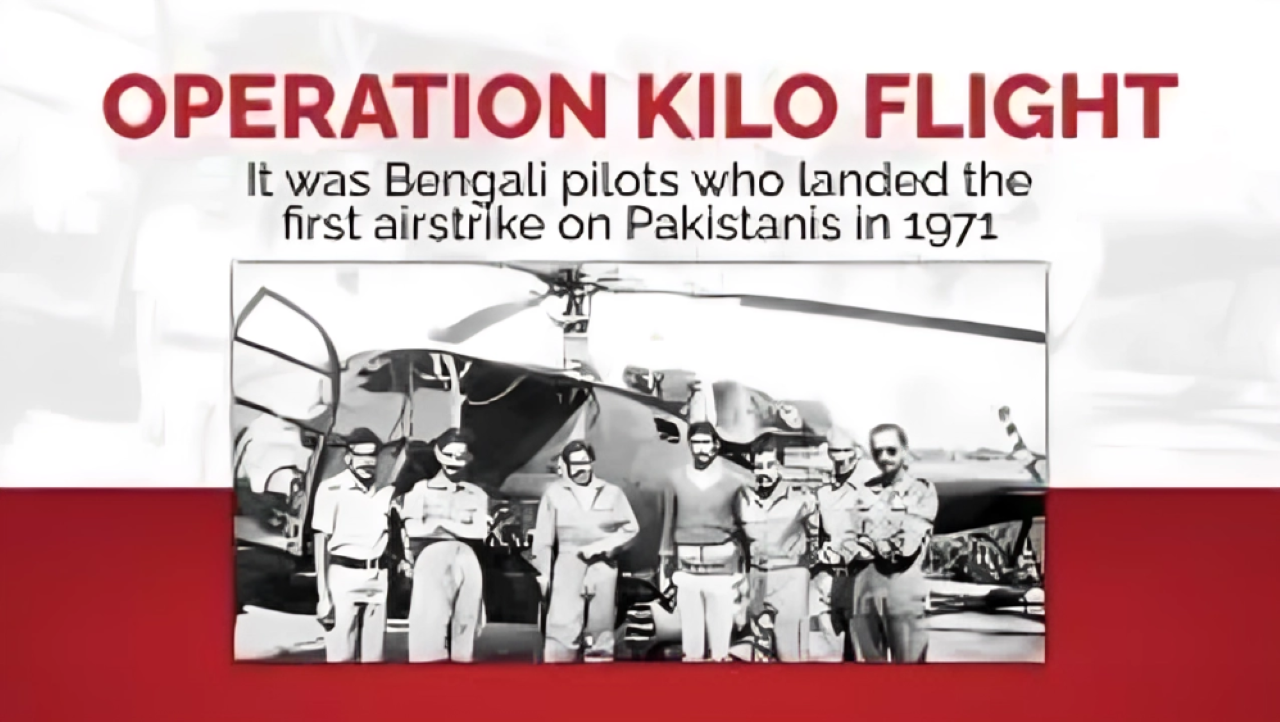
Operation Kilo Flight occupies a distinctive and heroic position in the military history of the Bangladesh Liberation War. While the land campaigns, guerrilla resistance, and naval operations of 1971 are widely remembered, the dramatic emergence of Bangladesh’s air capability remains comparatively underappreciated. Yet, in the final and decisive weeks of the war, a small group of determined Bengali airmen demonstrated extraordinary courage and ingenuity by launching organised airstrikes against Pakistani military installations. Working with improvised aircraft, minimal technology, and limited logistical support, they proved that control of the skies was not beyond the reach of a people fighting for national survival.
On the night of 3–4 December 1971, Bengali pilots of the newly formed Bangladesh Air Force carried out the first coordinated aerial assaults of the Liberation War. Their targets were two strategically vital fuel depots located in Chittagong and Narayanganj. The destruction of these installations severely disrupted Pakistani air operations in the eastern theatre, grounding aircraft and weakening logistical supply lines. However, the importance of these attacks extended far beyond their immediate military consequences. They marked the symbolic birth of Bangladesh’s independent air power and signalled to both allies and adversaries that the Bengali resistance had matured into an organised military force capable of operating across land, sea, and air.
Operation Kilo Flight was not merely a tactical manoeuvre conceived in the urgency of wartime necessity. It was the culmination of months of preparation, political struggle, sacrifice, and remarkable improvisation. The mission reflected the broader transformation of the liberation movement from scattered resistance into a coordinated national struggle for sovereignty. In the absence of advanced aircraft, modern radar systems, or established airbases, Bengali airmen relied on creativity, discipline, and unwavering resolve to construct an operational air unit from almost nothing. Their achievement stands as one of the most inspiring examples of resourcefulness in modern military history.
The strategic significance of air power in the conflict cannot be overstated. When Pakistan launched its brutal military crackdown on 25 March 1971, it quickly established aerial dominance over East Pakistan. Pakistani aircraft conducted reconnaissance missions, transported troops and supplies, and carried out bombing operations designed to intimidate both resistance fighters and civilians. This superiority allowed the occupation forces to maintain mobility across vast distances and reinforced their control over key urban centres. In contrast, the Bengali resistance initially lacked heavy weaponry, mechanised units, and any form of air support. Although guerrilla tactics proved effective in disrupting enemy operations, the absence of aerial capability left liberation forces exposed and placed them at a considerable strategic disadvantage.
Air superiority influences the course of war in multiple ways. It ensures the protection of supply routes, enables rapid deployment of troops, provides reconnaissance intelligence, and exerts psychological dominance over adversaries. For months, Pakistani control of the skies served as a constant reminder of the imbalance of power. The formation of an indigenous Bengali air unit therefore carried immense military and symbolic value. It meant that the struggle for independence had reached a stage where the liberation forces could challenge the enemy in every domain of warfare.
Before the outbreak of the war, many Bengalis had served with distinction in the Pakistan Armed Forces, including the Pakistan Air Force. These officers were highly trained professionals, often educated abroad and experienced in modern aviation. However, as political tensions escalated between East and West Pakistan, the military regime grew increasingly suspicious of Bengali personnel. Following the crackdown in March 1971, Bengali officers were gradually removed from sensitive assignments, grounded from flying duties, and placed under surveillance. They were treated not as trusted servicemen but as potential collaborators with the independence movement.
This climate of mistrust proved deeply humiliating for Bengali officers who had dedicated their lives to military service. Many soon realised that remaining within the Pakistani system was no longer possible. The war had become personal, and neutrality was morally untenable. Defection, however, carried enormous risks. Military installations were heavily guarded, intelligence agencies monitored communications, and escape attempts could lead to imprisonment, torture, or execution. Nevertheless, driven by patriotism and conscience, Bengali airmen began undertaking perilous journeys to join the liberation struggle.
Their escapes were acts of extraordinary bravery. Some disguised themselves as civilians, while others slipped away during transit assignments. Many travelled by night through remote rural routes, avoiding checkpoints and military patrols. They crossed rivers in small boats, sought refuge in sympathetic households, and navigated dense forests on foot. Each successful journey to neighbouring India was not merely a personal triumph but a declaration of allegiance to the future nation of Bangladesh.
By mid-1971, the Indian city of Kolkata had become a vital centre for the liberation movement. The Government of Bangladesh-in-exile operated from there, coordinating diplomatic initiatives, military planning, and international advocacy. For Bengali airmen arriving after their dangerous escapes, Kolkata represented legitimacy, hope, and the opportunity to resume their duty in the service of their homeland.
They reported to senior military leaders of the liberation forces, including Group Captain A. K. Khandker, a respected officer who would later become the first Chief of Air Staff of independent Bangladesh. Under his guidance, defected airmen were reorganised into a structured unit with the goal of establishing an independent air capability. They were received not as refugees, but as professional soldiers returning to active service.
The creation of an air force in exile posed immense challenges. A functional air unit requires aircraft, trained pilots, engineers, communication systems, maintenance facilities, and weapons infrastructure. Bangladesh possessed none of these independently. Yet, despite the apparent impossibility of the task, determination prevailed. India, recognising both the humanitarian crisis and strategic stakes of the conflict, extended crucial assistance. While diplomatic constraints prevented the open transfer of modern fighter aircraft, India provided transport planes, helicopters, training grounds, and logistical support.
The aircraft supplied were never designed for combat operations, yet they became the foundation of Bangladesh’s aerial resistance. Bengali pilots and engineers modified them with improvised bomb racks, reinforced structures, and adapted navigation systems. Through innovation and courage, civilian and utility aircraft were transformed into effective strike platforms. Intensive training followed in remote areas of India, where crews practised low-altitude flying, night navigation, and precision bombing techniques under simulated combat conditions.
These preparations laid the groundwork for Operation Kilo Flight — a mission that would announce the arrival of Bangladesh in the skies and forever alter the psychological and strategic balance of the war.
The success of Operation Kilo Flight was rooted not only in courage but in careful preparation shaped by harsh wartime realities. Forming an effective air unit from scratch during an ongoing conflict required strategic patience, technical innovation, and disciplined coordination. The Bengali airmen understood that their aircraft were few, their resources scarce, and their margin for error virtually nonexistent. Every mission would have to be executed with precision, because losses could not easily be replaced.
The first challenge lay in evaluating operational limitations. The aircraft available to the newly formed Bangladesh Air Force were not fighter jets designed for combat, but transport and utility platforms adapted for war. They were slower, lightly armed, and lacked defensive protection. Their fuel capacity restricted operational range, making long-distance missions risky. Navigation systems were rudimentary, with pilots often depending on magnetic compasses, printed maps, and visible terrain features rather than radar guidance. Furthermore, flying at low altitudes to avoid detection exposed aircraft to anti-aircraft fire and increased the danger of collision with natural obstacles. Weather posed another serious threat, as fog, monsoon clouds, and strong winds could easily disrupt fragile flight plans.
Given these constraints, military planners carefully considered which targets would yield maximum strategic value while minimising operational risk. Heavily defended airbases and urban command centres were ruled out because the likelihood of aircraft losses was too great. Instead, attention turned towards logistical infrastructure — the essential systems that sustained Pakistani military operations. Intelligence reports indicated that fuel storage facilities were particularly vulnerable and critically important. Destroying them would disrupt aircraft operations, immobilise transport fleets, and weaken supply networks without requiring large-scale bombardment.
Two fuel depots emerged as priority targets. The installation at Chittagong supported naval operations and air activity in the eastern sector, while the depot at Narayanganj supplied inland transport routes and military movements near Dhaka. Both facilities were strategically vital yet comparatively less defended at night, making them suitable targets for surprise attacks. Striking these depots would inflict disproportionate damage on the enemy’s operational capability.
Reliable intelligence was essential for mission planning. Mukti Bahini operatives working deep inside occupied territory gathered information at enormous personal risk. They identified depot layouts, guard patterns, anti-aircraft placements, and surrounding civilian settlements to reduce unintended casualties. Their reports were supplemented by Indian reconnaissance data, weather forecasts, and aerial imagery. This collaboration between ground resistance networks and allied intelligence agencies ensured that Kilo Flight crews possessed accurate and actionable information before departure.
Initial discussions included an ambitious proposal to strike Dhaka directly using the larger Dakota aircraft. However, further analysis revealed serious drawbacks. The Dakota’s size made it easily detectable by radar, and its slower speed rendered it vulnerable to interception. Additionally, the long distance between operational bases and Dhaka strained fuel capacity, leaving little margin for unexpected diversions. A failed strike on the capital would carry significant symbolic and operational costs. Military prudence therefore prevailed, and planners focused on more attainable objectives.
Tactical innovation became the foundation of mission design. To evade radar detection, pilots planned to fly at extremely low altitudes, using natural terrain as concealment. River routes would serve as navigational guides, particularly at night when ground visibility was limited. Railway lines and road networks would provide additional reference points. Because the aircraft lacked sophisticated targeting systems, crews prepared to make multiple bombing passes over each target to ensure accuracy.
Training intensified in remote Indian airfields, especially near Dimapur, where varied terrain offered realistic practice conditions. Pilots rehearsed night take-offs, low-altitude manoeuvres, emergency landings, and coordinated flight patterns. Bomb-release timing was practised repeatedly to compensate for the absence of automated systems. Ground crews simultaneously trained in rapid refuelling, improvised bomb loading, and emergency aircraft repairs. Every rehearsal simulated battlefield stress to prepare crews for the unpredictability of combat.
The air unit was divided into specialised operational teams. A helicopter assault group was tasked with striking the Narayanganj depot using an Alouette III helicopter, whose manoeuvrability allowed precise low-level attacks. A fixed-wing team operating the Otter aircraft was assigned the Chittagong mission, relying on speed and repeated attack runs. This division enabled simultaneous strikes that would maximise confusion and overwhelm enemy response capacity.
Psychological preparation was equally important. Pilots were acutely aware that capture would likely result in torture or execution. Mechanical failure could force emergency landings in hostile territory. Nevertheless, morale remained remarkably strong. The airmen viewed their mission as a sacred duty to their homeland. Some wrote letters to their families before departure, conscious that they might not return. These quiet gestures reflected both the gravity of the moment and their willingness to sacrifice everything for independence.
Just as preparations neared completion, an unexpected order temporarily halted the mission. The cancellation disappointed the crews, who had trained relentlessly for weeks. However, circumstances soon changed dramatically. On 3 December 1971, Pakistan launched pre-emptive airstrikes on Indian airbases in the western theatre, expanding the conflict into a full-scale regional war. India formally entered the war within hours, altering strategic priorities overnight.
For Kilo Flight, the delay ended instantly. Orders were issued to proceed without hesitation. Final briefings confirmed target coordinates, fuel calculations, bomb loads, and emergency contingencies. There would be no further rehearsals. The mission would commence under cover of darkness, relying entirely on the skill, discipline, and courage of the pilots.
As engines prepared to ignite and crews moved toward their aircraft, the significance of the moment was unmistakable. Bangladesh’s air warriors were about to carry their nation’s struggle into the skies.
The evening of 3 December 1971 marked a decisive turning point in the Liberation War. Pakistan’s pre-emptive aerial attacks on Indian airbases had expanded the conflict into a full-scale regional war, and within hours new operational orders reached the Bengali pilots of Kilo Flight. Months of preparation, uncertainty, and waiting were over. The mission that would inaugurate Bangladesh’s air combat history was authorised for immediate execution.
At the forward airbase, preparations unfolded with disciplined urgency. Ground crews worked under minimal lighting to avoid detection, securing improvised bombs beneath aircraft wings and checking fuel lines repeatedly. Mechanics listened carefully to engine vibrations, aware that mechanical failure in hostile airspace would mean certain disaster. Maps were reviewed for the final time as pilots memorised river routes, railway lines, and terrain patterns that would guide them through darkness. There would be no electronic navigation support and no radar assistance; success depended entirely on training, coordination, and nerve.
Two strike teams prepared to depart separately. The first, assigned to attack the vital fuel installations at Chittagong, would fly the modified Otter aircraft under the command of Flight Lieutenant Shamsul Alam, accompanied by Captain Badrul Alam. The second team, led by Squadron Leader Sultan Mahmud and Captain Shahabuddin, would operate the Alouette helicopter to strike the Narayanganj fuel depot near Dhaka. The decision to conduct simultaneous attacks aimed to divide enemy attention and maximise operational shock.
Shortly after sunset, engines roared into life. Around 7:30 pm, the Otter lifted from the runway and disappeared into the darkened sky, followed later by the helicopter along a separate flight path. Both aircraft maintained extremely low altitudes to evade radar detection, skimming above treetops and riverbanks. Inside the cockpits, conversation was minimal. Each crew member focused intensely on instruments, compass bearings, and fleeting visual cues on the landscape below.
Approaching occupied territory demanded exceptional composure. Pakistani anti-aircraft defences could open fire without warning, and even minor navigational errors risked mission failure. Around midnight, the Otter crossed into Bangladeshi airspace. Beneath them stretched a homeland subdued by occupation — silent villages, unlit roads, and scattered military positions. Relief came briefly when moonlight reflected off the winding waters of the Feni River, confirming they were on the correct route toward Chittagong.
As the aircraft neared its target zone, altitude was reduced further. The pilots could make out faint industrial shapes near the port area, partially concealed but recognisable from intelligence briefings. Lacking modern targeting systems, they relied entirely on visual judgement. The aircraft aligned for its first bombing pass.
The first bomb was released. Seconds passed without detonation. Assuming a malfunction, the crew circled for another attempt. The second release also appeared unsuccessful, heightening tension within the cockpit. Refusing to abandon the mission, the pilots initiated a third pass. This time a brilliant flash erupted, followed by rising flames. Encouraged, they executed a fourth run. A massive explosion illuminated the night sky as fuel storage tanks ignited, sending thick columns of smoke upward. The Chittagong depot was ablaze.
Simultaneously, the Alouette helicopter executed its strike on Narayanganj. Flying perilously low across riverine terrain, the crew approached the depot under cover of darkness. Hovering briefly to ensure accuracy, they released their munitions with careful timing. Explosions ripped through the facility, and secondary blasts followed as flames spread rapidly among fuel reserves. Despite exposure to potential ground fire, the helicopter completed its attack and withdrew safely.
Mission success did not eliminate danger. Both aircraft still had to return across hostile territory with limited fuel reserves. Pilots maintained strict speed discipline to conserve fuel while remaining alert to interception risks. Fatigue mounted, but concentration remained unbroken. Hours later, distant runway lights appeared, guiding the aircraft safely back to Kumbhigram Air Base between approximately 2:00 am and 3:00 am on 4 December.
Ground crews rushed forward as engines shut down. There were no dramatic celebrations — only profound relief and quiet recognition of historic achievement. Bangladesh had just conducted its first aerial combat missions.
The destruction of the two fuel depots delivered an immediate strategic blow. Pakistani air operations in the eastern theatre faced severe logistical disruption, reducing patrol frequency and limiting reinforcement capacity. Beyond material damage, the strikes shattered the perception of uncontested Pakistani air dominance. Freedom fighters across the country drew renewed confidence from the knowledge that Bengali pilots now contested the skies.
More importantly, the night’s events carried immense symbolic significance. A nation still fighting for recognition had demonstrated sovereign military capability in the air domain. Operation Kilo Flight transformed Bangladesh’s struggle from a purely ground resistance into a multidimensional war of liberation.
The skies over Bangladesh were no longer silent. They now echoed with the assertion of an emerging nation.
1 thought on “Operation Kilo Flight: It was Bengali pilots who landed the first airstrike on Pakistanis in 1971 [ December 3 and 4, 1971 ]”