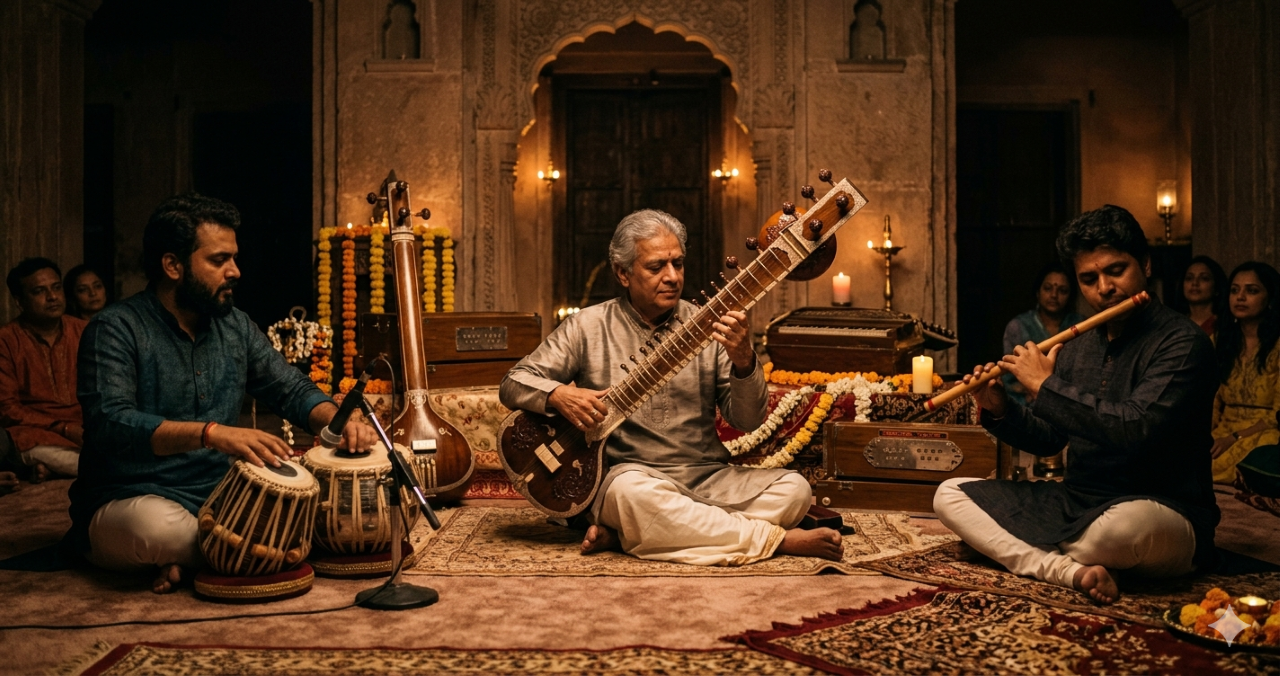
The soul of music lies in the swara (musical note). Without swara, music itself would be inconceivable. Just as language is constructed from letters, the language of music is formed from notes. For this reason, many musicologists describe the swara as the primary alphabet or phonetic unit of music. Since the earliest days of human civilisation, people have attempted to create melody by imitating the sounds of nature—the gentle whisper of the wind, the murmuring flow of a river, or the calls of birds. Through such imitation, the earliest notions of music gradually took shape.
Table of Contents
The Mythical Origins of the Seven Notes
Ancient musical literature contains a popular legend about the origins of the first musical notes. According to this tradition, the seven fundamental swaras were inspired by the voices of different animals and birds in nature.
- The call of the peacock gave rise to Sa
- The lowing of a bull inspired Re
- The bleat of a goat became Ga
- The voice of a crane suggested Ma
- The melodious song of the cuckoo inspired Pa
- The neigh of a horse produced Dha
- The deep call of an elephant gave rise to Ni
Although this explanation is largely symbolic, it beautifully illustrates an essential truth: human musical sensibility has its roots in nature itself.
From Seven Notes to Twelve
In the earliest stages of musical development, these seven notes formed the basic framework of music. Later, five additional altered notes were incorporated into the system. Thus emerged the twelve-note structure that forms the foundation of Indian music.
From the countless arrangements and combinations of these twelve notes arise ragas, which express the colours, moods, and emotions of music. The very word “raga” derives from a root meaning to colour or to dye the mind. In other words, a raga is a melodic framework capable of evoking a particular emotional atmosphere in the listener.
Mythological Accounts of the First Ragas
Ancient Indian musical tradition also preserves mythological accounts regarding the origins of ragas. According to legend, there were originally six principal ragas. Five of them—Shri, Basant, Bhairav, Pancham, and Megh—are said to have emerged from the mouth of Lord Shiva, while the sixth raga, Nat-Narayan, was born from Goddess Parvati.
Although modern musicology recognises far more ragas, these mythological narratives remain an important part of the spiritual heritage of Indian music.
The Concept of Shruti
Another key concept in Indian classical music is shruti. Broadly speaking, shruti refers to the smallest perceptible unit of pitch that the human ear can distinguish.
Ancient musicological texts describe 22 shrutis within the musical scale. From among these subtle tonal divisions, 12 principal shrutis are commonly used in practice; these are what we recognise as the twelve musical notes. With the help of these twelve notes, almost all musical sounds and melodic structures can be represented.
Pure and Altered Notes
Among the twelve notes, seven are known as shuddha swaras (natural or pure notes). These are considered the fundamental tones of the musical system. The remaining five are called vikrit swaras (altered notes).
Although the term vikrit may sound somewhat harsh, these altered notes are by no means inferior; in fact, they are essential to the richness and beauty of music. Among them, four are komal (flattened) notes, and one is tivra (sharpened).
These altered notes generally lie slightly above or slightly below their neighbouring natural notes.
The Twelve Notes of Indian Music
The twelve notes of the Indian musical system are:
- Shadja (Sa) – the fundamental or tonic note of music; sometimes called Kharaj.
- Rishabh (Re) – occasionally referred to as Rikhab or Rekhab.
- Komal Rishabh – the flattened form of Re.
- Gandhar (Ga)
- Komal Gandhar
- Madhyam (Ma)
- Tivra Madhyam – the sharpened form of Ma.
- Pancham (Pa)
- Dhaivat (Dha)
- Komal Dhaivat
- Nishad (Ni) – sometimes referred to as Nikhad.
- Komal Nishad
In singing and practical performance, musicians usually employ the abbreviated forms of the notes—Sa, Re, Ga, Ma, Pa, Dha, Ni. However, in theoretical discussion and writing about music, their full names are commonly used. For this reason, it is important for any student or enthusiast of music to become familiar with these terms.
Swara: The Gateway to the World of Music
Taken together, swara forms the life, foundation, and language of music. From the subtle rise and fall of notes, their relationships and patterns, emerge the worlds of raga, tala, and musical expression.
Indeed, the realm of music is a vast universe of sound—and the first doorway into that universe opens through the swara.
See also: