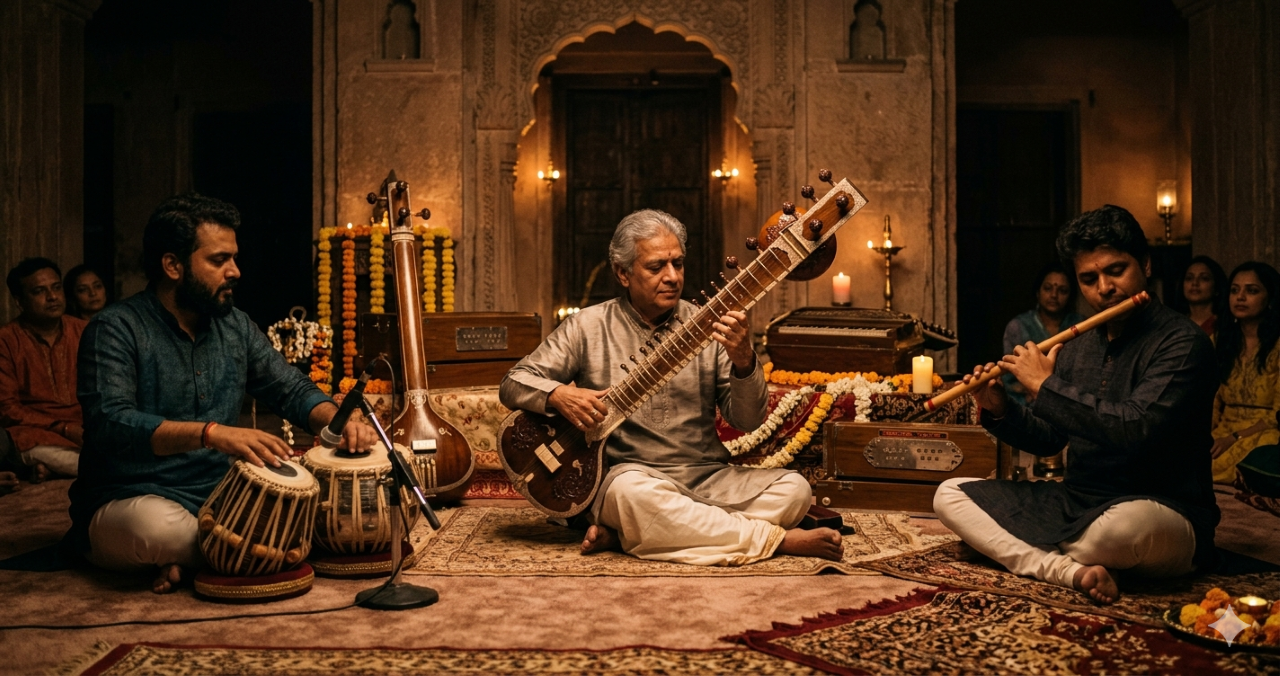
Indian classical music is one of the oldest and richest artistic traditions in the world. It is not merely a collection of melodies; rather, it represents a remarkable synthesis of thousands of years of spiritual practice, philosophy, and scientific understanding. India is perhaps the only region in the world where two completely distinct yet extraordinarily sophisticated systems of classical music have flowed side by side for centuries.
Although these two traditions differ in their styles of singing, instrumental techniques, and theoretical structures, they share the same spiritual origin: the primordial concept of Naad—the cosmic sound believed to permeate the universe.
The two principal streams of Indian classical music are:
Table of Contents
1. Hindustani Classical Music (The Hindustani System)
This tradition is primarily associated with North India. Its evolution reflects a remarkable cultural synthesis in which the ancient heritage of Vedic Samagana merged with influences from Persian, Central Asian, and Mughal cultures. From around the thirteenth century onward, the development of this system accelerated, especially under the influence of great figures such as Amir Khusrau, who helped shape new musical forms.
Beyond India, the Hindustani tradition is also widely practised in Bangladesh, Nepal, Pakistan, and Afghanistan. Under the patronage of the Mughal emperors, classical music gradually moved from temple settings into royal courts. This transition introduced new instruments, musical aesthetics, and elaborate ornamentation.
A central pillar of Hindustani music is the gharana system—distinct stylistic lineages of musical training and performance. The Gwalior, Kirana, Agra, and Patiala gharanas, for example, each represent unique musical philosophies. One of the defining features of Hindustani music is its strong emphasis on improvisation, allowing performers to explore and expand the raga creatively during performance.
Much of the melodic framework used in modern Bengali songs—including Rabindra Sangeet and Nazrul Sangeet—is deeply rooted in the Hindustani classical tradition.
2. South Indian Classical Music (The Carnatic System)
The second major tradition is Carnatic music, the classical system of South India. Compared with Hindustani music, Carnatic music has remained more strictly traditional and structurally conservative. It has experienced relatively little influence from external cultures, and therefore preserves what many consider to be the purest form of ancient Indian musical heritage.
Carnatic music is practised primarily in the four southern states of Tamil Nadu, Kerala, Andhra Pradesh, and Karnataka.
In southern India, Carnatic music is not merely a form of entertainment; it is deeply embedded in family education, daily life, and religious practice. In many educated households, introducing children to classical music at an early age is considered a normal cultural tradition.
Unlike Hindustani music, which emphasises improvisation, Carnatic music places greater emphasis on pre-composed compositions known as “Kriti.” The works of the celebrated **Carnatic Trinity—Tyagaraja, Muthuswami Dikshitar, and Syama Sastri—**remain the central pillars of this musical tradition.
Hindustani vs Carnatic Music: Key Differences
| Feature | Hindustani Music (North Indian) | Carnatic Music (South Indian) |
|---|---|---|
| Cultural Influence | Influenced by Persian and Mughal traditions | Preserves largely indigenous and ancient traditions |
| Raga System | Time of performance (morning, afternoon, night) is significant | Greater emphasis on theoretical structure rather than time |
| Instruments | Sitar, Sarod, Tabla, Harmonium | Veena, Violin, Mridangam |
| Language | Hindi, Urdu, Braj, and Bengali commonly used | Telugu, Tamil, Kannada, and Sanskrit predominant |
Both systems are distinct, highly refined, and immensely rich in musical heritage.
Note: In the remainder of the Asurer Surlokjatra series, the discussions and lessons will primarily focus on the Hindustani classical music tradition.
See more: