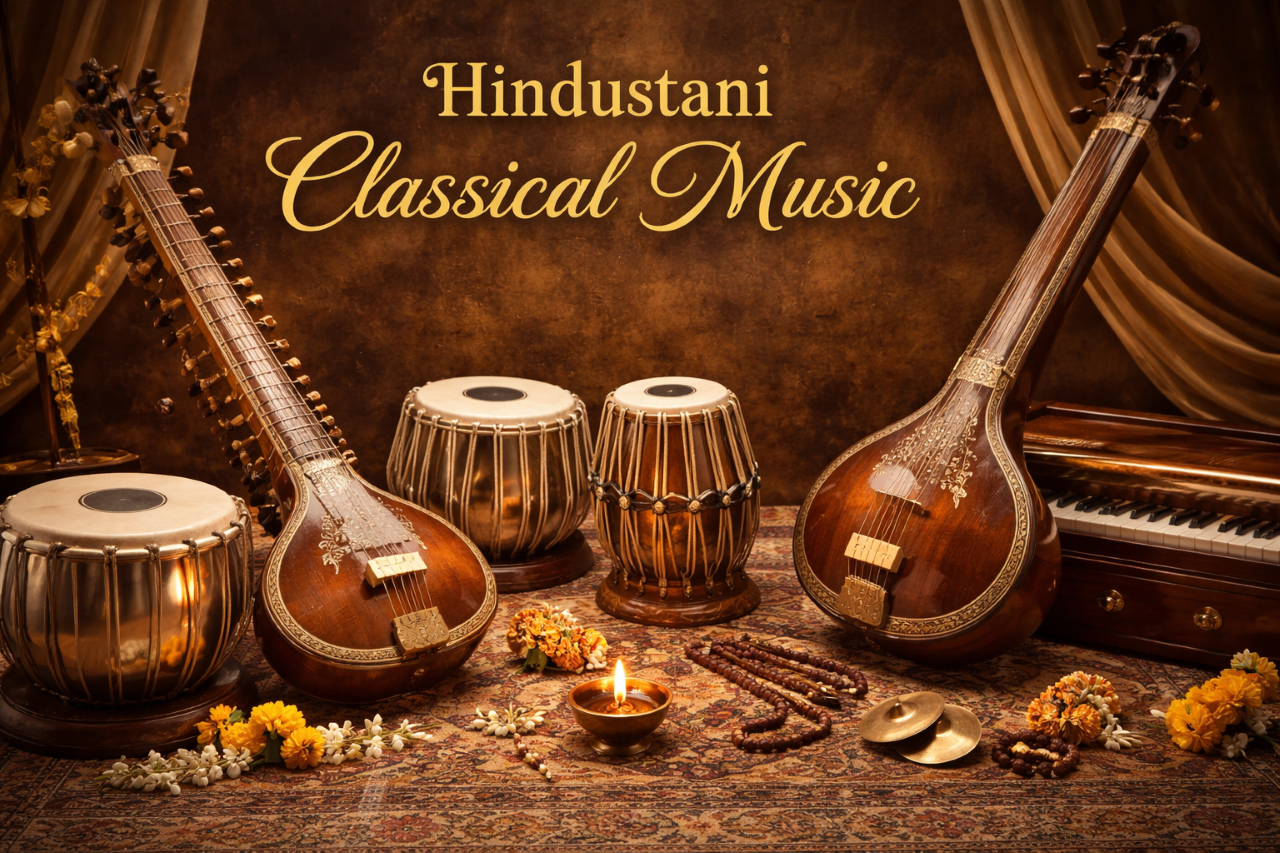
Hindustani classical music is not merely an arrangement of notes; it is a profound philosophy of life and an aesthetic discipline. Within this musical tradition, each raga is often regarded as a living entity, possessing its own time, season, temperament, and emotional character. Some ragas evoke the purity of dawn, others capture the melancholy of evening, while certain ragas awaken the meditative stillness of the deep night.
Spanning the vast cultural landscape of North India and extending into regions such as Bangladesh and Pakistan, this musical heritage has today secured a unique and distinguished place on the global stage.
Table of Contents
In Search of Origins: From the Vedic Age to the Modern Era
The roots of Hindustani music stretch deep into the ancient Vedic period. Around a thousand years before the Common Era, the tradition of melodic recitation known as Vedic Samagana laid the foundation of Indian classical music. When the hymns of the Rigveda began to be chanted according to specific melodic patterns, the first steps were taken towards organising music within a structured and scholarly framework.
However, the form of Hindustani classical music that we recognise today evolved primarily between the twelfth and thirteenth centuries. During this period, the encounter between Persian and Indian cultural traditions gave rise to a new and vibrant musical synthesis.
A pivotal figure in this transformation was the legendary poet, musician, and Sufi thinker Amir Khusrau (1253–1325). He is widely regarded as one of the foundational architects of modern Hindustani music. According to popular tradition, he played an influential role in the development of forms such as khayal, tarana, and qawwali, and his name is often associated with the early evolution of instruments like the sitar and tabla.
The Structure and Performance Style of Hindustani Music
The fundamental foundation of the Hindustani musical system is the raga. A raga is not merely a collection of notes; rather, it is an organised melodic framework through which a specific emotion, mood, and aesthetic experience can be expressed. Each raga possesses its own distinctive arrangement of notes, characteristic movements, ornamentations, and particular note treatments. Together these elements create a unique sonic universe.
When an artist performs a raga, the presentation usually unfolds gradually. Through stages such as alap (the slow, rhythm-free exploration), melodic expansion, taan (rapid melodic improvisations), and rhythm-bound compositions, the musician slowly reveals the inner beauty and emotional depth of the raga to the listener. For this reason, both vocal and instrumental traditions hold equal importance in Hindustani music, as the subtleties of a raga may sometimes be expressed more delicately through the human voice, and at other times more profoundly through an instrument.
Instruments and Musical Ensemble
A complete Hindustani classical performance typically involves the interplay of several key instruments. Among them, the tanpura holds a particularly crucial role. It provides a continuous tonal drone that establishes the fundamental pitch and sonic foundation for the entire performance. Against this steady backdrop, the vocalist or instrumentalist elaborates the raga through intricate melodic ornamentation and improvisation.
The responsibility for rhythm and tempo usually falls to the tabla, which is indispensable in forms such as khayal, thumri, and other later classical styles. In the more ancient and solemn traditions of dhrupad and dhamar, however, the tabla is replaced by the pakhawaj, a deeper-toned percussion instrument that lends the music a majestic and resonant character.
The Rich World of Instrumental Music
Alongside vocal music, Hindustani classical music also boasts a remarkably rich instrumental tradition. Instruments such as the sitar, sarod, bansuri (bamboo flute), sarangi, and santoor each present the subtle melodic nuances of a raga in their own distinctive way.
In particular, the extended alap and virtuosic improvisations performed on instruments like the sitar and sarod have gained immense popularity on international concert stages. Through the interplay of voice and instrument, Hindustani music constructs an extraordinary sonic landscape—one that is at once classical, contemplative, and deeply aesthetic in experience.
Major Traditions or Genres
In Hindustani music, the styles of performance, the use of ragas, and the manner of emotional expression generally divide the tradition into two broad streams: the pure classical tradition and the semi-classical tradition. The principal difference between these two lies in the application of raga grammar and structural purity. In the pure classical tradition, the rules governing the raga—its scale, note treatment, and melodic movement—are followed with great strictness. In the semi-classical tradition, however, while the framework of the raga is retained, greater emphasis is placed on expressive beauty and melodic charm.
Within the pure classical tradition, the most ancient and solemn vocal forms are dhrupad and dhamar. In these styles, the raga unfolds slowly and meditatively, often emphasising moods of heroism (vira rasa) or tranquillity (shanta rasa). Performances of dhrupad are typically accompanied by the deep and resonant rhythms of the pakhawaj, lending the music a majestic and dignified atmosphere.
Over time, another major vocal form developed from this classical lineage—khayal. Today, khayal stands as the most widely performed genre in Hindustani classical music. In this style, artists enjoy far greater freedom in elaborating a raga through imagination, ornamentation, melodic runs (taan), and intricate note patterns. As a result, the same raga may appear in remarkably different forms depending on the interpretation of each performer. Other forms such as tarana and sadra also belong to this domain, often characterised by rapid tempo, complex rhythmic patterns, and intricate melodic improvisation.
In contrast, the semi-classical tradition preserves the structural outline of the raga but places greater emphasis on emotional expression and lyrical beauty. Among the most popular forms in this category are thumri and dadra, where themes of love, longing, and human emotion are conveyed through gentle and melodious musical phrases.
Forms such as tappa and kajri originated from folk melodies but gradually evolved into refined musical genres within the classical tradition. Their performances are often marked by swift movements and distinctive vocal ornamentation. Meanwhile, the spiritual dimensions of music find expression in traditions such as Sufi music and qawwali, where song becomes a profound medium for expressing the soul’s longing for union with the Divine.
Similarly, ghazal and bhajan occupy an honoured place as poetry-centred musical forms. Ghazals typically convey subtle emotions of love, separation, and introspection, while bhajans express devotional sentiments and spiritual contemplation.
Thus, through the harmonious coexistence of both pure classical and semi-classical traditions, Hindustani music has created a vast and diverse musical universe—one in which rigorous classical discipline and emotive beauty flourish side by side.
Influence on Our Musical Heritage
The influence of Hindustani classical music on the development of Bengali music has been both profound and far-reaching. During the nineteenth and twentieth centuries, when Bengali music began to evolve into new artistic forms, many elements of the Hindustani raga and rhythmic systems gradually entered its structure, shaping a rich and sophisticated musical tradition. In particular, features such as raga-based composition, alap (melodic exposition), taan (rapid improvisational runs), and intricate melodic ornamentation slowly found their place within Bengali songs.
This influence is most clearly visible in the works of Rabindranath Tagore. Drawing inspiration from Hindustani raga music, he composed numerous songs based on classical ragas. Within those melodic frameworks, however, he introduced his own poetic imagination and musical freedom, creating a distinctive musical tradition that is today known as Rabindra Sangeet.
Similarly, the National Poet Kazi Nazrul Islam deeply absorbed the grammar of Hindustani raga music and composed a vast repertoire of raga-based songs. Many of his compositions are built upon specific ragas, while in others he experimented by blending multiple ragas to create entirely new melodic expressions. In Nazrul Sangeet, one can clearly observe the influence of forms such as khayal, thumri, and ghazal, which introduced new stylistic diversity into the treasury of Bengali music.
Another significant chapter in the history of Bengali music is Bengali Tappa, which evolved under the inspiration of the Hindustani tappa tradition. In the nineteenth century, Ramnidhi Gupta, popularly known as Nidhubabu, established a distinctive Bengali form of tappa. Characterised by rapid tempo, elaborate taans, and distinctive melodic movements, Bengali Tappa remains an important and vibrant part of Bengal’s musical heritage. Likewise, the tradition of Bengali Thumri also reflects the soft emotional expression and raga-based melodic style inherited from its Hindustani counterpart.
The influence of ragas is also clearly evident in Bengali kirtan music. Many kirtan melodies reveal the melodic imprint of ragas such as Bhairavi, Khamaj, and Kafi, which lend these devotional songs a deep emotional resonance and lyrical beauty. Moreover, a large number of modern Bengali songs—particularly those composed during the golden age of twentieth-century Bengali cinema—were also based on Hindustani ragas. Even today, simplified raga structures can often be found in contemporary Bengali compositions, enabling the elegance of classical music to reach a wider audience.
Thus, it becomes evident that Hindustani classical music has never remained confined to the concert stage alone. Its influence has permeated nearly every stream of Bengali musical culture—from Rabindra Sangeet and Nazrul Sangeet to Bengali Tappa, Thumri, Kirtan, and modern Bengali songs. Through this profound interaction, Hindustani classical music has greatly enriched and diversified the broader heritage of Bengali musical expression.
Geographical and Cultural Landscape
The term “Hindustani” music derives its name from the vast northern region of the Indian subcontinent historically known as Hindustan. Geographically, this musical tradition developed primarily in the territories north of the Vindhya mountain range, where it gradually took shape through centuries of cultural exchange and artistic patronage.
From the medieval period onward, the Mughal imperial courts and various regional royal courts emerged as important centres of musical practice. Historic cities such as Delhi, Lucknow, Gwalior, Agra, and Varanasi became vibrant hubs where different musical styles, traditions, and pedagogical lineages evolved. Within these cultural environments—supported by royal patronage, Sufi shrines (dargahs), and gatherings of scholars and artists—Hindustani music flourished and diversified into numerous gharanas (musical lineages) and performance traditions.
Over time, this musical heritage spread far beyond the boundaries of northern India, eventually permeating the wider Indian subcontinent. Today, the influence of Hindustani classical music can be clearly observed in the musical cultures of India, Bangladesh, and Pakistan. Across the fertile plains nourished by the Ganges, Yamuna, and Padma rivers, the rhythms of daily life, spiritual devotion, love, longing, and human emotion seem to resonate within the melodic expressions of this music.
For this reason, Hindustani music is not merely a musical style; it represents centuries of cultural exchange, spiritual exploration, and human expression across the subcontinent.
Many musicians and devoted listeners therefore believe that Hindustani classical music is not simply something to be heard, but something to be experienced inwardly—a profound inner journey. Indeed, it is often described as a long voyage of the soul, undertaken through the language of melody.
See also: