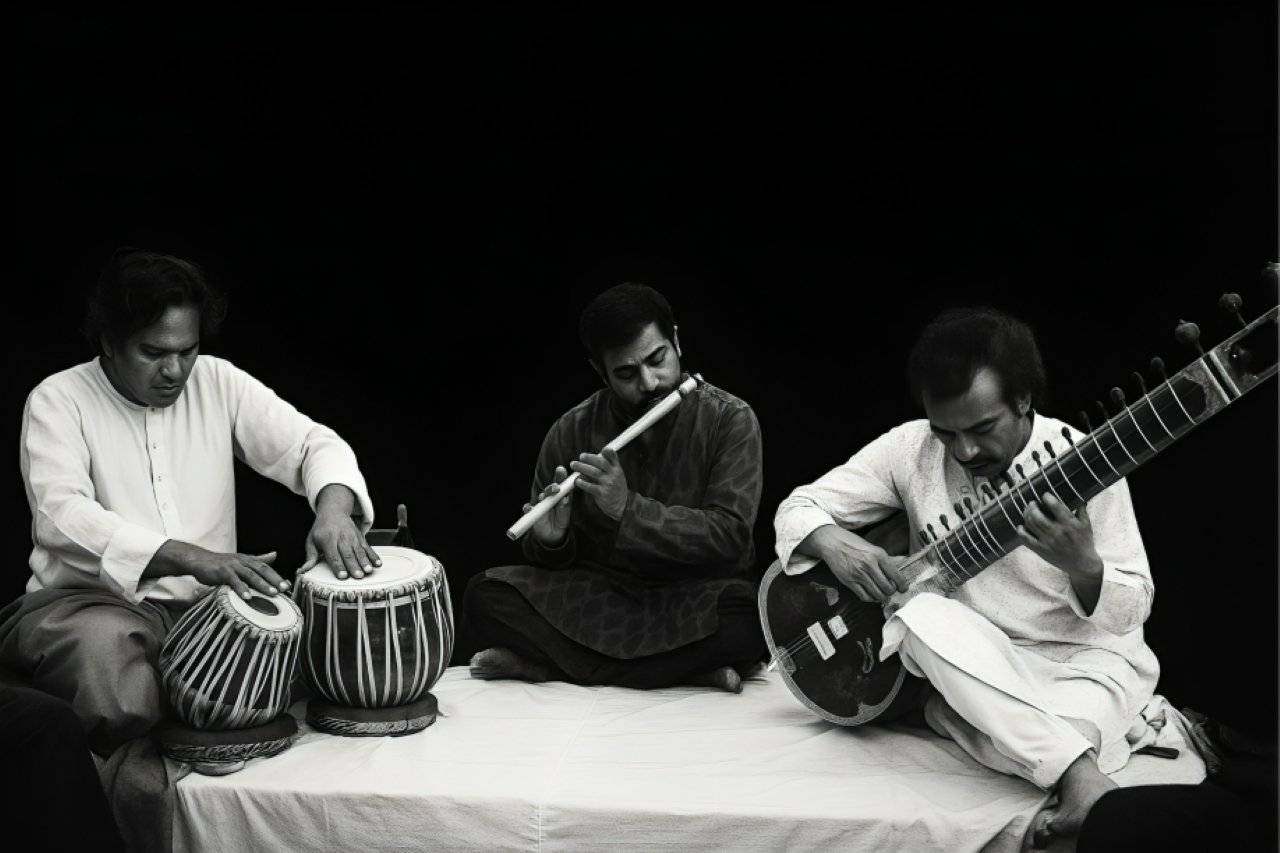
What does it truly mean to listen to classical music? In the simplest possible terms, the answer is: you listen to the raga—its many colours, its various forms of expression, and its different modes of presentation. These presentations may appear through vocal music or instrumental performance, and across many genres: pure classical, semi-classical, or blended forms.
In essence, you listen to whatever resonates with your ears and your mind—whatever feels meaningful and enjoyable to you.
Listening to classical music means listening to a raga, or a composition built upon a raga. This might be performed by voice or by instrument. One gradually explores how that raga appears across different genres, styles of performance, and compositional forms, learning to appreciate the many ways in which musicians interpret and present it.
At first, one’s ear often becomes familiar with ragas through lighter raga-based songs and performances. As you continue listening to music built upon a particular raga, its shape, mood, and emotional character slowly begin to reveal themselves to your ears and mind. Over time, the raga starts to form a kind of emotional map within you. When your mind reaches a certain emotional state, you may suddenly feel an urge to hear that particular raga again. In those moments, listening to it can feel like spending time with a dear companion, someone with whom you can share both joy and sorrow without hesitation.
As the raga grows more familiar and beloved—much like a cherished person—you naturally become curious to know more about it. You begin to wonder about its structure, origin, history, evolution, and stylistic characteristics. You want to understand its movements, its emotional essence, and the context in which it developed. Along this path of discovery, your affection for the raga deepens.
Over the centuries, great masters have devised numerous ways to refine and present each raga more beautifully. As a listener, you gradually begin to recognise these artistic approaches. You become interested in the distinctive features of different gharanas (musical lineages) and performance styles, and you start to notice when and how those characteristics appear within a performance.
Through this process of exploration, the technical aspects of music slowly become familiar, and the raga’s form becomes clearer and more vivid.
Thus, as with any classical tradition, the enjoyment of Indian classical music grows alongside one’s curiosity and understanding. The more you learn, the richer the experience becomes. Eventually, the fascination deepens into something like a gentle addiction.
And perhaps that is part of its enduring charm: no single lifetime is long enough to know everything about classical music. One may spend an entire life exploring it, and still leave the world carrying a sweet, unfinished love for its endless depths.
What Does a Classical Music Performance Mean?
A classical music performance essentially means the presentation of a raga through singing or instrumental playing. A raga can be performed using only vowel sounds—such as aa, ee, oo—or through sargam, the melodic syllables like sa, re, ga, ma. Even with these simple vocalisations, a musician can fully establish the structure and character of a raga. In earlier times, this was largely how classical music was presented.
Over the centuries, however, musicians began to develop more elaborate ways of presenting ragas in order to make performances more engaging and expressive. As a result, different musical forms and styles emerged. Various genres such as dhrupad and khayal were developed to frame and embellish the presentation of ragas. At the same time, influences from regional folk singing styles also contributed to the emergence of distinctive stylistic approaches within classical music.
The unique artistic approaches of great masters eventually gave rise to different gharanas, or musical schools. Each gharana developed its own interpretation of style, phrasing, and ornamentation. Within these traditions, musicians composed numerous bandishes—structured compositions set within particular ragas and rhythmic cycles.
Because of this diversity, classical music offers much more than just the raga itself. The variations in style, genre, and gharana provide listeners with different musical flavours. The same raga, when performed in different traditions, styles, or interpretative approaches, can create entirely different emotional experiences.
Therefore, listening to classical music means not only exploring different ragas, but also appreciating the variety of styles, interpretations, and musical traditions that surround them. The more you listen, the clearer these nuances become. With time, the enjoyment deepens—and gradually, the fascination with classical music grows stronger, almost like a quiet, irresistible passion.
See also: