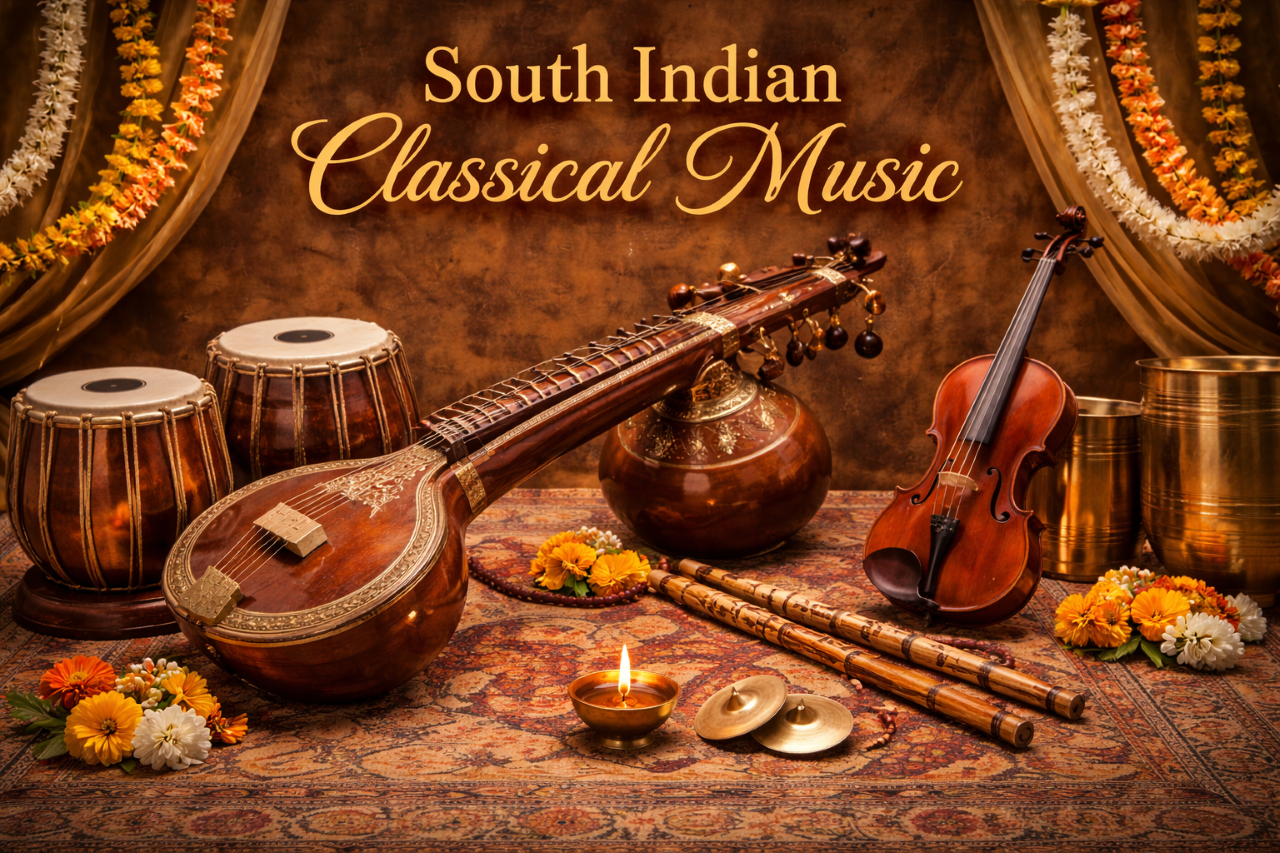
South Indian classical music is commonly known as Carnatic music. While the musical system that evolved in North India came to be known as Hindustani classical music, a parallel and equally rich tradition developed in the southern regions of the subcontinent—particularly in Tamil Nadu, Karnataka, Andhra Pradesh, Telangana, and Kerala. This tradition is renowned for its rigorous classical structure, deeply devotional character, and intricate rhythmic sophistication.
Carnatic music is not merely a musical form; it is an integral part of the religious, cultural, and philosophical heritage of South India. Its purpose extends beyond aesthetic enjoyment, seeking instead to express spiritual devotion and inner contemplation through the medium of music.
Table of Contents
Historical Origins and Development
The roots of Carnatic music lie in the ancient Vedic musical traditions. The melodic recitation of sacred hymns found in the Rigveda, Yajurveda, and Samaveda formed the earliest foundations of Indian musical thought. Over time, the blending of these ancient traditions with temple culture and regional folk music of South India gradually gave rise to a distinctive musical system that later became known as Carnatic music.
Temple-based musical practices played a particularly important role in the development of this tradition. Devotional songs performed in temples, ritual worship of deities, and various spiritual ceremonies introduced musicians to the disciplined use of ragas, structured melodies, and devotional expression. Through this sacred context, Carnatic music evolved as both an artistic and spiritual practice.
The modern structure of Carnatic music largely took shape between the seventeenth and eighteenth centuries. During this period, three extraordinary composers and musicians refined and enriched the tradition so profoundly that they came to be known collectively as the “Trinity of Carnatic Music.”
They are:
- Tyagaraja, who elevated raga-based devotional compositions through his profound and disciplined kritis.
- Muthuswami Dikshitar, who introduced remarkable melodic sophistication and grammatical precision in his devotional and seasonal compositions.
- Syama Sastri, who enriched the tradition through complex rhythmic structures and profound musical depth.
These three composers created numerous kritis (compositional forms) that significantly enriched the repertoire of Carnatic music. Their works serve not only as performance pieces but also as essential pedagogical materials for students of the tradition.
By integrating melodic aesthetics, rhythmic complexity, and spiritual philosophy, they established a coherent theoretical and practical framework for Carnatic music. As a result, Carnatic music today stands not only as a cornerstone of South Indian cultural heritage, but also as one of the most valuable and enduring traditions within the broader landscape of Indian classical music.
The Core Structure of Carnatic Music
The lifeblood and structural backbone of Carnatic music lie in the concepts of raga and tala. The raga determines the melodic framework of a composition, shaping the emotional atmosphere and musical colour of a performance. The tala, on the other hand, governs the rhythmic structure and tempo, providing the ordered framework within which the artist’s melodic expression unfolds. Together, raga and tala form a system that is highly intricate yet beautifully organised, giving Carnatic music its distinctive musical architecture.
A defining feature of Carnatic music is its extensive classification of ragas, organised through what is known as the Melakarta system. This system identifies 72 fundamental parent ragas (melakarta ragas). From each of these parent scales, numerous derivative ragas—often called “janya ragas”—have been developed. As a result, the Carnatic tradition encompasses an enormous variety of melodic possibilities, offering musicians vast scope for creativity and expressive exploration.
During performance, Carnatic music typically unfolds through several structured stages. The presentation often begins with an alapana, a free and rhythmically unbound melodic exploration of the raga. In this section, the performer gradually reveals the raga’s essential mood and tonal character.
Following the alapana comes the kriti, the central compositional form of Carnatic music. Here, the raga and tala combine within a composed piece that often carries a devotional or philosophical theme, guiding the listener into a deeper emotional and spiritual experience.
The performance then expands through passages of improvisation and melodic elaboration, where the musician explores the raga through intricate note patterns, ornamentations, and variations in pitch and register. These improvisational elements bring the raga vividly to life and highlight the performer’s artistry.
Finally, complex rhythmic sections and tala-based improvisations demonstrate the musician’s mastery of rhythm and control. These concluding passages often elevate the entire performance to a climactic state of aesthetic intensity and spiritual resonance.
In this way, the structure of Carnatic music is far more than a technical system of composition and performance. It functions as a bridge between artist and listener, creating a shared spiritual and emotional experience through the unfolding beauty of melody and rhythm.
Major Musical Forms
Carnatic music encompasses a variety of compositional forms and performance styles, each contributing to the richness and spiritual depth of the tradition. These musical forms not only shape the structure of performances but also provide artists with different avenues through which to express melody, rhythm, and devotion.
Among these, the most important and widely performed form is the kriti. A kriti is typically devotional in nature and composed within a specific raga and tala framework. It is considered the central pillar of Carnatic music performance. Through a kriti, the performer reveals the beauty of the raga, explores melodic ornamentation, and conveys spiritual emotion. The result is an immersive musical experience that draws the listener into the subtle resonance of the melody.
Another important compositional form is the varnam. This form is particularly significant for students of Carnatic music, as it serves as a vital training piece. Through the practice of varnams, learners become familiar with the fundamental movements of a raga, the correct application of tala, and the intricate coordination of rhythm and melody. Performing a varnam helps musicians fully understand the structure of a raga while also developing technical proficiency and stylistic control.
The tillana is a lively and rhythm-driven form, often associated with dance performances. Characterised by rapid tempo and intricate rhythmic patterns, it combines melodic phrases with rhythmic syllables to create an energetic musical texture. In many ways, the tillana may be compared to the tarana of Hindustani music. It is frequently performed at the conclusion of a concert or as part of a classical dance presentation.
Another devotional form within the Carnatic tradition is the kirtanam. Closely connected with temple-based musical practices, the kirtanam serves as a powerful medium for expressing devotion to the divine. Through this form, musicians present spiritual narratives and expressions of faith within the framework of specific ragas and talas, often inspiring a profound emotional response among listeners.
Together, these musical forms give Carnatic music its remarkable diversity and depth. They combine discipline, creativity, and spirituality in such a way that a performance becomes far more than mere entertainment—it transforms into an inward journey through melody and rhythm.