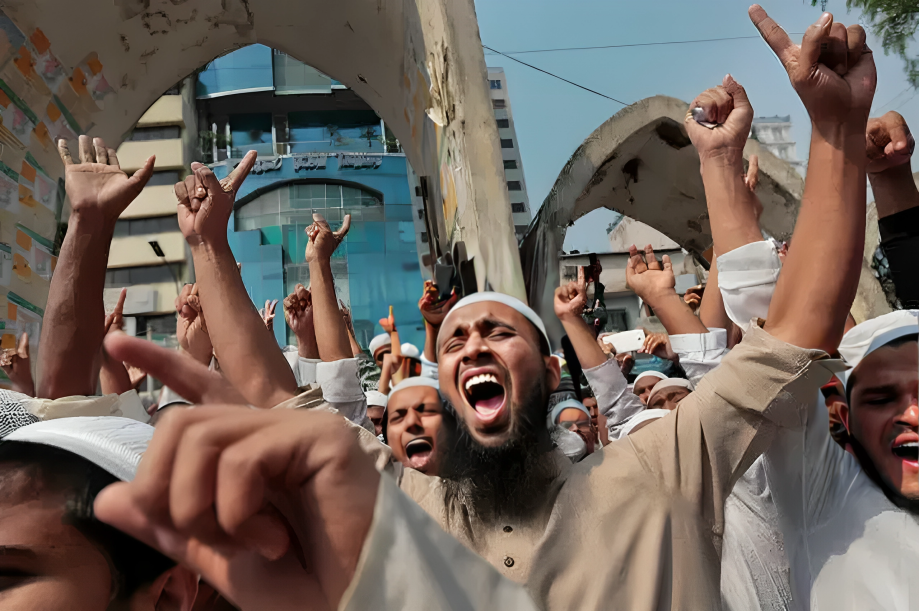
During the month dedicated to language, fresh controversy has gathered around words such as Azadi, Inqilab, Insaf, Mazloom, Zalim, and Naya Bandobast. Over the past two years, those who have subtly attempted to introduce these terms into public discourse are no longer politically ambiguous ahead of the election. They are, in essence, the defeated forces of 1971 or disguised offshoots of the same tradition.
Opposing this debate, as expected, are the Bengali nationalists; and in the current political alignment, Bangladeshi nationalists have joined them as well. This exchange has created an opportunity—through interaction among people of differing persuasions—for collective introspection, something that had been entirely absent over the past two years. Yet to understand this political debate properly, we must examine its psychological and historical realities.
In the pages of the Language Movement’s history, Urdu appears as the ‘enemy’. But the question is this: was our struggle against the Urdu language itself, or was it in defence of the rights of the Bangla language? Had Pakistan attempted to impose Punjabi, Pashto, Sindhi or Saraiki upon us instead (all of which had more native speakers than Urdu), would we have accepted it? Certainly not. The enemy, therefore, was never any specific language; the enemy was what may be termed the ‘Pakistan Syndrome’. Urdu was merely a political instrument employed to implement that syndrome.
Although the 1952 movement was emotional in its attachment to language, its underlying reality was economic and cultural. We demanded that our dealings and communication with the state be conducted in our mother tongue. Civil service examinations, official signboards, and the language of the law were to be in Bangla. We also sought to reap the benefits of the cultural capital that we had built over generations. Had Urdu become the sole state language, the majority of our educated population would overnight have been rendered ‘illiterate’ and ‘unqualified’ in the eyes of the state. It was a calculated deprivation.
Ironically, Urdu was not even the language of the majority in Pakistan at the time. It was primarily the language of roughly ten per cent of ‘Mohajirs’ who had migrated from Lucknow, Allahabad, Meerut, Saharanpur, Delhi, Bihar, Hyderabad, Madhya Pradesh and Rajasthan. That ten per cent resided mainly in West Pakistan. Thus, had Urdu been established as the state language, they would have benefited most. The majority of Pakistan’s population would have been marginalised. In other words, the design was to capture the state by imposing the language of a small minority upon the majority. This carefully engineered discrimination is what I refer to as the ‘Pakistan Syndrome’.
From that period onward, Pakistan has projected an attachment to Urdu. But what is the reality? Even today, more than ninety per cent of the population do not speak Urdu as their mother tongue. In terms of native speakers, Urdu still ranks only fifth. In offices and in the media it may be spoken, yet at home people revert to their own mother tongues—of which there are at least eight. People profess to sacrifice themselves for Urdu, yet in seven decades Pakistan has never truly embraced it in its heart.
The same phenomenon can be observed here. Those who make the most noise about Urdu often possess only the most rudimentary knowledge of the language and have never engaged with Urdu literature. They may be able to read Nastaliq script owing to madrasa education, but hand them Maulana Abul Kalam Azad’s Ghubar-e-Khatir and ask them to explain it, and they will promptly retreat. This ostentatious love of Urdu, coupled with such duplicity, is itself a manifestation of the ‘Pakistan Syndrome’.
The truth is that they harbour no genuine affection for Urdu; what appears as love is in fact rooted in hostility towards Bangla. Whenever Bangla is invoked, it inevitably recalls the Language Movement of 1952, the Mass Uprising of 1969, and the Liberation War of 1971. These histories blister their political consciousness. From this resentment arises the search for an ‘alternative’ to Bangla. Whatever has been achieved under a Bengali identity, they seek to supplant. Out of this restlessness they repeatedly introduce various disguised theoretical terms into public discourse—only to fail. The ‘Pakistan Syndrome’ does not release them, and thus they revolve endlessly within this cycle of failure.
To demonstrate how hollow their professed love of Urdu truly is, one need not look far. Stage a drama based on the stories of Saadat Hasan Manto. Bring into the public sphere the writings of Faiz Ahmed Faiz, Habib Jalib, Kishwar Naheed, Fahmida Riaz, or Ahmed Faraz. You will see their discomfort surface immediately; their so-called love of Urdu will evaporate. The same ‘Pakistan Syndrome’ will then drive them in search of yet another alternative.
Today, 21 February, is International Mother Language Day—one of our nation’s greatest achievements. Displaying hatred towards any language does not ennoble that achievement. We must remember that our struggle was not against Urdu; our struggle was against the ‘Pakistan Syndrome’. We must broaden our vision and recognise the real adversary. This struggle is fundamentally against religious extremism, communalism, duplicity and falsehood. Our cultural foundations and liberal values must be strengthened to such an extent that any such ‘new arrangement’ loses relevance and fades away before it can even enter serious discussion.