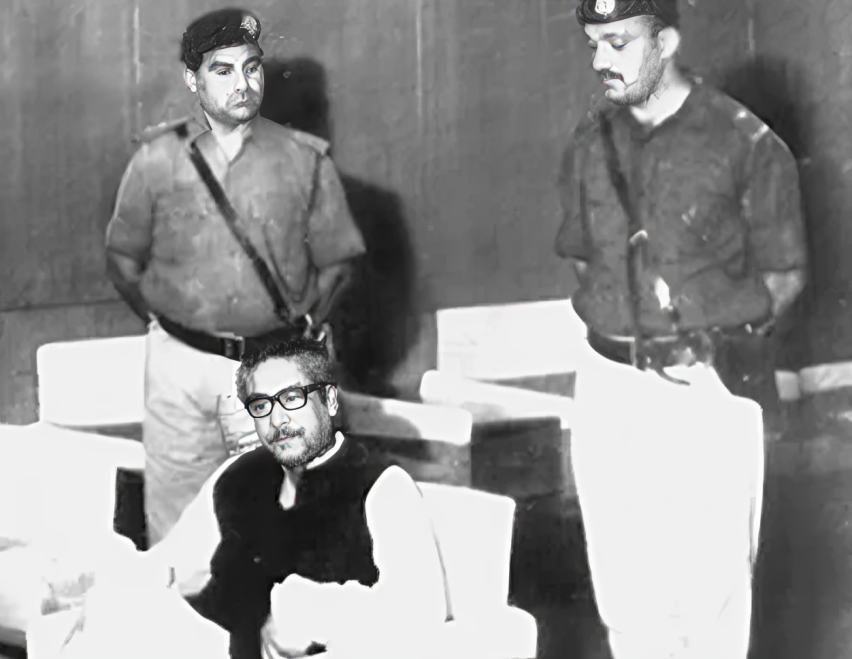
It was for proclaiming the independence of Bangladesh on the night of 25 March 1971 that Bangabandhu Sheikh Mujibur Rahman was arrested.
In the early hours of 25 March 1971, as the Pakistani army launched ‘Operation Searchlight’, Bangabandhu Sheikh Mujibur Rahman declared the independence of Bangladesh. Both the declaration itself and his immediate arrest are substantiated not only in political history, but also in international media reports and in the Pakistani military’s own records.
Below is a detailed discussion of the matter, supported by evidence and documentation.
Table of Contents
1. The Declaration of Independence: Time and Medium
At 12:20 a.m. on the night of 25 March, as Pakistani troops began their brutal assault on the streets of Dhaka, Bangabandhu transmitted the final message of independence from his residence at 32 Dhanmondi, using the wireless network of the East Pakistan Rifles (EPR).
The original message he conveyed was as follows:
“This may be my last message. From today Bangladesh is independent. I call upon the people of Bangladesh, wherever you might be and with whatever you have, to resist the army of occupation to the last. Your fight must go on until the last soldier of the Pakistan occupation army is expelled from the soil of Bangladesh and final victory is achieved.”
2. ‘Operation Big Bird’: The Plan Behind the Arrest
The Pakistani military junta mounted a special commando operation to apprehend Bangabandhu, code-named ‘Operation Big Bird’. The Third Commando Battalion of the Pakistan Army took part in this mission.
- Time of arrest: 1:30 a.m. on 26 March (the night of 25 March). He was arrested from his residence at 32 Dhanmondi.
- Reason for arrest: The principal objective of the Pakistani authorities was to neutralise the movement by detaining Bangabandhu. In confidential documents, he was described as the “principal instigator of the rebellion”.
3. Testimony of the International Media
That Bangabandhu’s declaration was not merely oral is evident from reports published in the international press on 26 March.
- BBC: On the morning of 26 March, the BBC reported that Sheikh Mujib had declared East Pakistan independent.
- The New York Times: On 27 March, The New York Times reported that Sheikh Mujibur Rahman had proclaimed East Pakistan the “People’s Republic of Bangladesh”.
- The Dawn: The Karachi-based newspaper Dawn published news of Bangabandhu’s arrest, describing him as a “separatist”.
4. Statements and Memoirs of Pakistani Officials
The authenticity of the declaration is also confirmed in books and interviews by senior Pakistani military officials.
- Siddiq Salik’s Witness to Surrender: General Niazi’s public relations officer, Siddiq Salik, wrote that they clearly heard Bangabandhu’s declaration over the wireless.
- Interview of General Tikka Khan: The then military governor of East Pakistan, General Tikka Khan, later acknowledged in an interview that Sheikh Mujib had declared independence from his residence and that he was arrested for that very act.
5. Documents of the CIA and the United States State Department
Numerous telegrams dated 26 March 1971 appear in the Foreign Relations of the United States series, preserved in the U.S. National Archives.
- Message from the U.S. Consul General in Dhaka: On the morning of 26 March, Consul General Archer Blood sent an urgent message to Washington, noting that Sheikh Mujibur Rahman’s declaration of independence had been heard on a clandestine radio frequency.
- CIA Special Report: A CIA report recorded that, immediately prior to the commencement of military operations, Mujib had broadcast a message declaring East Pakistan to be the independent state of “Bangladesh”.
6. British Intelligence and Foreign Office Reports
Declassified British government documents show that London-based intelligence units were closely monitoring Bangabandhu’s declaration.
-
South Asia Department Memorandum: On the afternoon of 26 March, a memorandum of the Foreign and Commonwealth Office stated that Sheikh Mujib had likely issued a declaration of independence shortly before his arrest. British intelligence characterised it as a definitive political break.
7. Indian Intelligence (R&AW) and BSF Records
Indian intelligence agencies also possessed evidence of Bangabandhu’s declaration.
-
Wireless intercept: K. F. Rustamji, then Director General of the Border Security Force (BSF), recorded in his personal diary that in the early hours of 26 March Indian signal units intercepted a message in which Sheikh Mujib declared Bangladesh independent. Indian intelligence swiftly verified the authenticity of the message and informed Delhi.
8. Pakistani Military Intelligence (ISI/MI) Reports
The report of the Hamoodur Rahman Commission, established by the Government of Pakistan, contains significant commentary on intelligence failures and Bangabandhu’s declaration.
-
Evidence of rebellion: Pakistan’s Military Intelligence (MI) prepared a report on the basis of documents recovered from 32 Dhanmondi and intercepted wireless messages. In that report, Bangabandhu was accused of undermining Pakistan’s territorial integrity, the principal basis being his declaration of independence on 26 March.
9. The Proclamation of Independence
The Proclamation of Independence issued by the Mujibnagar Government on 10 April 1971 legally affirmed:
“Whereas Bangabandhu Sheikh Mujibur Rahman, the undisputed leader of seventy-five million people of Bangladesh, duly made a declaration of independence at Dhaka on 26 March 1971 in order to ensure the lawful right of self-determination of the people…”
In light of the foregoing documentary evidence, those who seek to cast doubt upon Bangabandhu’s declaration of independence must confront the weight of historical record. The facts are neither obscure nor inaccessible; rather, attempts to dispute them are often driven by political expediency and the desire to sow confusion.
Yet such distortions have consistently failed in the face of international documentation and the enduring truth of history.