On June 5, 1955, the 21 Points, a political manifesto, was declared by the United Front (Jukto Front) in East Bengal. This electoral alliance was formed on December 4, 1953, with the aim of opposing the ruling Muslim League and ending its dominance in East Bengal. The United Front was a coalition of the Awami Muslim League, the Krishak Sramik Party, the Nizam-e-Islam Party, and the Democratic Party. Key figures such as A.K. Fazlul Haque, President of the Krishak Sramik Party, Maulana Abdul Hamid Khan Bhashani, President of the Awami Muslim League, and leaders like Hossain Shaheed Suhrawardy played pivotal roles in its formation.
The manifesto, known as the 21 Points, set forth the following key promises:
Table of Contents
The 21 Points of the United Front (Jukto Front)
Principle: No law should be enacted that contradicts the basic tenets of the Quran and Sunnah. The lives of citizens should be managed based on the principles of equality and brotherhood as outlined in Islam.
-
Bengali should be made one of the state languages of Pakistan.
-
Zamindari (landlord) and all revenue collection rights should be abolished without compensation, and surplus land should be distributed among landless farmers. Tax rates should be justly reduced, and the system of collecting taxes through certificates should be abolished.
-
The jute industry should be nationalised and brought under the direct management of the East Bengal Government. A system should be established to ensure jute farmers receive proper prices for their produce. The jute scandals of the League Ministry should be investigated, and those responsible should be punished, with their ill-gotten wealth confiscated.
-
A cooperative agricultural system should be introduced for agricultural improvement, and the government should provide assistance for the development of all forms of cottage and handicraft industries.
-
To make East Bengal self-sufficient in salt production, salt factories should be established along the coastline for both cottage and large-scale industries. An investigation should be carried out into the salt scandals during the League Ministry’s tenure, with appropriate punishment for the guilty and the confiscation of their ill-gotten wealth.
-
Immediate employment should be arranged for poor migrant workers from the industrial and technical classes, and plans for their rehabilitation should be made.
-
Measures should be taken for the excavation of canals and irrigation systems to protect the country from floods and famine.
-
East Bengal should be industrialised through scientific means and agriculture should be modernised to make the country self-reliant in both industry and food. Labourers’ economic, social, and all kinds of rights should be established in accordance with the principles of the International Labour Organisation.
-
Primary and free compulsory education should be introduced nationwide, and teachers should be provided with just salaries and allowances.
-
A fundamental reform of the education system should be carried out, making it scientifically effective and ensuring that education is delivered in the mother tongue. The current distinction between public and private schools should be removed, and all schools should be turned into government-assisted educational institutions. Teachers should be provided with appropriate salaries and allowances.
-
Regressive laws like the Dhaka and Rajshahi University Acts should be abolished, and universities should be turned into autonomous institutions, making higher education cheaper and more accessible.
-
Administrative expenses should be reduced to the minimum, with the salaries of high-ranking officials reduced and the salaries of lower-ranking officials increased, ensuring a balanced distribution of income. No minister of the United Front should receive a salary of more than one thousand rupees.
-
Effective measures should be taken to eliminate corruption, nepotism, bribery, and favoritism. All government and private officials involved in business should be held accountable for their financial activities from 1940 to the present, and if they cannot provide satisfactory explanations, their properties should be confiscated.
-
Repressive laws like the Public Safety Act should be repealed. Prisoners detained without trial should be released, and those accused of treason should be tried in open courts. The freedom to hold meetings, form associations, and express opinions should be unrestricted.
-
The judiciary should be separated from the executive.
-
The Prime Minister of the United Front should reside in a more modest house instead of the luxurious Bardhaman House, which should be turned into a student hostel and later a Bengali language research centre.
-
A monument should be built at the location where those who died for the cause of Bengali as the state language during the Muslim League Ministry’s tenure, and their families should be provided with suitable compensation.
-
February 21 should be declared Martyrs’ Day and observed as a national holiday.
-
Based on the Lahore Resolution, East Bengal should be granted autonomy and sovereignty, with all matters except defence, foreign affairs, and currency transferred to the East Bengal Government. The headquarters of the Pakistan Army should be relocated to West Pakistan, while the headquarters of the Navy should be placed in East Pakistan. East Bengal should be made self-sufficient in its defence industry, and the Ansar Force should be converted into an armed force.
-
The United Front Ministry should not extend the life of the Legislative Assembly under any circumstances. The Cabinet should resign six months before the Assembly’s term ends, and arrangements should be made for free and fair elections through the Election Commission.
-
Whenever a seat in the United Front’s Cabinet becomes vacant, by-elections should be arranged within three months. If the candidate nominated by the United Front loses in three consecutive by-elections, the Cabinet should voluntarily resign.
Source: The 21 Points of the United Front, United Front Publicity Office, January 1954, 56 Simpson Road, Dhaka.
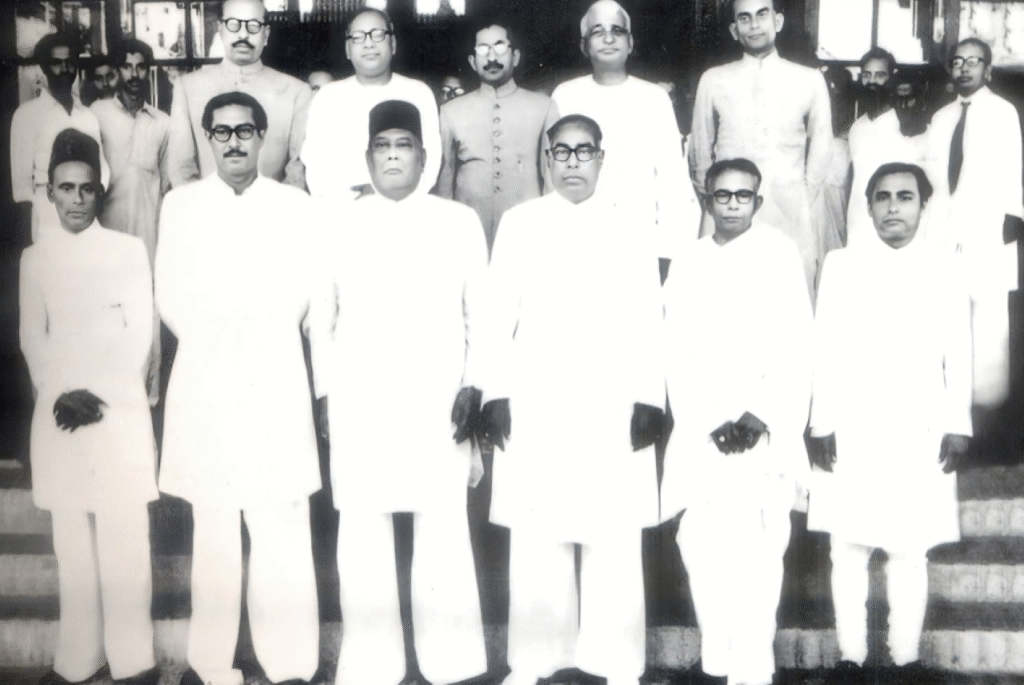
The Outcome of the United Front’s 21-Point Program:
In the March 1954 elections, based on the 21-point program, the United Front secured 228 out of the 237 Muslim seats in the East Bengal Legislative Assembly.
What was the United Front?
The United Front was a political alliance formed in 1954 for the purpose of ousting the Muslim League from power in the East Bengal Provincial Assembly elections. Although the decision to form the United Front was made on November 14, 1953, it was only on December 4, 1953, that the Awami Muslim League (led by Maulana Bhashani), Krishak Shramik Party (Sher-e-Bangla A.K. Fazlul Haque), Nezam-e-Islam Party (Maulana Ataur Ali), the Leftist Democratic Party (Haji Mohammad Danesh and Mahmud Ali Sileti), and the Pakistan Democratic Party united to create the United Front.
The three main leaders of the United Front were Maulana Bhashani, Sher-e-Bangla A.K. Fazlul Haque, and Hossain Shahid Suhrawardy. This alliance issued an electoral manifesto, known as the 21-Point Program. Among the primary demands were granting full autonomy to East Bengal based on the Lahore Resolution, recognizing Bengali as the state language, declaring February 21 as Martyrs’ Day and a public holiday, and constructing a Shaheed Minar in memory of the language martyrs. The electoral symbol of the United Front was the “Boat,” while the Muslim League’s symbol was the “Hurricane.”
Sheikh Mujibur Rahman and the United Front in 1954:
Within less than seven years after the formation of Pakistan, the Muslim League, which had played a pivotal role in the independence movement, was almost obliterated in the 1954 elections. At that time, several parties referred to the United Front as the Hossain-Bhashani-Suhrwardy alliance. Sher-e-Bangla A.K. Fazlul Haque had been the Chief Minister of undivided Bengal multiple times during the British period. Hossain Shahid Suhrawardy was also elected to this position in 1946 and had served in Sher-e-Bangla’s cabinet.
In 1938, both Haque and Suhrawardy visited Gopalganj, where they were impressed by the 18-year-old Mujib. On June 23, 1949, Maulana Abdul Hamid Khan Bhashani was elected the first president of the Awami Muslim League. After the creation of Pakistan, he was elected to the East Bengal Legislative Assembly from a seat in Tangail, but the Muslim League government used various tactics to annul his membership. He never ran for office again, but his participation in any election campaign was considered essential as he had the ability to inspire and motivate the people.
The candidates of the United Front’s allied parties wanted these three popular leaders to participate in their campaign for seats. At that time, the 34-year-old Sheikh Mujib was also desired by many to be a speaker in their respective areas.
After the historic language movement of February 21, 1952, the Muslim League was losing support. It became an increasingly unpopular party. The Awami League, on the other hand, was quickly gathering strength, with the young Sheikh Mujib holding frequent meetings in the districts and sub-districts.
In addition to organizing the Awami League, he was also focused on strengthening the Chhatra League (Students League). Due to the language movement, the student community had gained immense trust and respect from the public. It was clear that they would play a significant role in the election campaign in support of the United Front.
A sense of discontent had already begun to spread among the people of East Bengal due to the Muslim League’s misgovernance. In response, the foundation for the historic United Front alliance was laid in November 1953, aimed at liberating the people from the misrule of the Muslim League government. The United Front arose as a response to economic disparity, low representation of Bengalis in the government, corruption, and political repression under the then ruling system.
The founding leaders of the United Front—A.K. Fazlul Haque, Hossain Shahid Suhrawardy, and Maulana Abdul Hamid Khan Bhashani—formed the front with four parties from East Pakistan: the Awami League, Krishak Shramik Party, Nezam-e-Islam, and the Democratic Party. The main goal of the alliance was to contest the East Pakistan Legislative Assembly elections, scheduled between March 8-12, 1954, against the ruling Muslim League.
The United Front’s manifesto, promoting the 21-point program, included demands such as: recognizing Bengali as one of Pakistan’s state languages, abolishing the zamindari (landlord) system, nationalizing the jute trade, promoting cooperative farming, rehabilitating refugees, building permanent flood control measures, modernizing agriculture, reforming the education system, abolishing black laws, introducing a unified pay scale, combating corruption, separating the executive and judiciary, constructing memorials for the language martyrs, converting the Chief Minister’s residence into a center for the development of the Bengali language, declaring February 21 as Martyrs’ Day, and establishing full provincial autonomy (Abul Mansur Ahmad, Fifty Years of Politics as I Have Seen It, 2017, Firsta Publications).
These demands were presented by A.K. Fazlul Haque, Hossain Shahid Suhrawardy, Maulana Bhashani, and Sheikh Mujibur Rahman. With support from the left-wing party activists, the United Front leaders managed to campaign even in remote areas.
The issues highlighted by the United Front included the February 21, 1952, martyrdom of students for the Bengali language and the rising prices of essential commodities like salt, rice, and other daily necessities. The mass arrest of opposition political leaders turned the public against the Muslim League government (Abul Mansur Ahmad, Fifty Years of Politics as I Have Seen It, 2017, Firsta Publications).
At that time, Sheikh Mujib and most of his colleagues stood against the United Front. Sheikh Mujib famously said that there was no other party in the country except the Awami League. Forming the United Front meant keeping some dead entities alive. Both Hossain Shahid Suhrawardy and Maulana Bhashani were staunch opponents of the United Front. After deciding that the United Front should not proceed, Hossain Shahid went to Pakistan. Meanwhile, Sheikh Mujib toured districts, holding meetings, while Maulana Bhashani, in Dhaka, signed the United Front agreement with Sher-e-Bangla.
In areas where the Awami League could have won independently, the Nezam-e-Islam Party, Krishak Shramik Party, and the Democratic Party, along with other organizations under the United Front banner, began demanding nominations. Those who had worked tirelessly for the Awami League received no nominations, while individuals who had been with the Muslim League just three to four months ago were nominated.
It is important to note that from the beginning, Sheikh Mujib opposed the formation of the United Front. He knew that with the political strength the Awami League had gained, it would have won the elections against the Muslim League alone. However, respecting the opinions of the senior leaders, he did not oppose the decision (Sheikh Mujibur Rahman, The Unfinished Memoirs, Dhaka, The University Press Limited, 2012).
When the Pakistani rulers agreed to hold elections, the 21-point manifesto presented by the United Front included demands for cultural, economic, political, and social freedom from Western exploitation. For example, the first point of the 21-point program was to grant Bengali the status of a state language, along with improvements in education, agriculture, and the autonomy of East Bengal. From the outset, Sheikh Mujib was committed to awakening the Bengali language and cultural identity. His long political struggle for full political sovereignty for East Bengal was reflected in his Six-Point Movement.
After winning the election, on April 3, 1954, the leader of the United Front, A.K. Fazlul Haque, was invited by the provincial governor to form a cabinet. However, a dispute immediately arose over the formation of the cabinet. After the Awami League’s victory in the election, the sharing of ministries led to a conflict within the alliance.
Though Ataur Rahman Khan and Sheikh Mujibur Rahman were nominated by the Awami League, Fazlul Haque expressed reluctance to include Sheikh Mujib in the cabinet. In his autobiography, Sheikh Mujib wrote:
“Mr. Haque told Shahid Sahib and Bhashani Sahib that he would not take Sheikh Mujib into his ministry.”
In response, Shahid Sahib said, “It is for me and Bhashani Sahib to decide whom the Awami League will include. When you say that your ministry cannot function without Nanna Mia, we can also say that we cannot function without Sheikh Mujib.”
“He is our party’s secretary. Mujib is not a candidate for a ministry. If we say this, the party may object” (Sheikh Mujibur Rahman, The Unfinished Memoirs, Dhaka, The University Press Limited, 2012, p. 29). However, at that point, Sheikh Mujib told Shahid Sahib and Bhashani Sahib, “There is no need to create confusion about me. I do not want a ministry. If you are willing to form the entire cabinet without me, then please proceed” (Sheikh Mujibur Rahman, The Unfinished Memoirs, Dhaka, The University Press Limited, 2012, p. 29).
This shows how detached Sheikh Mujib was from power. Despite being young in age, his political foresight was much greater. This is why he opposed the formation of the United Front—because he realized that the alliance, made up of lesser-known political parties, would not last long. Another point to note is that Sheikh Mujib had a deep commitment to Bengali nationalism and sovereignty. The politics of the United Front did not fit his vision for East Bengal, but his personal dedication to the cause helped further the vision of a free and autonomous Bengali state.